QUESTION IMAGE
Question
- diodes are commonly used inside a vehicles charging system ______ to rectify ac voltage to dc voltage.
- what type of diode is a special type of diode that serves as a voltage regulator?
(a) forward bias
(b) reverse bias
(c) rectified
(d) zener
- a(n)______ is a semiconductor device that regulates current or voltage in a circuit.
- a bipolar junction transistor (bjt) is made by joining ______ semiconductor materials.
(a) two
(b) three
(c) four
(d) five
- what is the difference between an npn transistor and a pnp transistor?
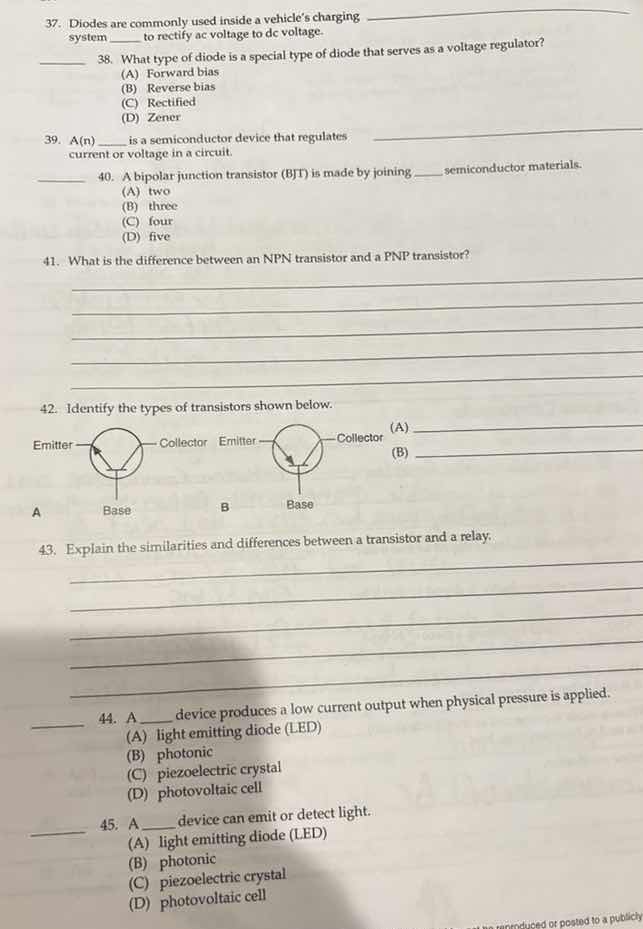
- identify the types of transistors shown below.
emitter $longleftrightarrow$ collector emitter $longleftrightarrow$ collector
(a) ______
(b) ______
base base
a b
- explain the similarities and differences between a transistor and a relay.
- a ______ device produces a low current output when physical pressure is applied.
(a) light emitting diode (led)
(b) photonic
(c) piezoelectric crystal
(d) photovoltaic cell
- a ______ device can emit or detect light.
(a) light emitting diode (led)
(b) photonic
(c) piezoelectric crystal
(d) photovoltaic cell
- Diodes convert AC to DC in vehicle chargers.
- Zener diodes regulate voltage via reverse breakdown.
- Voltage regulators stabilize circuit current/voltage.
- BJTs use 3 layered semiconductor materials.
- NPN uses P-type base, PNP uses N-type base; current flow direction differs.
- Transistor A is PNP (arrow points in); Transistor B is NPN (arrow points out).
- Both control signals; transistors are solid-state, relays use electromagnets.
- Piezoelectric crystals generate current from pressure.
- Photonic devices emit/detect light.

Snap & solve any problem in the app
Get step-by-step solutions on Sovi AI
Photo-based solutions with guided steps
Explore more problems and detailed explanations
- diode
- (D) Zener
- voltage regulator
- (B) three
- The key difference is the type of semiconductor material used for the base: an NPN transistor has a P-type base sandwiched between two N-type layers, while a PNP transistor has an N-type base between two P-type layers. This reverses the direction of conventional current flow through the device (current flows into the collector of an NPN, and out of the collector of a PNP).
- (A) PNP Transistor
(B) NPN Transistor
- Similarities: Both transistors and relays act as switching/control devices to manage the flow of a larger signal using a smaller input signal.
Differences: Transistors are solid-state semiconductor devices with no moving parts, operate quickly, and are suitable for low-power, high-frequency applications. Relays are electromechanical devices with physical switches, handle higher power loads, but have slower response times and moving components that can wear out.
- (C) piezoelectric crystal
- (B) photonic