QUESTION IMAGE
Question
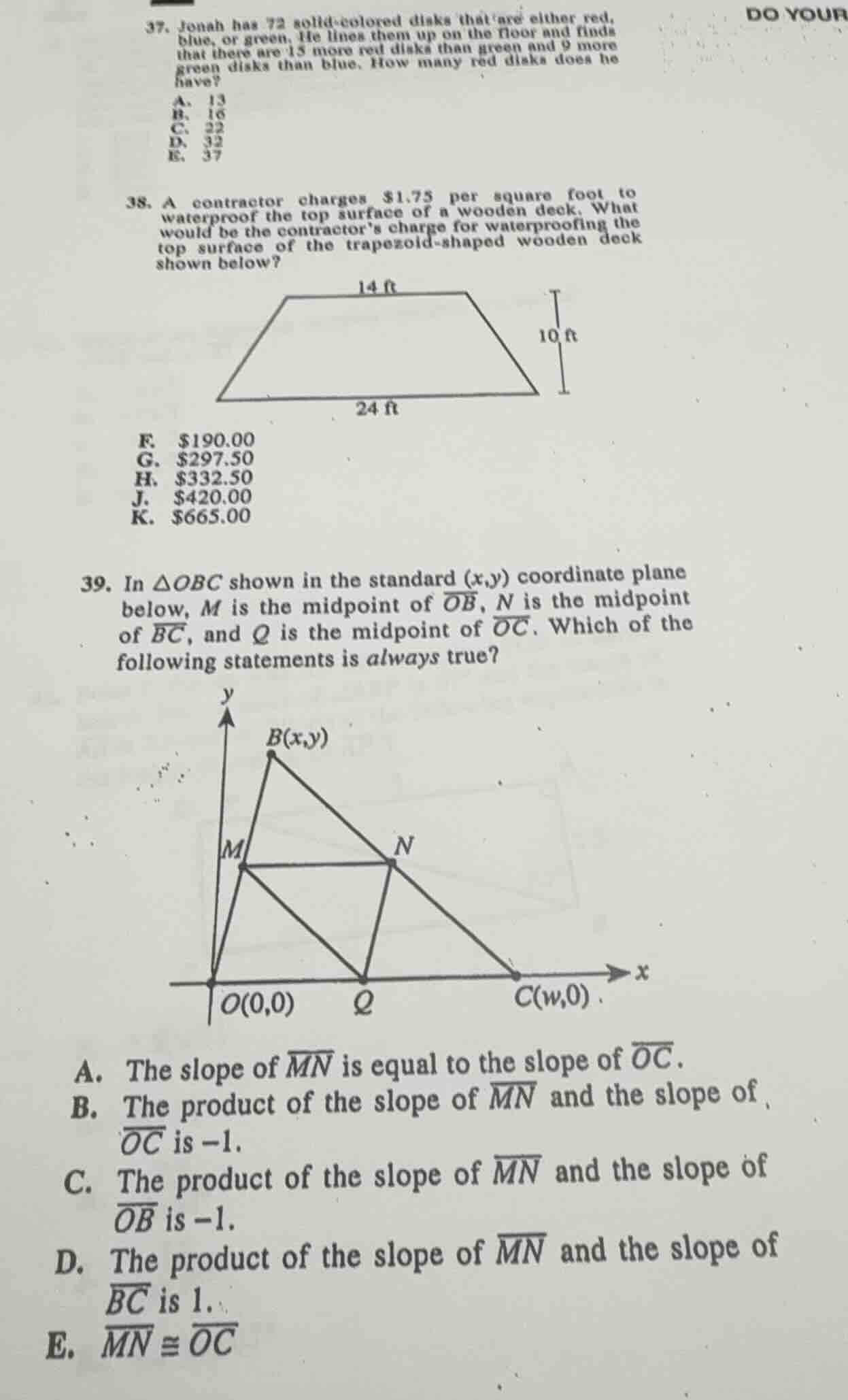
- jonah has 72 solid - colored disks that are either red, blue, or green. he lines them up on the floor and finds that there are 15 more red disks than green and 9 more green disks than blue. how many red disks does he have?
a. 13
b. 16
c. 22
d. 32
e. 37
- a contractor charges $1.75 per square foot to waterproof the top surface of a wooden deck. what would be the contractor’s charge for waterproofing the top surface of the trapezoid - shaped wooden deck shown below?
trapezoid with top base 14 ft, bottom base 24 ft, height 10 ft
f. $190.00
g. $297.50
h. $332.50
j. $420.00
k. $665.00
- in $\triangle obc$ shown in the standard $(x,y)$ coordinate plane below, $m$ is the midpoint of $\overline{ob}$, $n$ is the midpoint of $\overline{bc}$, and $q$ is the midpoint of $\overline{oc}$. which of the following statements is always true?
coordinate plane with $o(0,0)$, $c(w,0)$, $b(x,y)$, midpoints $m$, $n$, $q$
a. the slope of $\overline{mn}$ is equal to the slope of $\overline{oc}$.
b. the product of the slope of $\overline{mn}$ and the slope of $\overline{oc}$ is - 1.
c. the product of the slope of $\overline{mn}$ and the slope of $\overline{ob}$ is - 1.
d. the product of the slope of $\overline{mn}$ and the slope of $\overline{bc}$ is 1.
e. $\overline{mn}\cong\overline{oc}$
Question 37
Step1: Define variables
Let the number of blue disks be \( x \). Then the number of green disks is \( x + 9 \), and the number of red disks is \( (x + 9)+ 15=x + 24 \).
Step2: Set up equation
The total number of disks is 72, so \( x+(x + 9)+(x + 24)=72 \).
Step3: Solve the equation
Combine like terms: \( 3x+33 = 72 \). Subtract 33 from both sides: \( 3x=72 - 33=39 \). Divide by 3: \( x = 13 \).
Step4: Find red disks
The number of red disks is \( x + 24=13 + 24 = 37 \). Wait, but let's check again. Wait, the problem says "15 more red disks than green and 9 more green disks than blue". So green = blue + 9, red = green + 15=blue + 9+15=blue + 24. Total: blue + (blue + 9)+(blue + 24)=3blue + 33 = 72. 3blue=39, blue=13. Green=13 + 9=22, red=22 + 15=37. Wait, but the options have E as 37. But wait, let me check the arithmetic again. 13 (blue)+22 (green)+37 (red)=72. 13+22=35, 35+37=72. Yes. But wait, maybe I misread the problem. Wait, the problem says "15 more red disks than green and 9 more green disks than blue". So red = green + 15, green = blue + 9. So red = blue + 9+15=blue + 24. Total: blue + (blue + 9)+(blue + 24)=3blue + 33=72. 3blue=39, blue=13. Green=22, red=37. So the answer is E. 37.
Wait, but let's check the options. The options are A.13, B.16, C.22, D.32, E.37. So E is correct.
Step1: Recall trapezoid area formula
The area of a trapezoid is \( A=\frac{(a + b)h}{2} \), where \( a \) and \( b \) are the lengths of the two parallel sides, and \( h \) is the height.
Step2: Identify values
Here, \( a = 14 \) ft, \( b = 24 \) ft, \( h = 10 \) ft.
Step3: Calculate area
\( A=\frac{(14 + 24)\times10}{2}=\frac{38\times10}{2}=190 \) square feet.
Step4: Calculate cost
The contractor charges $1.75 per square foot, so the cost is LXI0. Wait, wait, 190*1.75: 200*1.75=350, minus 10*1.75=17.5, so 350 - 17.5=332.5. So the cost is $332.50, which is option H.
Wait, let's recalculate the area: (14 + 24)/2 10=(38/2)10=1910=190. Then 1901.75: 190(7/4)= (1907)/4=1330/4=332.5. So the answer is H. $332.50.
Step1: Use midline theorem (midsegment theorem)
In a triangle, the segment connecting the midpoints of two sides is parallel to the third side and half as long. Here, M is the midpoint of OB, N is the midpoint of BC. So by the midline theorem, MN is parallel to OC and \( MN=\frac{1}{2}OC \).
Step2: Analyze slope
If two lines are parallel, their slopes are equal. Since MN is parallel to OC, the slope of MN is equal to the slope of OC. Let's check the options:
- Option A: The slope of \( \overline{MN} \) is equal to the slope of \( \overline{OC} \). This is true because they are parallel.
- Option B: The product of slopes being -1 means they are perpendicular, but they are parallel, so this is false.
- Option C: The product of slopes being -1 is for perpendicular lines, not applicable here, false.
- Option D: The product of slopes being 1 is not a property of these lines, false.
- Option E: \( \overline{MN}\cong\overline{OC} \) is false because \( MN=\frac{1}{2}OC \), so they are not congruent.
So the correct option is A.

Snap & solve any problem in the app
Get step-by-step solutions on Sovi AI
Photo-based solutions with guided steps
Explore more problems and detailed explanations
E. 37