QUESTION IMAGE
Question
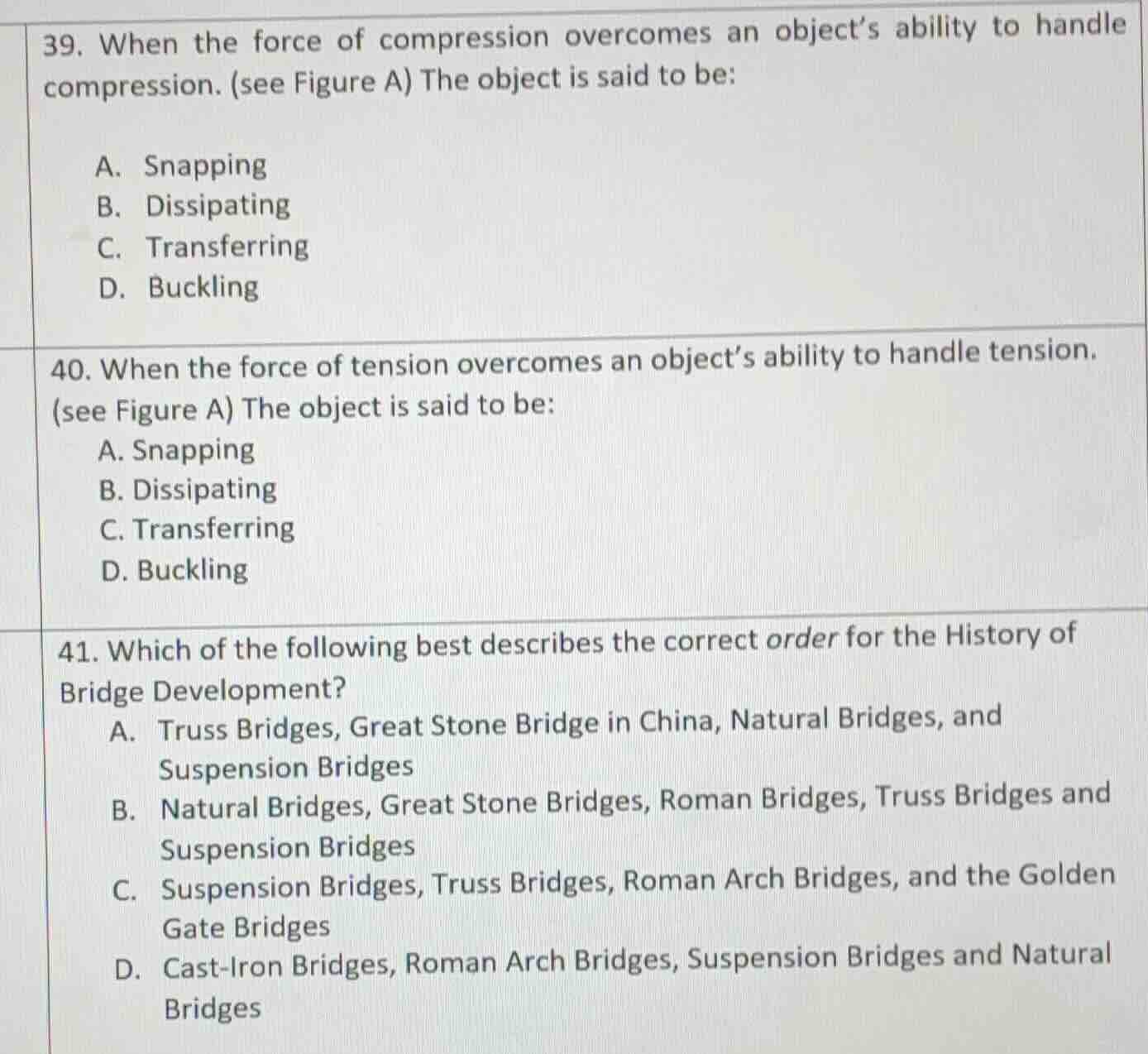
- when the force of compression overcomes an object’s ability to handle compression. (see figure a) the object is said to be:
a. snapping
b. dissipating
c. transferring
d. buckling
- when the force of tension overcomes an object’s ability to handle tension. (see figure a) the object is said to be:
a. snapping
b. dissipating
c. transferring
d. buckling
- which of the following best describes the correct order for the history of bridge development?
a. truss bridges, great stone bridge in china, natural bridges, and suspension bridges
b. natural bridges, great stone bridges, roman bridges, truss bridges and suspension bridges
c. suspension bridges, truss bridges, roman arch bridges, and the golden gate bridges
d. cast - iron bridges, roman arch bridges, suspension bridges and natural bridges
Brief Explanations
- Buckling is the failure mode when an object can no longer withstand compressive forces, causing it to deform or collapse under compression.
- Snapping (or fracturing) occurs when an object's tensile strength is exceeded, causing it to break under tension forces.
- The history of bridge development starts with naturally occurring bridges, followed by early man-made stone bridges like the Great Stone Bridge, then Roman arch bridges, and later engineered truss and suspension bridges as construction technology advanced.

Snap & solve any problem in the app
Get step-by-step solutions on Sovi AI
Photo-based solutions with guided steps
Explore more problems and detailed explanations
- D. Buckling
- A. Snapping
- B. Natural Bridges, Great Stone Bridges, Roman Bridges, Truss Bridges and Suspension Bridges