QUESTION IMAGE
Question
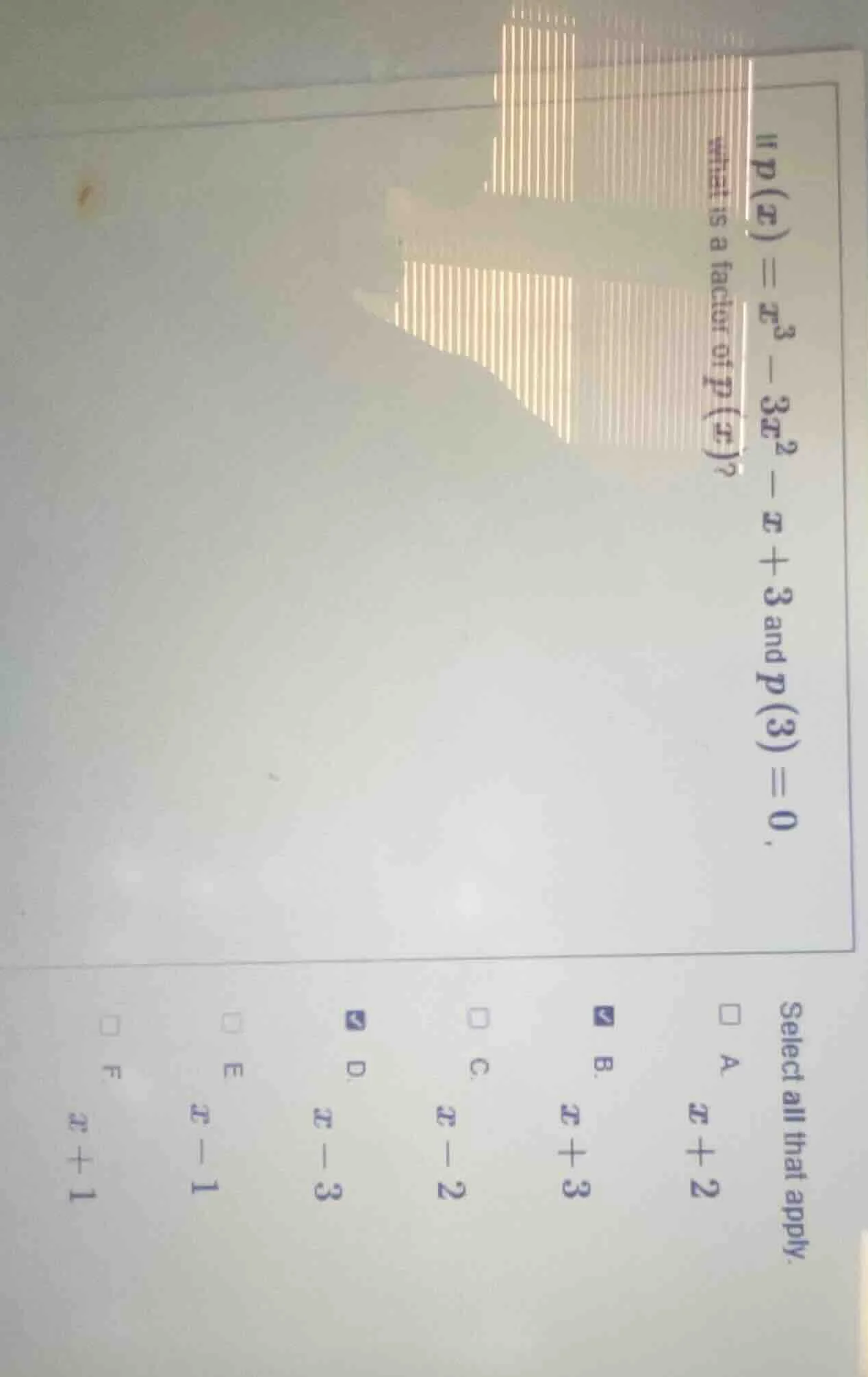
if ( p(x) = x^3 - 3x^2 - x + 3 ) and ( p(3) = 0 ), what is a factor of ( p(x) )?
select all that apply.
a ( x + 2 )
b ( x + 3 )
c ( x - 2 )
d ( x - 3 )
e ( x - 1 )
f ( x + 1 )
Step1: Recall the Factor Theorem
The Factor Theorem states that if \( p(c) = 0 \), then \( (x - c) \) is a factor of \( p(x) \). We know \( p(3)=0 \), so by the Factor Theorem, \( (x - 3) \) is a factor. Now we can perform polynomial division or factor by grouping to find other factors.
Step2: Factor the polynomial \( p(x)=x^3 - 3x^2 - x + 3 \)
First, group the terms:
\( (x^3 - 3x^2)+(-x + 3) \)
Factor out common terms from each group:
\( x^2(x - 3)-1(x - 3) \)
Now, factor out \( (x - 3) \):
\( (x - 3)(x^2 - 1) \)
Notice that \( x^2 - 1 \) is a difference of squares, so it factors as \( (x - 1)(x + 1) \). Thus, \( p(x)=(x - 3)(x - 1)(x + 1) \).
Step3: Identify the factors
From the factored form \( p(x)=(x - 3)(x - 1)(x + 1) \), the factors are \( x - 3 \), \( x - 1 \), and \( x + 1 \). Let's check the options:
- Option A: \( x + 2 \) - Not a factor.
- Option B: \( x + 3 \) - Not a factor.
- Option C: \( x - 2 \) - Not a factor.
- Option D: \( x - 3 \) - Is a factor (matches our factoring).
- Option E: \( x - 1 \) - Is a factor (matches our factoring).
- Option F: \( x + 1 \) - Is a factor (matches our factoring).

Snap & solve any problem in the app
Get step-by-step solutions on Sovi AI
Photo-based solutions with guided steps
Explore more problems and detailed explanations
D. \( x - 3 \), E. \( x - 1 \), F. \( x + 1 \)