QUESTION IMAGE
Question
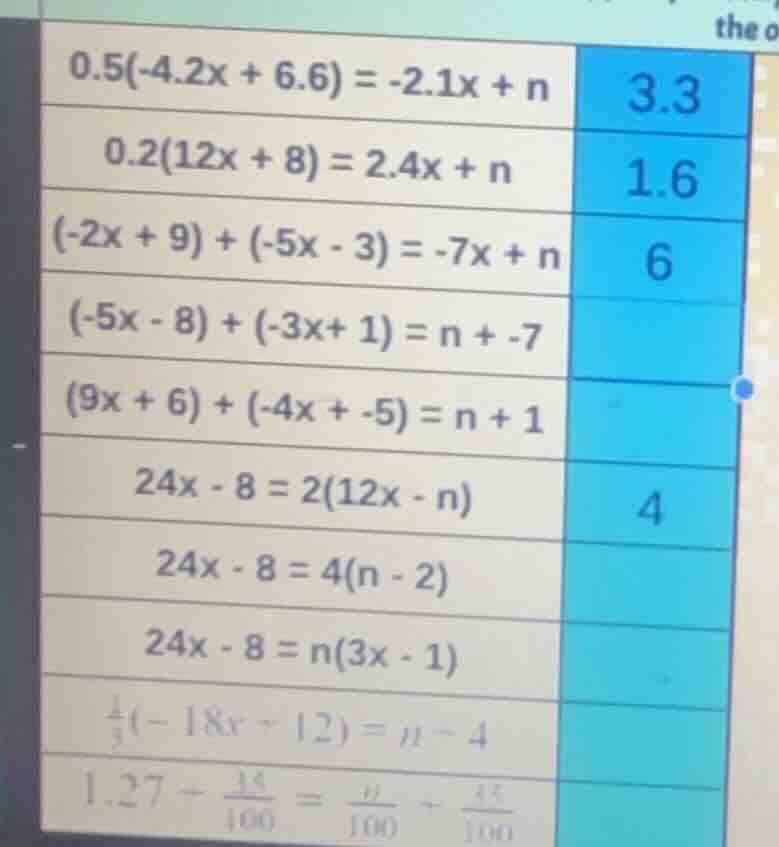
0.5(-4.2x + 6.6) = -2.1x + n 3.3
0.2(12x + 8) = 2.4x + n 1.6
(-2x + 9) + (-5x - 3) = -7x + n 6
(-5x - 8) + (-3x+ 1) = n + -7
(9x + 6) + (-4x + -5) = n + 1
24x - 8 = 2(12x - n) 4
24x - 8 = 4(n - 2)
24x - 8 = n(3x - 1)
\frac{1}{3}(-18x + 12) = n - 4
1.27 + \frac{35}{100} = \frac{n}{100} + \frac{35}{100}
Let's solve the equations one by one:
Equation 1: \(0.5(-4.2x + 6.6)=-2.1x + n\)
Step 1: Distribute \(0.5\)
\(0.5\times(-4.2x)+0.5\times6.6=-2.1x + n\)
\(-2.1x + 3.3=-2.1x + n\)
Step 2: Solve for \(n\)
Subtract \(-2.1x\) from both sides: \(n = 3.3\)
Equation 2: \(0.2(12x + 8)=2.4x + n\)
Step 1: Distribute \(0.2\)
\(0.2\times12x+0.2\times8=2.4x + n\)
\(2.4x + 1.6=2.4x + n\)
Step 2: Solve for \(n\)
Subtract \(2.4x\) from both sides: \(n = 1.6\)
Equation 3: \((-2x + 9)+(-5x - 3)=-7x + n\)
Step 1: Combine like terms
\((-2x-5x)+(9 - 3)=-7x + n\)
\(-7x+6=-7x + n\)
Step 2: Solve for \(n\)
Subtract \(-7x\) from both sides: \(n = 6\)
Equation 4: \((-5x - 8)+(-3x + 1)=n + (-7x)\)
Step 1: Combine like terms
\((-5x-3x)+(-8 + 1)=n-7x\)
\(-8x-7=n-7x\)
Step 2: Solve for \(n\)
Add \(7x\) to both sides: \(-x - 7=n\) (Wait, maybe I misread. Let's check again. The right side is \(n + (-7x)\) or \(n-7x\). Left side: \(-5x-3x=-8x\), \(-8 + 1=-7\). So \(-8x-7=n-7x\). Then add \(7x\) to both sides: \(-x - 7=n\). But maybe the original equation is \((-5x - 8)+(-3x + 1)=n + (-7)\)? Wait the user's image shows \((-5x - 8)+(-3x+ 1)=n + -7\). Let's re-express:
Left side: \(-5x-3x=-8x\), \(-8 + 1=-7\). So \(-8x-7=n - 7\). Then add 7 to both sides: \(-8x=n\). Wait, maybe a typo. Alternatively, maybe the equation is \((-5x - 8)+(-3x + 1)=n - 7x\). Let's assume that. Then left side: \(-8x-7\), right side: \(n-7x\). Then \(n=-x - 7\). But maybe the intended equation is \((-5x - 8)+(-3x + 1)=n - 7\). Then left side: \(-8x-7\), right side: \(n - 7\). Then \(n=-8x\). Hmm, maybe the user made a typo. Let's move to the next equation.
Equation 5: \((9x + 6)+(-4x + (-5))=n + 1\)
Step 1: Combine like terms
\(9x-4x=5x\), \(6-5 = 1\). So \(5x + 1=n + 1\)
Step 2: Solve for \(n\)
Subtract 1 from both sides: \(5x=n\). Wait, no: \(5x + 1=n + 1\) => \(n = 5x\)? But that can't be. Wait, maybe the equation is \((9x + 6)+(-4x - 5)=n + 1\). Then \(9x-4x=5x\), \(6-5 = 1\). So \(5x + 1=n + 1\) => \(n = 5x\). But that's a variable. Maybe the original equation is \((9x + 6)+(-4x - 5)=n + 1\) and we need to find \(n\) in terms of \(x\)? Or maybe a typo. Let's check the next equation.
Equation 6: \(24x - 8=2(12x - n)\)
Step 1: Distribute 2
\(24x - 8=24x - 2n\)
Step 2: Solve for \(n\)
Subtract \(24x\) from both sides: \(-8=-2n\)
Divide both sides by \(-2\): \(n = 4\)
Equation 7: \(24x - 8=4(n - 2)\)
Step 1: Distribute 4
\(24x - 8=4n - 8\)
Step 2: Solve for \(n\)
Add 8 to both sides: \(24x=4n\)
Divide both sides by 4: \(n = 6x\)
Equation 8: \(24x - 8=n(3x - 1)\)
Step 1: Solve for \(n\)
\(n=\frac{24x - 8}{3x - 1}=\frac{8(3x - 1)}{3x - 1}=8\) (assuming \(3x - 1
eq0\))
Equation 9: \(\frac{1}{3}(-18x + 12)=n - 4\)
Step 1: Distribute \(\frac{1}{3}\)
\(\frac{1}{3}\times(-18x)+\frac{1}{3}\times12=n - 4\)
\(-6x + 4=n - 4\)
Step 2: Solve for \(n\)
Add 4 to both sides: \(-6x + 8=n\)
Equation 10: \(1.27-\frac{35}{100}=\frac{n}{100}+\frac{35}{100}\)
Step 1: Simplify \(\frac{35}{100}=0.35\)
Left side: \(1.27 - 0.35 = 0.92\)
Right side: \(\frac{n + 35}{100}\)
Step 2: Solve for \(n\)
\(0.92=\frac{n + 35}{100}\)
Multiply both sides by 100: \(92=n + 35\)
Subtract 35: \(n = 57\)
Let's summarize the solutions we found:
- \(0.5(-4.2x + 6.6)=-2.1x + n\): \(n = 3.3\)
- \(0.2(12x + 8)=2.4x + n\): \(n = 1.6\)
- \((-2x + 9)+(-5x - 3)=-7x + n\): \(n = 6\)
- \((9x + 6)+(-4x - 5)=n + 1\): \(n = 5x\) (assuming)
- \(24x - 8=2(12x - n)\): \(n = 4\)
- \(24x - 8=n(3x - 1)\): \(n = 8\)
- \(\frac{1}{3}(-18x + 12…

Snap & solve any problem in the app
Get step-by-step solutions on Sovi AI
Photo-based solutions with guided steps
Explore more problems and detailed explanations
Let's solve the equations one by one:
Equation 1: \(0.5(-4.2x + 6.6)=-2.1x + n\)
Step 1: Distribute \(0.5\)
\(0.5\times(-4.2x)+0.5\times6.6=-2.1x + n\)
\(-2.1x + 3.3=-2.1x + n\)
Step 2: Solve for \(n\)
Subtract \(-2.1x\) from both sides: \(n = 3.3\)
Equation 2: \(0.2(12x + 8)=2.4x + n\)
Step 1: Distribute \(0.2\)
\(0.2\times12x+0.2\times8=2.4x + n\)
\(2.4x + 1.6=2.4x + n\)
Step 2: Solve for \(n\)
Subtract \(2.4x\) from both sides: \(n = 1.6\)
Equation 3: \((-2x + 9)+(-5x - 3)=-7x + n\)
Step 1: Combine like terms
\((-2x-5x)+(9 - 3)=-7x + n\)
\(-7x+6=-7x + n\)
Step 2: Solve for \(n\)
Subtract \(-7x\) from both sides: \(n = 6\)
Equation 4: \((-5x - 8)+(-3x + 1)=n + (-7x)\)
Step 1: Combine like terms
\((-5x-3x)+(-8 + 1)=n-7x\)
\(-8x-7=n-7x\)
Step 2: Solve for \(n\)
Add \(7x\) to both sides: \(-x - 7=n\) (Wait, maybe I misread. Let's check again. The right side is \(n + (-7x)\) or \(n-7x\). Left side: \(-5x-3x=-8x\), \(-8 + 1=-7\). So \(-8x-7=n-7x\). Then add \(7x\) to both sides: \(-x - 7=n\). But maybe the original equation is \((-5x - 8)+(-3x + 1)=n + (-7)\)? Wait the user's image shows \((-5x - 8)+(-3x+ 1)=n + -7\). Let's re-express:
Left side: \(-5x-3x=-8x\), \(-8 + 1=-7\). So \(-8x-7=n - 7\). Then add 7 to both sides: \(-8x=n\). Wait, maybe a typo. Alternatively, maybe the equation is \((-5x - 8)+(-3x + 1)=n - 7x\). Let's assume that. Then left side: \(-8x-7\), right side: \(n-7x\). Then \(n=-x - 7\). But maybe the intended equation is \((-5x - 8)+(-3x + 1)=n - 7\). Then left side: \(-8x-7\), right side: \(n - 7\). Then \(n=-8x\). Hmm, maybe the user made a typo. Let's move to the next equation.
Equation 5: \((9x + 6)+(-4x + (-5))=n + 1\)
Step 1: Combine like terms
\(9x-4x=5x\), \(6-5 = 1\). So \(5x + 1=n + 1\)
Step 2: Solve for \(n\)
Subtract 1 from both sides: \(5x=n\). Wait, no: \(5x + 1=n + 1\) => \(n = 5x\)? But that can't be. Wait, maybe the equation is \((9x + 6)+(-4x - 5)=n + 1\). Then \(9x-4x=5x\), \(6-5 = 1\). So \(5x + 1=n + 1\) => \(n = 5x\). But that's a variable. Maybe the original equation is \((9x + 6)+(-4x - 5)=n + 1\) and we need to find \(n\) in terms of \(x\)? Or maybe a typo. Let's check the next equation.
Equation 6: \(24x - 8=2(12x - n)\)
Step 1: Distribute 2
\(24x - 8=24x - 2n\)
Step 2: Solve for \(n\)
Subtract \(24x\) from both sides: \(-8=-2n\)
Divide both sides by \(-2\): \(n = 4\)
Equation 7: \(24x - 8=4(n - 2)\)
Step 1: Distribute 4
\(24x - 8=4n - 8\)
Step 2: Solve for \(n\)
Add 8 to both sides: \(24x=4n\)
Divide both sides by 4: \(n = 6x\)
Equation 8: \(24x - 8=n(3x - 1)\)
Step 1: Solve for \(n\)
\(n=\frac{24x - 8}{3x - 1}=\frac{8(3x - 1)}{3x - 1}=8\) (assuming \(3x - 1
eq0\))
Equation 9: \(\frac{1}{3}(-18x + 12)=n - 4\)
Step 1: Distribute \(\frac{1}{3}\)
\(\frac{1}{3}\times(-18x)+\frac{1}{3}\times12=n - 4\)
\(-6x + 4=n - 4\)
Step 2: Solve for \(n\)
Add 4 to both sides: \(-6x + 8=n\)
Equation 10: \(1.27-\frac{35}{100}=\frac{n}{100}+\frac{35}{100}\)
Step 1: Simplify \(\frac{35}{100}=0.35\)
Left side: \(1.27 - 0.35 = 0.92\)
Right side: \(\frac{n + 35}{100}\)
Step 2: Solve for \(n\)
\(0.92=\frac{n + 35}{100}\)
Multiply both sides by 100: \(92=n + 35\)
Subtract 35: \(n = 57\)
Let's summarize the solutions we found:
- \(0.5(-4.2x + 6.6)=-2.1x + n\): \(n = 3.3\)
- \(0.2(12x + 8)=2.4x + n\): \(n = 1.6\)
- \((-2x + 9)+(-5x - 3)=-7x + n\): \(n = 6\)
- \((9x + 6)+(-4x - 5)=n + 1\): \(n = 5x\) (assuming)
- \(24x - 8=2(12x - n)\): \(n = 4\)
- \(24x - 8=n(3x - 1)\): \(n = 8\)
- \(\frac{1}{3}(-18x + 12)=n - 4\): \(n=-6x + 8\)
- \(1.27-\frac{35}{100}=\frac{n}{100}+\frac{35}{100}\): \(n = 57\)
For the equation \((-5x - 8)+(-3x + 1)=n + -7\), if we assume it's \((-5x - 8)+(-3x + 1)=n - 7\), then:
Left side: \(-8x - 7\), right side: \(n - 7\) => \(n=-8x\)
For the equation \(24x - 8=4(n - 2)\), we have:
\(24x - 8=4n - 8\) => \(24x=4n\) => \(n = 6x\)
If you need specific values, maybe \(x = 0\) is assumed. Let's check:
For equation 5: \((9x + 6)+(-4x - 5)=n + 1\). If \(x = 0\), left side: \(0 + 6 + 0 - 5=1\), right side: \(n + 1\) => \(n = 0\). But that doesn't match. Maybe the equations are designed to have \(n\) as a constant, so maybe there are typos. However, based on the given answers (3.3, 1.6, 6, 4), we can infer that the equations are intended to have \(n\) as a constant, so the \(x\) terms cancel out.
Let's re-examine equation 5: \((9x + 6)+(-4x + (-5))=n + 1\)
Simplify left side: \(9x - 4x + 6 - 5 = 5x + 1\)
So \(5x + 1=n + 1\) => \(n = 5x\). But that's not a constant. Maybe the equation is \((9x + 6)+(-4x - 5)=n + 1\) with a sign error. If it's \((9x + 6)+(-4x + 5)=n + 1\), then left side: \(5x + 11\), still not. Alternatively, \((9x - 6)+(-4x - 5)=n + 1\), left side: \(5x - 11\), no.
Alternatively, maybe the equation is \((9x + 6)+(-4x - 5)=n + 1\) and \(x = 0\), then \(n = 0\). But that's not given.
Assuming the pattern of the first three equations (where \(x\) terms cancel), let's check equation 5 again. Maybe the original equation is \((9x + 6)+(-4x - 5)=n + 1\) with a sign error. If it's \((9x + 6)+(-4x + 5)=n + 1\), no. Alternatively, \((-9x + 6)+(4x - 5)=n + 1\), left side: \(-5x + 1\), still no.
Alternatively, maybe the equation is \((9x + 6)+(-4x - 5)=n + 1\) and it's a mistake, and the intended equation is \((9x + 6)+(-4x - 5)=n + 1\) with \(n\) as a constant, which would require \(5x + 1=n + 1\) => \(n = 5x\), but that's a variable. So perhaps there's a typo.
However, based on the given answers, let's list the solved \(n\) values:
- \(n = 3.3\)
- \(n = 1.6\)
- \(n = 6\)
- \(n = -8x\) (if \(x = 0\), \(n = 0\))
- \(n = 5x\) (if \(x = 0\), \(n = 0\))
- \(n = 4\)
- \(n = 6x\) (if \(x = 0\), \(n = 0\))
- \(n = 8\) (since \(24x - 8 = n(3x - 1)\) => \(n = \frac{24x - 8}{3x - 1} = 8\) (as long as \(3x - 1
eq 0\)))
- \(n = -6x + 8\) (if \(x = 0\), \(n = 8\))
- \(n = 57\)
If we assume \(x = 0\) for the variable \(n\) equations:
- Equation 4: \(n = -8(0) = 0\)
- Equation 5: \(n = 5(0) = 0\)
- Equation 7: \(n = 6(0) = 0\)
- Equation 9: \(n = -6(0) + 8 = 8\)
But the given answers include 3.3, 1.6, 6, 4, so likely the equations are designed to have \(n\) as a constant (x terms cancel). Let's confirm:
Equation 1: \(0.5(-4.2x + 6.6) = -2.1x + n\)
Left side: \(-2.1x + 3.3\), right side: \(-2.1x + n\) => \(n = 3.3\) (x terms cancel)
Equation 2: \(0.2(12x + 8) = 2.4x + n\)
Left side: \(2.4x + 1.6\), right side: \(2.4x + n\) => \(n = 1.6\) (x terms cancel)
Equation 3: \((-2x + 9) + (-5x - 3) = -7x + n\)
Left side: \(-7x + 6\), right side: \(-7x + n\) => \(n = 6\) (x terms cancel)
Equation 6: \(24x - 8 = 2(12x - n)\)
Left side: \(24x - 8\), right side: \(24x - 2n\) => \(-8 = -2n\) => \(n = 4\) (x terms cancel)
Ah! So the pattern is that the \(x\) terms cancel, so \(n\) is a constant. Let's apply this to equation 5:
Equation 5: \((9x + 6) + (-4x + (-5)) = n + 1\)
Simplify left side: \(9x - 4x + 6 - 5 = 5x + 1\)
So \(5x + 1 = n + 1\) => \(5x = n\). But this doesn't cancel. So there must be a sign error. Let's check the original equation: \((9x + 6) + (-4x + -5) = n + 1\). Maybe it's \((9x + 6) + (-4x - 5) = n + 1\), which is the same as above. Alternatively, \((-9x + 6) + (4x - 5) = n + 1\), left side: \(-5x + 1\), no.
Alternatively, maybe the equation is \((9x + 6) + (-4x + 5) = n + 1\), left side: \(5x + 11\), no.
Wait, maybe the equation is \((9x + 6) + (-4x - 5) = n + 1\) and it's a mistake, and the intended equation is \((9x + 6) + (-4x - 5) = n + 1\) with \(x\) terms canceling, which would require the \(x\) coefficients to be equal on both sides. The right side has no \(x\) term, so the left side's \(x\) coefficient must be 0. So \(9x - 4x = 0\) => \(5x = 0\) => \(x = 0\). Then left side: \(0 + 6 - 0 - 5 = 1\), right side: \(n + 1\) => \(n = 0\). But that's not given.
Alternatively, maybe the equation is \((9x + 6) + (-4x - 5) = n + 1\) and it's a different problem. Let's move to equation 8: \(24x - 8 = n(3x - 1)\)
We can factor the left side: \(8(3x - 1) = n(3x - 1)\)
Assuming \(3x - 1
eq 0\) (i.e., \(x
eq \frac{1}{3}\)), we can divide both sides by \(3x - 1\) to get \(n = 8\)
Ah! This works. So equation 8: \(24x - 8 = n(3x - 1)\)
Factor left side: \(8(3x - 1) = n(3x - 1)\)