QUESTION IMAGE
Question
4-4 lesson quiz
linear inequalities in two variables
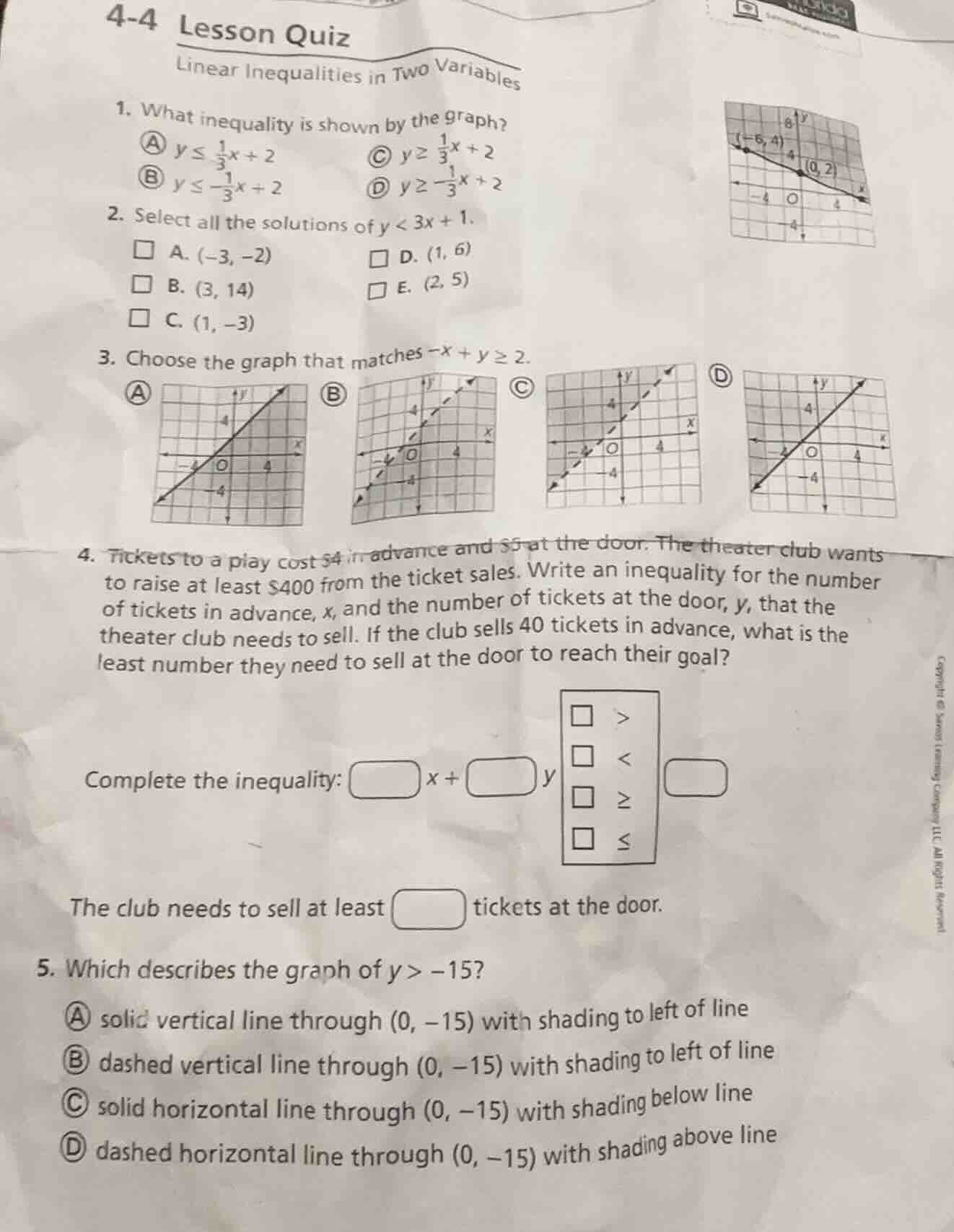
- what inequality is shown by the graph?
a ( y leq \frac{1}{3}x + 2 ) c ( y geq \frac{1}{3}x + 2 )
b ( y leq -\frac{1}{3}x + 2 ) d ( y geq -\frac{1}{3}x + 2 )
- select all the solutions of ( y < 3x + 1 ).
a. (-3, -2) d. (1, 6)
b. (3, 14) e. (2, 5)
c. (1, -3)
- choose the graph that matches ( -x + y geq 2 ).
(graphs for options a, b, c, d are shown)
- tickets to a play cost $4 in advance and $5 at the door. the theater club wants to raise at least $400 from the ticket sales. write an inequality for the number of tickets in advance, x, and the number of tickets at the door, y, that the theater club needs to sell. if the club sells 40 tickets in advance, what is the least number they need to sell at the door to reach their goal?
complete the inequality: \\( \square x + \square y \square \square \\)
the club needs to sell at least \\( \square \\) tickets at the door.
- which describes the graph of ( y > -15 )?
a solid vertical line through (0, -15) with shading to left of line
b dashed vertical line through (0, -15) with shading to left of line
c solid horizontal line through (0, -15) with shading below line
d dashed horizontal line through (0, -15) with shading above line
Question 1
Step 1: Find the slope
The two points on the line are \((-6, 4)\) and \((0, 2)\). The slope \(m=\frac{y_2 - y_1}{x_2 - x_1}=\frac{2 - 4}{0 - (-6)}=\frac{-2}{6}=-\frac{1}{3}\).
Step 2: Find the y - intercept
The line crosses the y - axis at \((0, 2)\), so the y - intercept \(b = 2\). The equation of the line is \(y=-\frac{1}{3}x + 2\).
Step 3: Determine the inequality
The line is solid (so the inequality includes equality) and the shading is below the line (so \(y\leq\) the line equation). So the inequality is \(y\leq-\frac{1}{3}x + 2\), which is option B.
We substitute each point into the inequality \(y<3x + 1\):
- For point A \((-3,-2)\): Substitute \(x=-3,y = - 2\) into \(y<3x + 1\). \(3x+1=3\times(-3)+1=-9 + 1=-8\). Since \(-2>-8\), \((-3,-2)\) is not a solution.
- For point B \((3,14)\): Substitute \(x = 3,y=14\) into \(y<3x + 1\). \(3x + 1=3\times3+1=9 + 1 = 10\). Since \(14>10\), \((3,14)\) is not a solution.
- For point C \((1,-3)\): Substitute \(x = 1,y=-3\) into \(y<3x + 1\). \(3x+1=3\times1+1=4\). Since \(-3<4\), \((1,-3)\) is a solution.
- For point D \((1,6)\): Substitute \(x = 1,y = 6\) into \(y<3x + 1\). \(3x+1=3\times1+1=4\). Since \(6>4\), \((1,6)\) is not a solution.
- For point E \((2,5)\): Substitute \(x = 2,y = 5\) into \(y<3x + 1\). \(3x+1=3\times2+1=7\). Since \(5<7\), \((2,5)\) is a solution.
First, rewrite the inequality \(-x + y\geq2\) as \(y\geq x + 2\).
- The line \(y=x + 2\) has a slope of \(1\) and a y - intercept of \(2\).
- Since the inequality is \(y\geq x + 2\), the line should be solid (because of the \(\geq\) sign) and the shading should be above the line.
- Looking at the options, option A has a line with slope \(1\), y - intercept \(2\) (it passes through \((0,2)\) and has a slope of \(1\)) and shading above the line.

Snap & solve any problem in the app
Get step-by-step solutions on Sovi AI
Photo-based solutions with guided steps
Explore more problems and detailed explanations
B. \(y\leq-\frac{1}{3}x + 2\)