QUESTION IMAGE
Question
42 what was the ultimate fate of the treaty of versailles in the united states?
a. it was vetoed by president wilson.
b. it was rejected by congress, which then signed a separate peace treaty with germany.
c. it was rejected by congress in its original form, but was ratified with reservations.
d. it was declared unconstitutional by the supreme court of the united states.
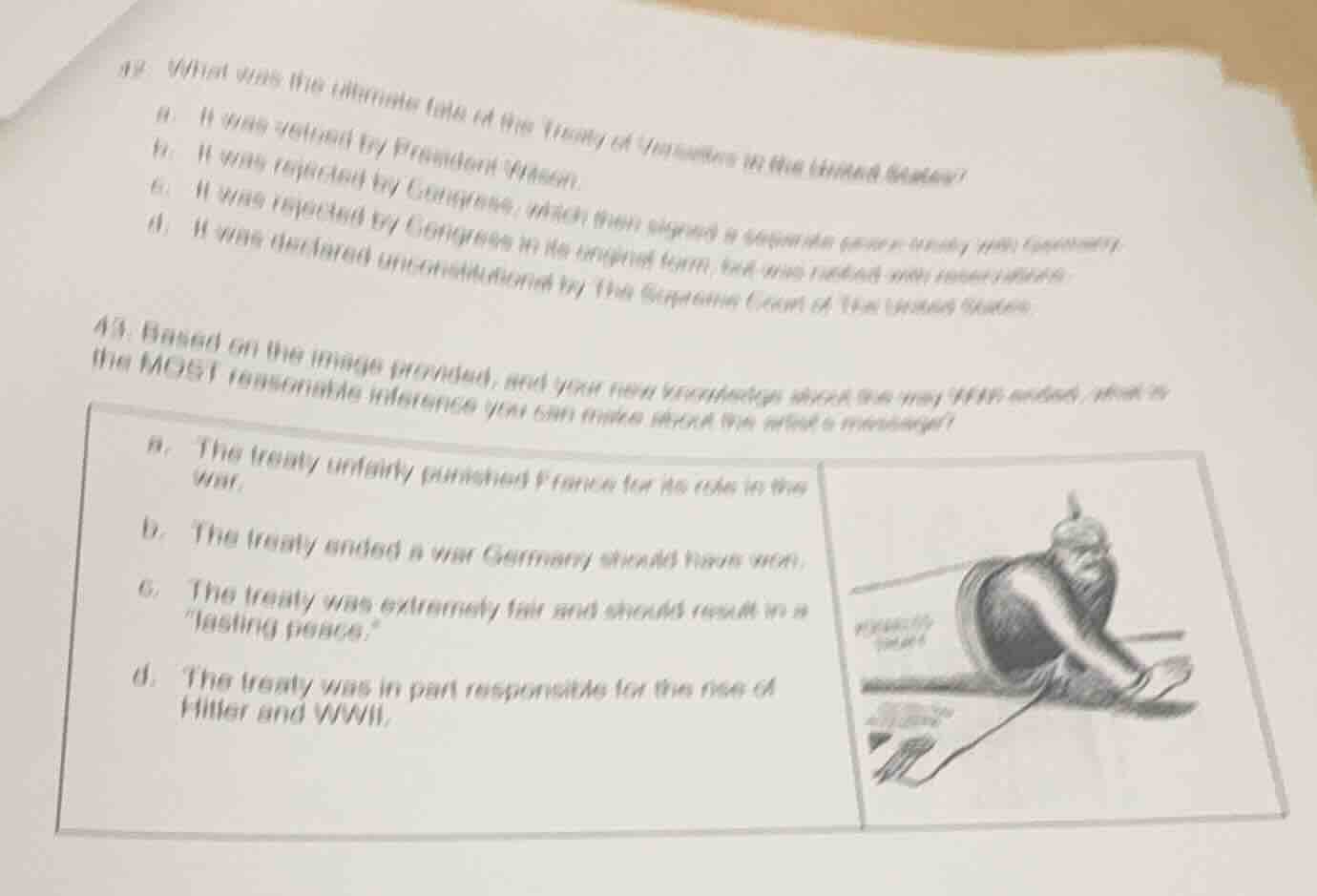
- based on the image provided, and your own knowledge about the time period involved, what is the most reasonable inference you can make about the allied \peacemaker\?
a. the treaty unfairly punished france for its role in the war.
b. the treaty ended a war germany should have won.
c. the treaty was extremely fair and should result in a \lasting peace.\
d. the treaty was in part responsible for the rise of hitler and wwii.
For question 42: The U.S. Senate rejected the original Treaty of Versailles (including membership in the League of Nations) and later signed separate peace treaties with the Central Powers instead. President Wilson did not veto it; he advocated for it, and the Supreme Court did not rule it unconstitutional.
For question 43: The image depicts a figure (representing Germany) burdened by a heavy "war guilt" chain, referencing the Treaty of Versailles' harsh terms on Germany. These severe punishments (reparations, territorial losses, war guilt clause) created economic and political instability in Germany, which contributed to the rise of Hitler and the outbreak of WWII. The other options are incorrect: the treaty punished Germany, not France; Germany did not deserve to win WWI; and the treaty's unfairness made lasting peace impossible.

Snap & solve any problem in the app
Get step-by-step solutions on Sovi AI
Photo-based solutions with guided steps
Explore more problems and detailed explanations
- b. It was rejected by Congress, which then signed a separate peace treaty with Germany.
- d. The treaty was in part responsible for the rise of Hitler and WWII.