QUESTION IMAGE
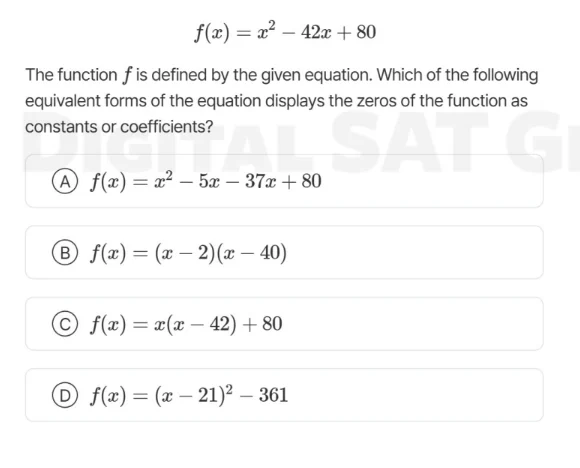
Question
f(x) = x^2 - 42x + 80
the function f is defined by the given equation. which of the following equivalent forms of the equation displays the zeros of the function as constants or coefficients?
a) f(x) = x^2 - 5x - 37x + 80
b) f(x) = (x - 2)(x - 40)
c) f(x) = x(x - 42) + 80
d) f(x) = (x - 21)^2 - 361
Step1: Recall the zero - factor property
The zeros of a quadratic function \(y = f(x)\) are the values of \(x\) for which \(f(x)=0\). For a quadratic function in factored form \(f(x)=(x - a)(x - b)\), the zeros are \(x = a\) and \(x = b\) because if \((x - a)(x - b)=0\), then either \(x - a = 0\) (so \(x=a\)) or \(x - b=0\) (so \(x = b\)).
Step2: Analyze each option
- Option A: \(f(x)=x^{2}-5x - 37x + 80\) is just a re - grouping of the middle term of the original quadratic. This form does not directly show the zeros of the function. It is still in a non - factored, expanded form with a sum of like terms combined, and we can't directly identify the zeros from this form.
- Option B: \(f(x)=(x - 2)(x - 40)\). Using the zero - factor property, if \((x - 2)(x - 40)=0\), then \(x-2 = 0\) or \(x - 40=0\). Solving these equations gives \(x = 2\) and \(x = 40\). So this factored form displays the zeros (\(2\) and \(40\)) as constants in the factors.
- Option C: \(f(x)=x(x - 42)+80\). If we set \(f(x) = 0\), we get \(x(x - 42)+80=0\), which is \(x^{2}-42x + 80=0\), but this form does not directly show the zeros. We would still need to solve the quadratic equation, and the form \(x(x - 42)+80\) is not a form that reveals the zeros as constants easily.
- Option D: \(f(x)=(x - 21)^{2}-361\) is the vertex form of the quadratic function (\(f(x)=a(x - h)^{2}+k\), where \((h,k)\) is the vertex). If we set \(f(x)=0\), we have \((x - 21)^{2}-361=0\), \((x - 21)^{2}=361\), \(x-21=\pm19\), \(x=21\pm19\), so \(x = 40\) or \(x = 2\). But this vertex form does not display the zeros as constants in the same direct way as the factored form. The vertex form is more useful for finding the vertex of the parabola.

Snap & solve any problem in the app
Get step-by-step solutions on Sovi AI
Photo-based solutions with guided steps
Explore more problems and detailed explanations
B. \(f(x)=(x - 2)(x - 40)\)