QUESTION IMAGE
Question
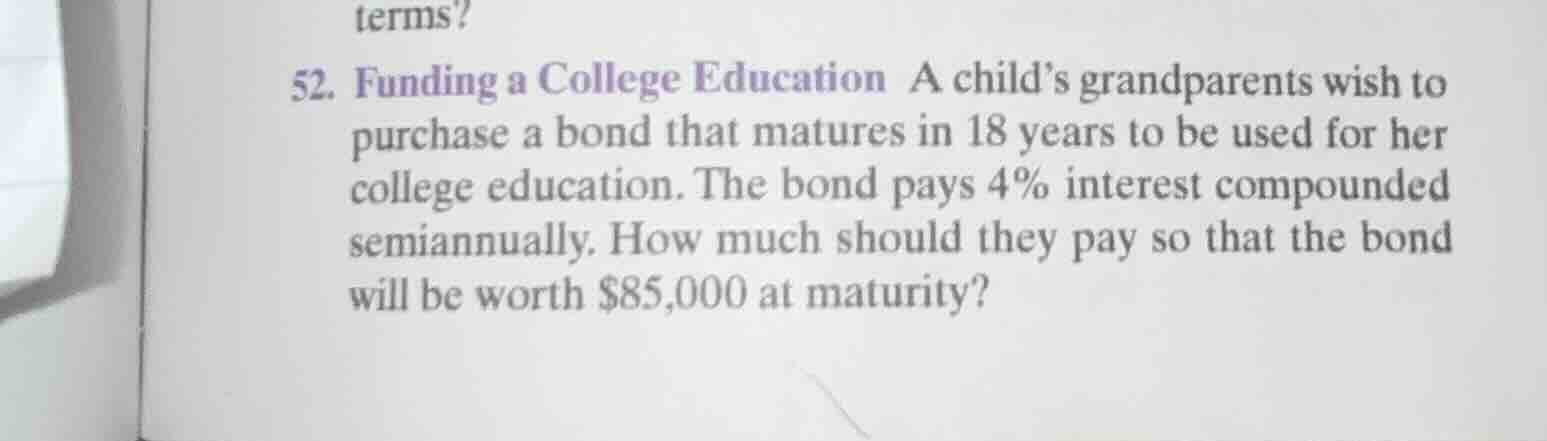
- funding a college education a child’s grandparents wish to purchase a bond that matures in 18 years to be used for her college education. the bond pays 4% interest compounded semiannually. how much should they pay so that the bond will be worth $85,000 at maturity?
Step1: Recall the compound - interest formula for present value
The formula for the present value \(P\) of an amount \(A\) (future value) with compound interest is given by \(P=\frac{A}{(1 + \frac{r}{n})^{nt}}\), where:
- \(A\) is the future value (the amount the bond will be worth at maturity),
- \(r\) is the annual interest rate (in decimal form),
- \(n\) is the number of times interest is compounded per year,
- \(t\) is the number of years.
Step2: Identify the values of \(A\), \(r\), \(n\), and \(t\)
- We are given that \(A = 85000\) dollars.
- The annual interest rate \(r=4\%=0.04\).
- Since interest is compounded semiannually, \(n = 2\) (because there are 2 compounding periods per year: half - years).
- The number of years \(t = 18\).
Step3: Substitute the values into the formula
First, calculate the exponent \(nt\): \(nt=2\times18 = 36\).
Then, calculate the value of \(\frac{r}{n}\): \(\frac{r}{n}=\frac{0.04}{2}=0.02\).
Next, calculate the value of \((1+\frac{r}{n})^{nt}=(1 + 0.02)^{36}\).
We know that \((1.02)^{36}\approx2.039887\) (using a calculator to find the value of \(1.02\) raised to the 36th power).
Now, use the formula \(P=\frac{A}{(1+\frac{r}{n})^{nt}}\):
\(P=\frac{85000}{(1.02)^{36}}\)
Substitute \((1.02)^{36}\approx2.039887\) into the formula:
\(P=\frac{85000}{2.039887}\approx41668.22\)

Snap & solve any problem in the app
Get step-by-step solutions on Sovi AI
Photo-based solutions with guided steps
Explore more problems and detailed explanations
They should pay approximately \(\$41668.22\) for the bond.