QUESTION IMAGE
Question
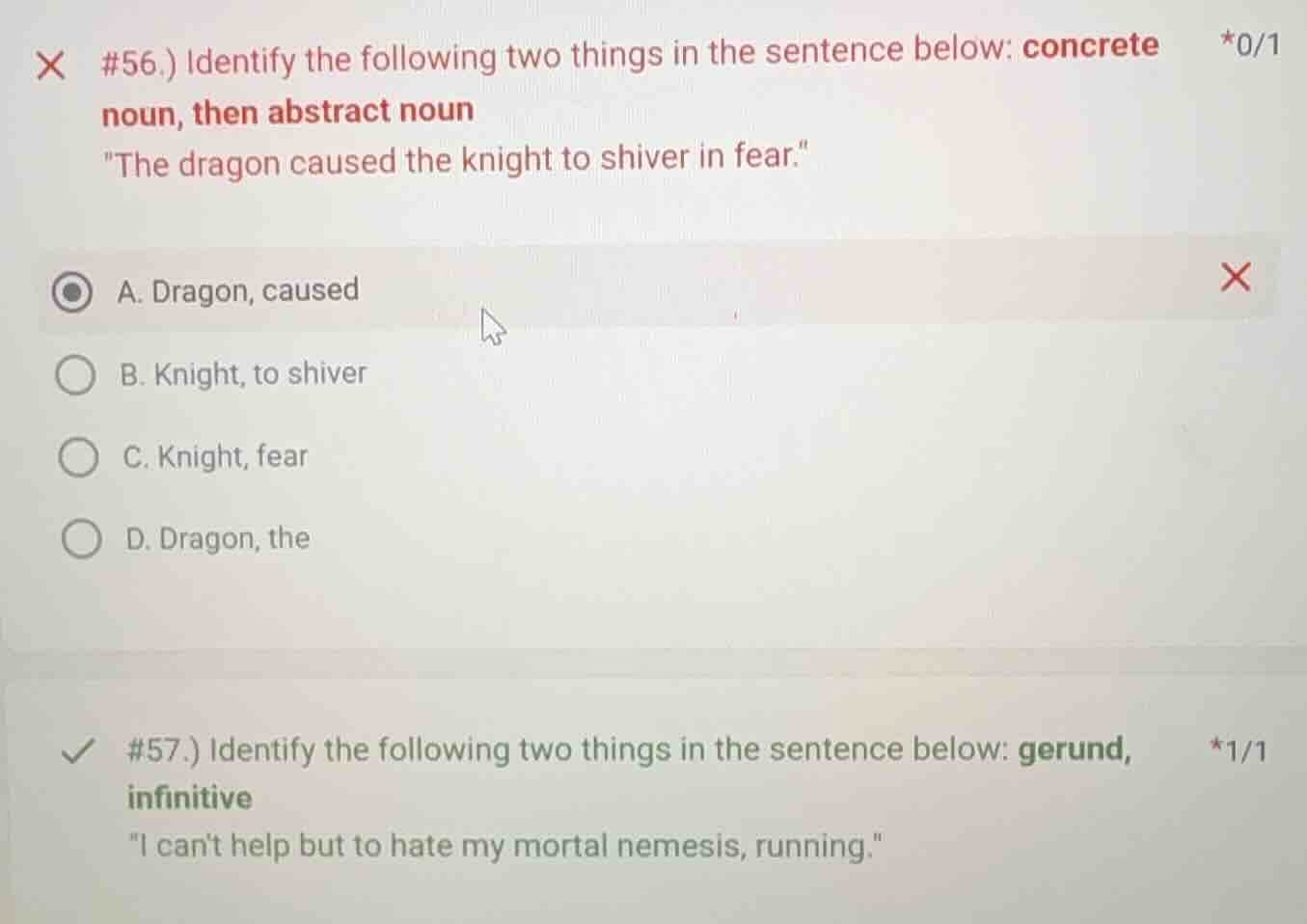
#56.) identify the following two things in the sentence below: concrete noun, then abstract noun \the dragon caused the knight to shiver in fear.\ a. dragon, caused b. knight, to shiver c. knight, fear d. dragon, the #57.) identify the following two things in the sentence below: gerund, infinitive \i cant help but to hate my mortal nemesis, running.\
Question 56
To solve this, we first recall: A concrete noun is a physical, tangible thing (e.g., person, animal, object). An abstract noun is intangible (e.g., emotion, idea).
- Option A: "caused" is a verb, not a noun. Eliminate.
- Option B: "to shiver" is an infinitive (verb form), not a noun. Eliminate.
- Option C: "Knight" is a concrete noun (a person, tangible). "Fear" is an abstract noun (an emotion, intangible). This fits.
- Option D: "the" is an article, not a noun. Eliminate.
A gerund is a verb form ending in -ing that acts as a noun. An infinitive is "to + verb".
In the sentence "I can’t help but to hate my mortal nemesis, running.":
- "running" ends in -ing and functions as a noun (gerund).
- "to hate" is "to + verb" (infinitive).
(Note: If we were to list the answer, it would be "running (gerund), to hate (infinitive)". But since the question likely expects identifying these, we confirm the gerund is "running" and infinitive is "to hate".)

Snap & solve any problem in the app
Get step-by-step solutions on Sovi AI
Photo-based solutions with guided steps
Explore more problems and detailed explanations
C. Knight, fear