QUESTION IMAGE
Question
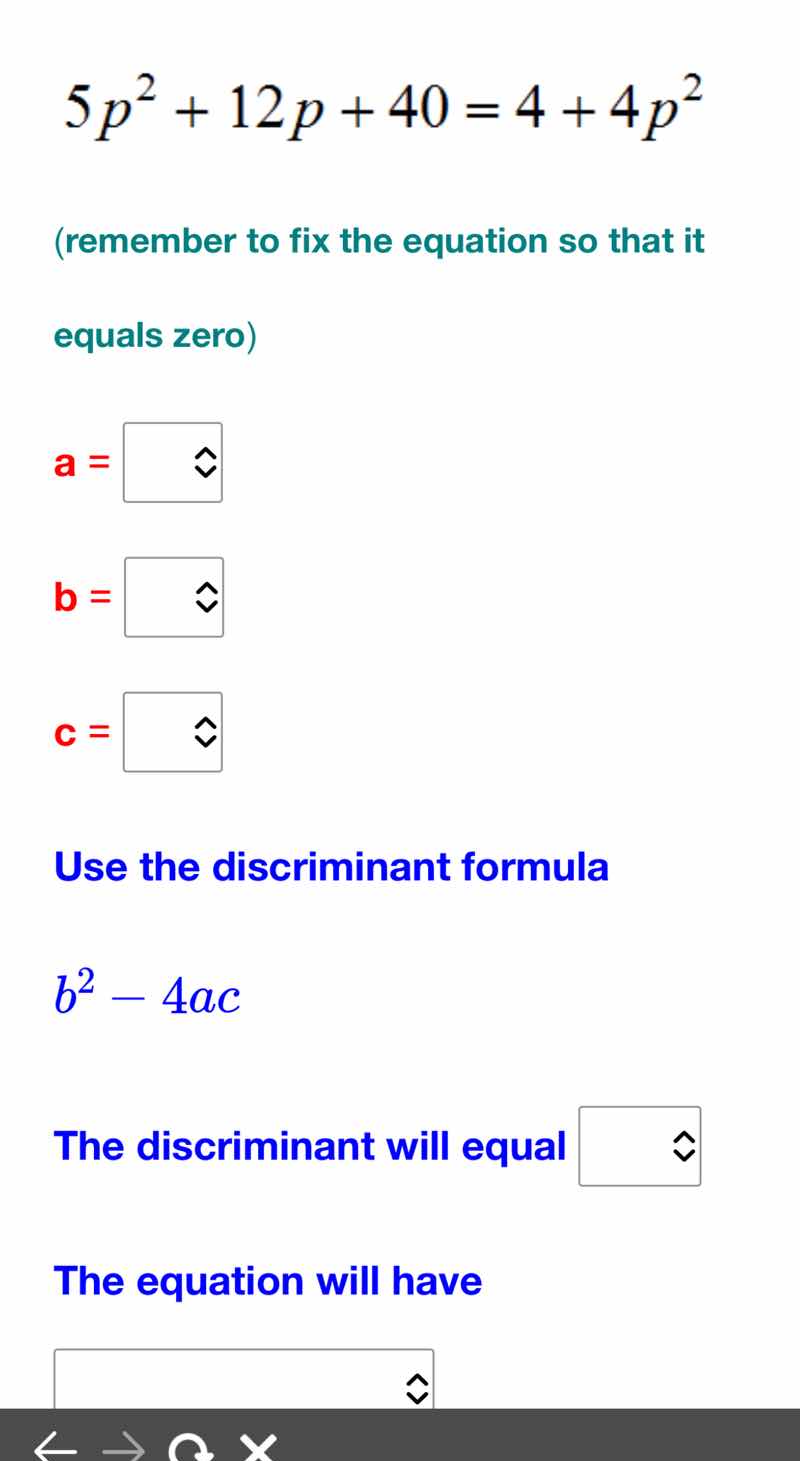
5p² + 12p + 40 = 4 + 4p²
(remember to fix the equation so that it equals zero)
a =
b =
c =
use the discriminant formula
b² − 4ac
the discriminant will equal
the equation will have
Step1: Rearrange the equation
Subtract \(4 + 4p^{2}\) from both sides to set the equation to zero:
\(5p^{2}+12p + 40-(4 + 4p^{2})=0\)
Simplify: \(5p^{2}-4p^{2}+12p+40 - 4=0\)
Which gives: \(p^{2}+12p + 36=0\)
Step2: Identify \(a\), \(b\), \(c\)
For a quadratic equation \(ap^{2}+bp + c = 0\), here \(a = 1\), \(b = 12\), \(c = 36\)
Step3: Calculate the discriminant
Use the formula \(b^{2}-4ac\)
Substitute \(a = 1\), \(b = 12\), \(c = 36\):
\(12^{2}-4\times1\times36\)
\(=144 - 144\)
\(=0\)
Step4: Determine the number of solutions
If the discriminant is zero, the quadratic equation has one real solution (a repeated root).

Snap & solve any problem in the app
Get step-by-step solutions on Sovi AI
Photo-based solutions with guided steps
Explore more problems and detailed explanations
\(a = 1\)
\(b = 12\)
\(c = 36\)
The discriminant will equal \(0\)
The equation will have one real solution (a repeated root)