QUESTION IMAGE
Question
8.6c & 8.7cd module assessment 1
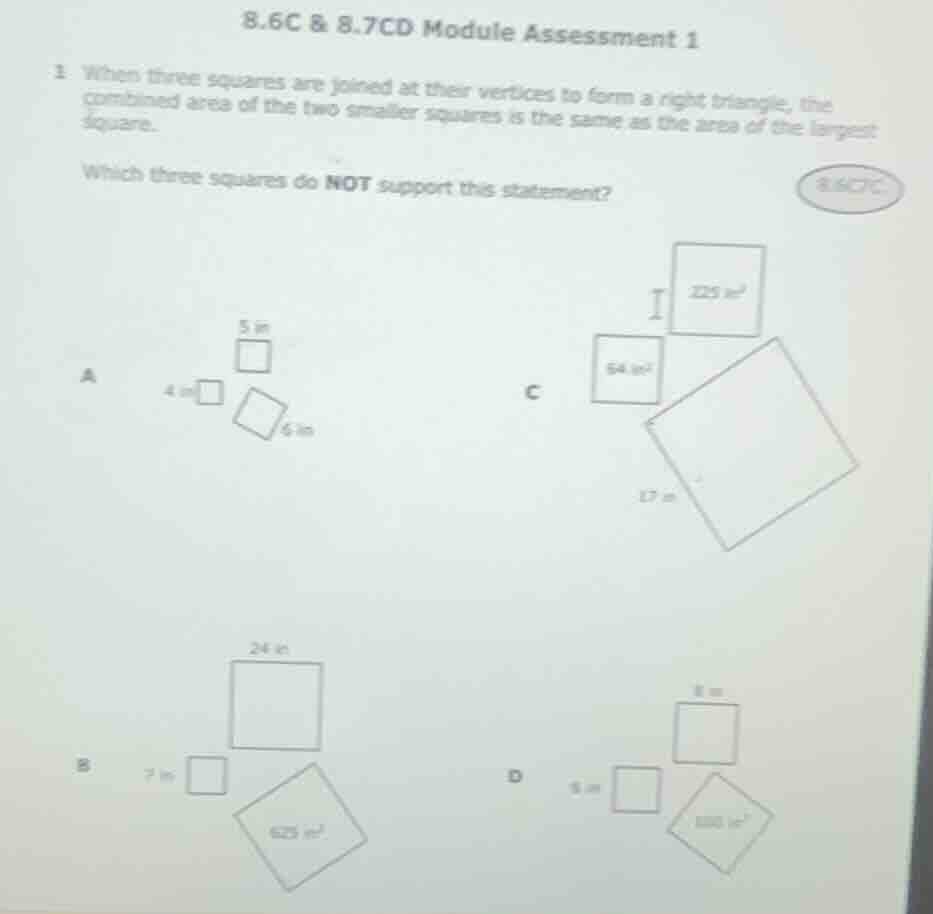
- when three squares are joined at their vertices to form a right triangle, the combined area of the two smaller squares is the same as the area of the largest square.
which three squares do not support this statement?
a
4 in□
5 in□
6 in□
b
7 in□
24 in□
625 in²□
c
64 in²□
225 in²□
17 m□
d
8 m□
9 m□
145 m²□
Step1: Recall Pythagorean theorem rule
For squares on right triangle sides: sum of areas of two smaller squares equals area of largest square. For a square with side length $s$, area is $s^2$.
Step2: Test Option A
Calculate areas: $4^2=16$, $5^2=25$, $6^2=36$. Sum of small areas: $16+25=41$. Check if equal to largest area: $41
eq36$.
Step3: Test Option B
Calculate areas: $7^2=49$, $24^2=576$, largest area=625. Sum of small areas: $49+576=625$. This equals largest area.
Step4: Test Option C
Calculate areas: 64, 225, $17^2=289$. Sum of small areas: $64+225=289$. This equals largest area.
Step5: Test Option D
Calculate areas: $8^2=64$, $9^2=81$, largest area=145. Sum of small areas: $64+81=145$. This equals largest area.

Snap & solve any problem in the app
Get step-by-step solutions on Sovi AI
Photo-based solutions with guided steps
Explore more problems and detailed explanations
A. 4 in square, 5 in square, 6 in square