QUESTION IMAGE
Question
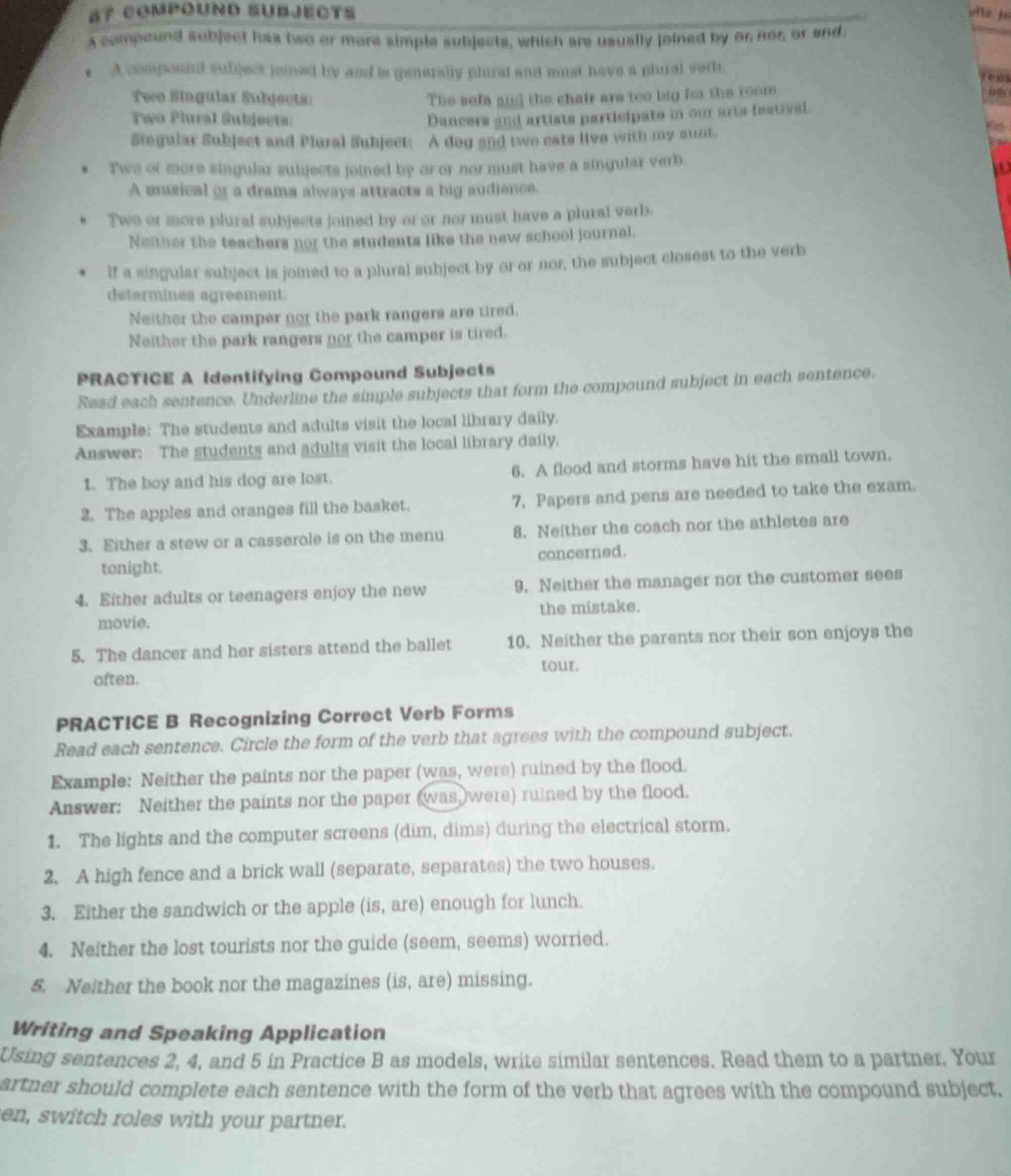
6f compound subjects
a compound subject has two or more simple subjects, which are usually joined by or, nor, or and.
- a compound subject joined by and is generally plural and must have a plural verb.
two singular subjects: the sofa and the chair are too big for the room.
two plural subjects: dancers and artists participate in our arts festival.
singular subject and plural subject: a dog and two cats live with my aunt.
- two or more singular subjects joined by or or nor must have a singular verb.
a musical or a drama always attracts a big audience.
- two or more plural subjects joined by or or nor must have a plural verb.
neither the teachers nor the students like the new school journal.
- if a singular subject is joined to a plural subject by or or nor, the subject closest to the verb determines agreement.
neither the camper nor the park rangers are tired.
neither the park rangers nor the camper is tired.
practice a identifying compound subjects
read each sentence. underline the simple subjects that form the compound subject in each sentence.
example: the students and adults visit the local library daily.
answer: the students and adults visit the local library daily.
- the boy and his dog are lost.
- the apples and oranges fill the basket.
- either a stew or a casserole is on the menu tonight.
- either adults or teenagers enjoy the new movie.
- the dancer and her sisters attend the ballet often.
- a flood and storms have hit the small town.
- papers and pens are needed to take the exam.
- neither the coach nor the athletes are concerned.
- neither the manager nor the customer sees the mistake.
- neither the parents nor their son enjoys the tour.
practice b recognizing correct verb forms
read each sentence. circle the form of the verb that agrees with the compound subject.
example: neither the paints nor the paper (was, were) ruined by the flood.
answer: neither the paints nor the paper (was, were) ruined by the flood.
- the lights and the computer screens (dim, dims) during the electrical storm.
- a high fence and a brick wall (separate, separates) the two houses.
- either the sandwich or the apple (is, are) enough for lunch.
- neither the lost tourists nor the guide (seem, seems) worried.
- neither the book nor the magazines (is, are) missing.
writing and speaking application
using sentences 2, 4, and 5 in practice b as models, write similar sentences. read them to a partner. your partner should complete each sentence with the form of the verb that agrees with the compound subject. then, switch roles with your partner.
PRACTICE A: Identifying Compound Subjects
Each answer underlines the simple subjects that form the compound subject in the sentence, following the rule that compound subjects are made of two or more simple subjects joined by and, or, nor.
Each answer circles the verb that agrees with the compound subject, following rules:
- Subjects joined by and take plural verbs.
- Subjects joined by or/nor take a verb matching the subject closest to the verb.
Created sentences follow the structure of Practice B sentences 2, 4, 5, using compound subjects joined by and or nor/or, with blank verbs for partner completion.

Snap & solve any problem in the app
Get step-by-step solutions on Sovi AI
Photo-based solutions with guided steps
Explore more problems and detailed explanations
- The <u>boy</u> and his <u>dog</u> are lost.
- The <u>apples</u> and <u>oranges</u> fill the basket.
- Either a <u>stew</u> or a <u>casserole</u> is on the menu tonight.
- Either <u>adults</u> or <u>teenagers</u> enjoy the new movie.
- The <u>dancer</u> and her <u>sisters</u> attend the ballet often.
- A <u>flood</u> and <u>storms</u> have hit the small town.
- <u>Papers</u> and <u>pens</u> are needed to take the exam.
- Neither the <u>coach</u> nor the <u>athletes</u> are concerned.
- Neither the <u>manager</u> nor the <u>customer</u> sees the mistake.
- Neither the <u>parents</u> nor their <u>son</u> enjoys the tour.
---