QUESTION IMAGE
Question
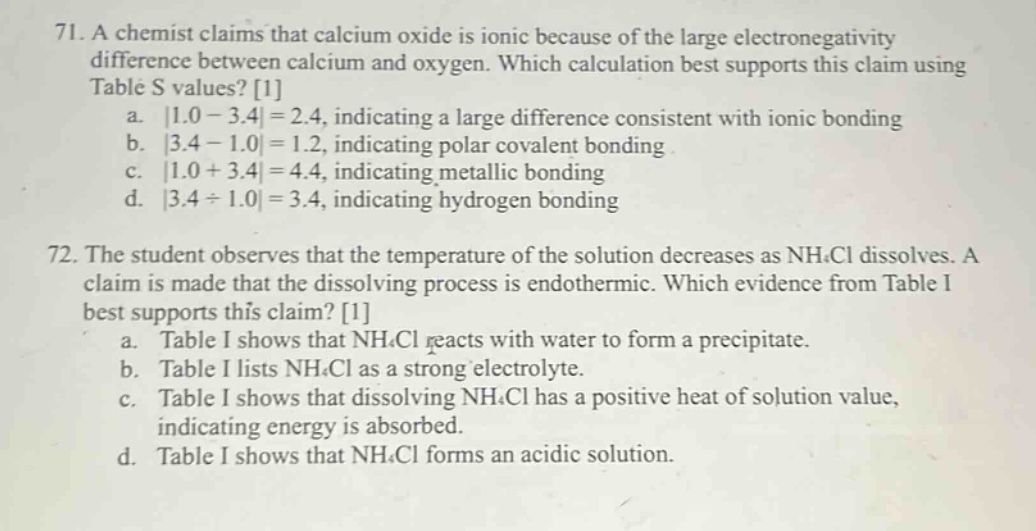
- a chemist claims that calcium oxide is ionic because of the large electronegativity difference between calcium and oxygen. which calculation best supports this claim using table s values? 1
a. |1.0 − 3.4| = 2.4, indicating a large difference consistent with ionic bonding
b. |3.4 − 1.0| = 1.2, indicating polar covalent bonding
c. |1.0 + 3.4| = 4.4, indicating metallic bonding
d. |3.4 ÷ 1.0| = 3.4, indicating hydrogen bonding
- the student observes that the temperature of the solution decreases as nh₄cl dissolves. a claim is made that the dissolving process is endothermic. which evidence from table i best supports this claim? 1
a. table i shows that nh₄cl reacts with water to form a precipitate.
b. table i lists nh₄cl as a strong electrolyte.
c. table i shows that dissolving nh₄cl has a positive heat of solution value, indicating energy is absorbed.
d. table i shows that nh₄cl forms an acidic solution.
Question 71
Step 1: Recall electronegativity difference formula
The electronegativity difference (\(\Delta \chi\)) between two atoms is calculated as the absolute value of the difference of their electronegativities, i.e., \(\Delta \chi = |\chi_1 - \chi_2|\). For calcium (Ca) and oxygen (O), the electronegativity of Ca is around 1.0 and O is around 3.4 (from standard values).
Step 2: Analyze each option
- Option a: \(|1.0 - 3.4| = 2.4\). Ionic bonds typically have electronegativity differences greater than 1.7, so a difference of 2.4 is large and consistent with ionic bonding.
- Option b: \(|3.4 - 1.0| = 1.2\), but 1.2 is less than 1.7, indicating polar covalent, not ionic. Also, the calculation is same as a but misinterpreted.
- Option c: \(|1.0 + 3.4| = 4.4\) is incorrect formula (we need difference, not sum) and metallic bonding is not related to electronegativity sum.
- Option d: \(|3.4 \div 1.0| = 3.4\) is incorrect formula (division, not difference) and hydrogen bonding is not related to this.
To support the claim that dissolving \(NH_4Cl\) is endothermic, we need evidence related to energy absorption. An endothermic process has a positive heat of solution (energy is absorbed from surroundings, causing temperature decrease).
- Option a: Precipitate formation is not related to energy change of dissolution.
- Option b: Being a strong electrolyte relates to dissociation, not energy change.
- Option c: Positive heat of solution means energy is absorbed, which matches endothermic (temperature of solution decreases as it absorbs heat from solution).
- Option d: Acidic solution formation is about pH, not energy change.

Snap & solve any problem in the app
Get step-by-step solutions on Sovi AI
Photo-based solutions with guided steps
Explore more problems and detailed explanations
a. \(|1.0 - 3.4| = 2.4\), indicating a large difference consistent with ionic bonding