QUESTION IMAGE
Question
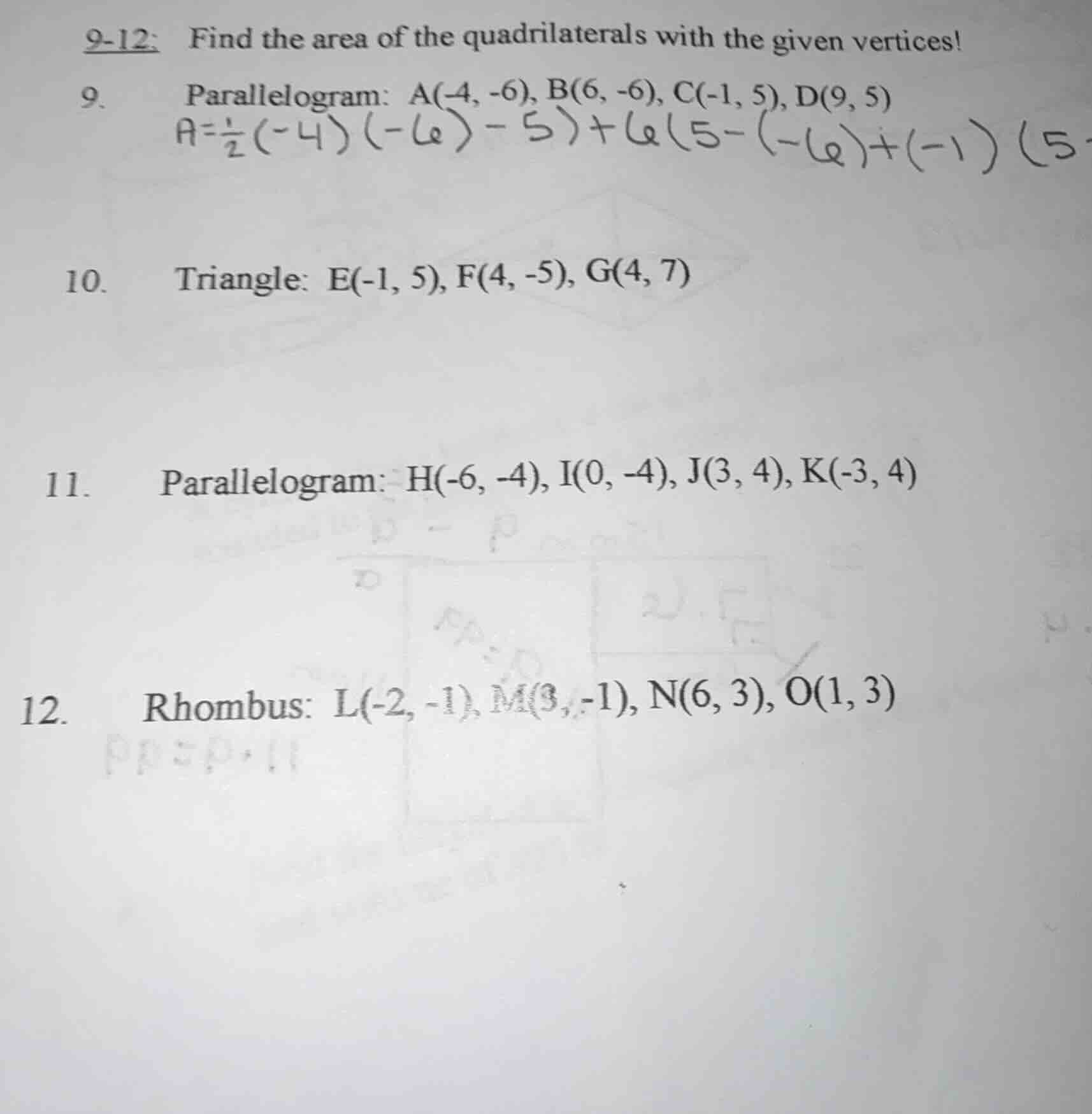
9-12: find the area of the quadrilaterals with the given vertices!
- parallelogram: a(-4, -6), b(6, -6), c(-1, 5), d(9, 5)
- triangle: e(-1, 5), f(4, -5), g(4, 7)
- parallelogram: h(-6, -4), i(0, -4), j(3, 4), k(-3, 4)
- rhombus: l(-2, -1), m(3, -1), n(6, 3), o(1, 3)
Problem 9: Parallelogram with vertices \( A(-4, -6) \), \( B(6, -6) \), \( C(-1, 5) \), \( D(9, 5) \)
Step 1: Identify base and height
For a parallelogram, area \( = \text{base} \times \text{height} \). The base can be the length of \( AB \). The \( y \)-coordinates of \( A \) and \( B \) are the same (\(-6\)), so \( AB \) is horizontal. Length of \( AB \): \( |6 - (-4)| = 10 \). The height is the vertical distance between the lines \( AB \) (where \( y = -6 \)) and \( CD \) (where \( y = 5 \)). So height \( = |5 - (-6)| = 11 \).
Step 2: Calculate area
Area \( = \text{base} \times \text{height} = 10 \times 11 = 110 \).
Step 1: Identify base and height
The \( x \)-coordinates of \( F \) and \( G \) are the same (\( 4 \)), so \( FG \) is vertical. Length of \( FG \): \( |7 - (-5)| = 12 \). The base is \( FG = 12 \). The height is the horizontal distance from \( E \) to the line \( FG \) (where \( x = 4 \)). So height \( = |4 - (-1)| = 5 \).
Step 2: Calculate area of triangle
Area of triangle \( = \frac{1}{2} \times \text{base} \times \text{height} = \frac{1}{2} \times 12 \times 5 = 30 \).
Step 1: Identify base and height
The \( y \)-coordinates of \( H \) and \( I \) are the same (\(-4\)), so \( HI \) is horizontal. Length of \( HI \): \( |0 - (-6)| = 6 \). The height is the vertical distance between \( y = -4 \) (line \( HI \)) and \( y = 4 \) (line \( JK \)). Height \( = |4 - (-4)| = 8 \).
Step 2: Calculate area
Area \( = \text{base} \times \text{height} = 6 \times 8 = 48 \).

Snap & solve any problem in the app
Get step-by-step solutions on Sovi AI
Photo-based solutions with guided steps
Explore more problems and detailed explanations
\( 110 \)