QUESTION IMAGE
Question
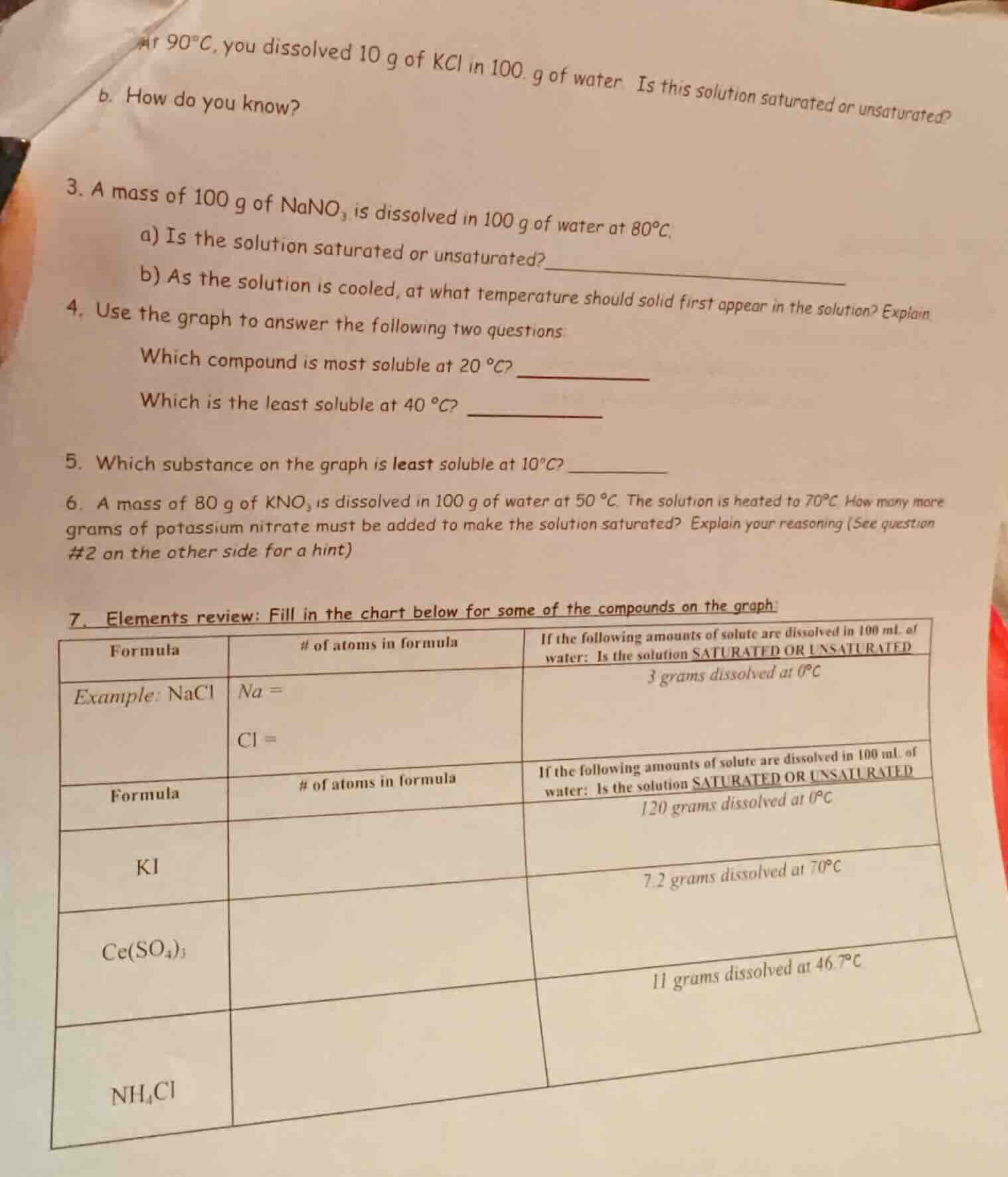
at 90°c, you dissolved 10 g of kcl in 100. g of water. is this solution saturated or unsaturated?
b. how do you know?
- a mass of 100 g of nano₃ is dissolved in 100 g of water at 80°c.
a) is the solution saturated or unsaturated?
b) as the solution is cooled, at what temperature should solid first appear in the solution? explain.
- use the graph to answer the following two questions:
which compound is most soluble at 20 °c?
which is the least soluble at 40 °c?
- which substance on the graph is least soluble at 10°c?
- a mass of 80 g of kno₃ is dissolved in 100 g of water at 50 °c. the solution is heated to 70°c. how many more grams of potassium nitrate must be added to make the solution saturated? explain your reasoning (see question #2 on the other side for a hint)
- elements review: fill in the chart below for some of the compounds on the graph:
| formula | # of atoms in formula | if the following amounts of solute are dissolved in 100 ml of water: is the solution saturated or unsaturated |
|---|---|---|
| formula | # of atoms in formula | if the following amounts of solute are dissolved in 100 ml of water: is the solution saturated or unsaturated |
| 120 grams dissolved at 0°c | ||
| ki | 7.2 grams dissolved at 70°c | |
| ce(so₄)₃ | 11 grams dissolved at 46.7°c | |
| nh₄cl |
To solve these problems, we typically refer to a solubility curve (a graph showing the solubility of various compounds in water at different temperatures). Since the specific solubility curve isn't provided here, I'll assume the standard solubility curves for these compounds (e.g., from a typical chemistry textbook or reference). Here's how to approach each problem:
Problem 2 (partially visible: 90°C, 10 g KCl in 100 g water)
a) Is the solution saturated/unsaturated?
The solubility of KCl at 90°C is approximately 54 g/100 g water (from standard solubility curves). Since 10 g < 54 g, the solution is unsaturated.
b) How do you know?
Compare the amount of solute dissolved (10 g) to the maximum solubility of KCl at 90°C (≈54 g/100 g water). If the dissolved amount is less than the solubility, the solution is unsaturated.
Problem 3: 100 g NaNO₃ in 100 g water at 80°C
a) Saturated/unsaturated?
The solubility of NaNO₃ at 80°C is approximately 150 g/100 g water (standard curve). Since 100 g < 150 g, the solution is unsaturated.
b) Temperature when solid first appears (cooling)
As the solution cools, solid appears when the solubility of NaNO₃ drops below 100 g/100 g water. From the solubility curve, NaNO₃ has a solubility of 100 g/100 g water at approximately 60°C. Thus, solid first appears at ≈60°C (when the solution becomes saturated upon cooling, and excess solute precipitates).
Problem 4: Using the graph
Which compound is most soluble at 20°C?
From standard solubility curves, NaNO₃ is typically the most soluble at 20°C (solubility ≈88 g/100 g water, higher than KCl, KNO₃, etc.).
Which is the least soluble at 40°C?
From standard curves, Ce(SO₄)₃ (or another low-solubility compound like KCl, but Ce(SO₄)₃ is often the least soluble at moderate temperatures) is typically the least soluble at 40°C.
Problem 5: Least soluble at 10°C
From standard curves, Ce(SO₄)₃ (or a similar low-solubility compound) is typically the least soluble at 10°C.
Problem 6: 80 g KNO₃ in 100 g water at 50°C, heated to 70°C
- Solubility of KNO₃ at 50°C: ≈85 g/100 g water (so 80 g is slightly unsaturated at 50°C).
- Solubility of KNO₃ at 70°C: ≈138 g/100 g water (from standard curves).
- To saturate the solution at 70°C, add: \( 138 \, \text{g} - 80 \, \text{g} = 58 \, \text{g} \) of KNO₃.
Problem 7: Elements Review (Chart)
Example: NaCl
- # of atoms: \( \text{Na} = 1 \), \( \text{Cl} = 1 \) (total 2 atoms).
- 3 g dissolved at 0°C: Solubility of NaCl at 0°C ≈35.7 g/100 mL water. Since 3 g < 35.7 g, the solution is unsaturated.
KI
- # of atoms: \( \text{K} = 1 \), \( \text{I} = 1 \) (total 2 atoms).
- 120 g dissolved at 0°C: Solubility of KI at 0°C ≈128 g/100 mL water. Since 120 g < 128 g, the solution is unsaturated.
- 7.2 g dissolved at 70°C: Solubility of KI at 70°C ≈140 g/100 mL water. Since 7.2 g < 140 g, the solution is unsaturated.
Ce(SO₄)₃
- # of atoms: \( \text{Ce} = 1 \), \( \text{S} = 3 \), \( \text{O} = 12 \) (total \( 1 + 3 + 12 = 16 \) atoms).
- 11 g dissolved at 46.7°C: Solubility of Ce(SO₄)₃ at ~47°C is very low (≈0.3 g/100 mL water). Since 11 g >> 0.3 g, the solution is supersaturated (or saturated if it’s the maximum, but Ce(SO₄)₃ is sparingly soluble).
NH₄Cl
- # of atoms: \( \text{N} = 1 \), \( \text{H} = 4 \), \( \text{Cl} = 1 \) (total \( 1 + 4 + 1 = 6 \) atoms).
Final Answers (Summarized)
- a) Unsaturated; b) 10 g < solubility at 90°C.
- a) Unsaturated; b) ≈60°C (when solubility = 100 g/100 g water).
- Most soluble…

Snap & solve any problem in the app
Get step-by-step solutions on Sovi AI
Photo-based solutions with guided steps
Explore more problems and detailed explanations
To solve these problems, we typically refer to a solubility curve (a graph showing the solubility of various compounds in water at different temperatures). Since the specific solubility curve isn't provided here, I'll assume the standard solubility curves for these compounds (e.g., from a typical chemistry textbook or reference). Here's how to approach each problem:
Problem 2 (partially visible: 90°C, 10 g KCl in 100 g water)
a) Is the solution saturated/unsaturated?
The solubility of KCl at 90°C is approximately 54 g/100 g water (from standard solubility curves). Since 10 g < 54 g, the solution is unsaturated.
b) How do you know?
Compare the amount of solute dissolved (10 g) to the maximum solubility of KCl at 90°C (≈54 g/100 g water). If the dissolved amount is less than the solubility, the solution is unsaturated.
Problem 3: 100 g NaNO₃ in 100 g water at 80°C
a) Saturated/unsaturated?
The solubility of NaNO₃ at 80°C is approximately 150 g/100 g water (standard curve). Since 100 g < 150 g, the solution is unsaturated.
b) Temperature when solid first appears (cooling)
As the solution cools, solid appears when the solubility of NaNO₃ drops below 100 g/100 g water. From the solubility curve, NaNO₃ has a solubility of 100 g/100 g water at approximately 60°C. Thus, solid first appears at ≈60°C (when the solution becomes saturated upon cooling, and excess solute precipitates).
Problem 4: Using the graph
Which compound is most soluble at 20°C?
From standard solubility curves, NaNO₃ is typically the most soluble at 20°C (solubility ≈88 g/100 g water, higher than KCl, KNO₃, etc.).
Which is the least soluble at 40°C?
From standard curves, Ce(SO₄)₃ (or another low-solubility compound like KCl, but Ce(SO₄)₃ is often the least soluble at moderate temperatures) is typically the least soluble at 40°C.
Problem 5: Least soluble at 10°C
From standard curves, Ce(SO₄)₃ (or a similar low-solubility compound) is typically the least soluble at 10°C.
Problem 6: 80 g KNO₃ in 100 g water at 50°C, heated to 70°C
- Solubility of KNO₃ at 50°C: ≈85 g/100 g water (so 80 g is slightly unsaturated at 50°C).
- Solubility of KNO₃ at 70°C: ≈138 g/100 g water (from standard curves).
- To saturate the solution at 70°C, add: \( 138 \, \text{g} - 80 \, \text{g} = 58 \, \text{g} \) of KNO₃.
Problem 7: Elements Review (Chart)
Example: NaCl
- # of atoms: \( \text{Na} = 1 \), \( \text{Cl} = 1 \) (total 2 atoms).
- 3 g dissolved at 0°C: Solubility of NaCl at 0°C ≈35.7 g/100 mL water. Since 3 g < 35.7 g, the solution is unsaturated.
KI
- # of atoms: \( \text{K} = 1 \), \( \text{I} = 1 \) (total 2 atoms).
- 120 g dissolved at 0°C: Solubility of KI at 0°C ≈128 g/100 mL water. Since 120 g < 128 g, the solution is unsaturated.
- 7.2 g dissolved at 70°C: Solubility of KI at 70°C ≈140 g/100 mL water. Since 7.2 g < 140 g, the solution is unsaturated.
Ce(SO₄)₃
- # of atoms: \( \text{Ce} = 1 \), \( \text{S} = 3 \), \( \text{O} = 12 \) (total \( 1 + 3 + 12 = 16 \) atoms).
- 11 g dissolved at 46.7°C: Solubility of Ce(SO₄)₃ at ~47°C is very low (≈0.3 g/100 mL water). Since 11 g >> 0.3 g, the solution is supersaturated (or saturated if it’s the maximum, but Ce(SO₄)₃ is sparingly soluble).
NH₄Cl
- # of atoms: \( \text{N} = 1 \), \( \text{H} = 4 \), \( \text{Cl} = 1 \) (total \( 1 + 4 + 1 = 6 \) atoms).
Final Answers (Summarized)
- a) Unsaturated; b) 10 g < solubility at 90°C.
- a) Unsaturated; b) ≈60°C (when solubility = 100 g/100 g water).
- Most soluble at 20°C: NaNO₃; Least soluble at 40°C: Ce(SO₄)₃ (or similar).
- Least soluble at 10°C: Ce(SO₄)₃ (or similar).
- Add 58 g KNO₃ (138 g - 80 g = 58 g).
- (Chart filled as above, with solubility comparisons.)
If you need more precise answers, provide the specific solubility curve or reference values.