QUESTION IMAGE
Question
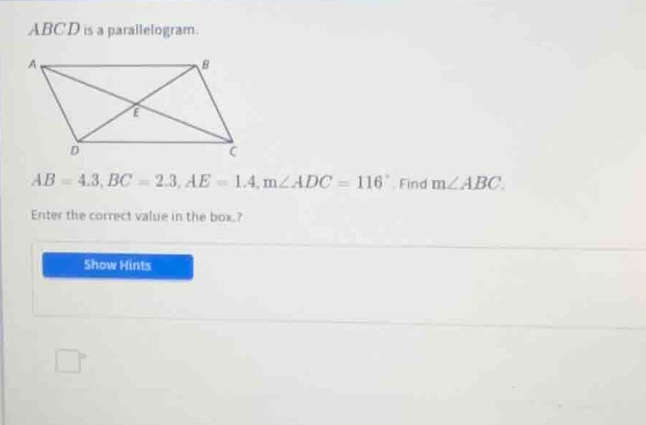
abcd is a parallelogram.
ab = 4.3, bc = 2.3, ae = 1.4, m∠adc = 116°, find m∠abc.
enter the correct value in the box.?
show hints
Step1: Recall properties of parallelogram
In a parallelogram, opposite angles are equal, and consecutive angles are supplementary. Also, opposite angles (like \(\angle ADC\) and \(\angle ABC\)) are equal? Wait, no, wait: Wait, in a parallelogram \(ABCD\), \(AB \parallel CD\) and \(AD \parallel BC\). So \(\angle ADC\) and \(\angle ABC\) are opposite angles? Wait, no, let's label the parallelogram: \(A\), \(B\), \(C\), \(D\) in order, so \(AB\) is adjacent to \(BC\), \(BC\) adjacent to \(CD\), \(CD\) adjacent to \(DA\), \(DA\) adjacent to \(AB\). So \(\angle ADC\) is at \(D\), between \(AD\) and \(DC\). \(\angle ABC\) is at \(B\), between \(AB\) and \(BC\). Since \(AD \parallel BC\) and \(AB \parallel DC\), the opposite angles: \(\angle A = \angle C\), \(\angle B = \angle D\)? Wait, no, wait: Let's think again. In parallelogram \(ABCD\), \(AB \parallel CD\) and \(AD \parallel BC\). So \(\angle ADC\) and \(\angle ABC\): Let's see, \(\angle ADC\) and \(\angle ABC\) are opposite angles? Wait, \(D\) and \(B\) are opposite vertices? Wait, \(A\) opposite \(C\), \(B\) opposite \(D\)? No, in a parallelogram, the vertices are in order, so \(A\) connected to \(B\) and \(D\), \(B\) connected to \(A\) and \(C\), \(C\) connected to \(B\) and \(D\), \(D\) connected to \(C\) and \(A\). So the angles: \(\angle A\) (at \(A\)) between \(AB\) and \(AD\), \(\angle B\) (at \(B\)) between \(AB\) and \(BC\), \(\angle C\) (at \(C\)) between \(BC\) and \(CD\), \(\angle D\) (at \(D\)) between \(CD\) and \(DA\). Now, since \(AB \parallel CD\) and \(AD\) is a transversal, \(\angle A + \angle D = 180^\circ\) (consecutive interior angles). Similarly, \(AD \parallel BC\) and \(AB\) is a transversal, so \(\angle A + \angle B = 180^\circ\). Therefore, \(\angle B = \angle D\) (since both are supplementary to \(\angle A\)). Wait, so \(\angle ABC = \angle ADC\)? Wait, no, wait: \(\angle D\) is \(\angle ADC\), \(\angle B\) is \(\angle ABC\). So if \(\angle B = \angle D\), then \(\angle ABC = \angle ADC\)? But wait, the problem says \(m\angle ADC = 116^\circ\), so \(m\angle ABC = 116^\circ\)? Wait, but that seems conflicting with consecutive angles. Wait, no, maybe I mixed up. Wait, let's take a standard parallelogram: in \(ABCD\), \(AB \parallel CD\) and \(AD \parallel BC\). So angle at \(A\) and angle at \(C\) are equal, angle at \(B\) and angle at \(D\) are equal. And consecutive angles (like \(A\) and \(B\)) are supplementary. So \(\angle A + \angle B = 180^\circ\), \(\angle B + \angle C = 180^\circ\), etc. So \(\angle ADC\) is angle at \(D\), which is equal to angle at \(B\) (angle \(ABC\))? Wait, angle at \(D\) is \(\angle ADC\), angle at \(B\) is \(\angle ABC\). So yes, in a parallelogram, opposite angles are equal. So \(\angle ABC = \angle ADC\). Wait, but that would mean \(m\angle ABC = 116^\circ\). But let's confirm. Let's check with a rectangle: in a rectangle, all angles are 90°, opposite angles equal. In a rhombus, opposite angles equal. So in a general parallelogram, opposite angles are equal. So if \(ABCD\) is a parallelogram, then \(\angle ABC \cong \angle ADC\), so their measures are equal. Therefore, \(m\angle ABC = m\angle ADC = 116^\circ\). Wait, but maybe I made a mistake. Wait, let's re-express:
In parallelogram \(ABCD\), \(AB \parallel CD\) and \(AD \parallel BC\). The angle at \(D\) ( \(\angle ADC\)) and angle at \(B\) ( \(\angle ABC\)): since \(AD \parallel BC\) and \(AB\) is a transversal, \(\angle DAB + \angle ABC = 180^\circ\). Also, \(AB \parallel CD\) and \(AD\) is a transversal, so \(\angle DAB + \angle ADC = 180^\circ\). Therefore, \(\an…

Snap & solve any problem in the app
Get step-by-step solutions on Sovi AI
Photo-based solutions with guided steps
Explore more problems and detailed explanations
\(116^\circ\)