QUESTION IMAGE
Question
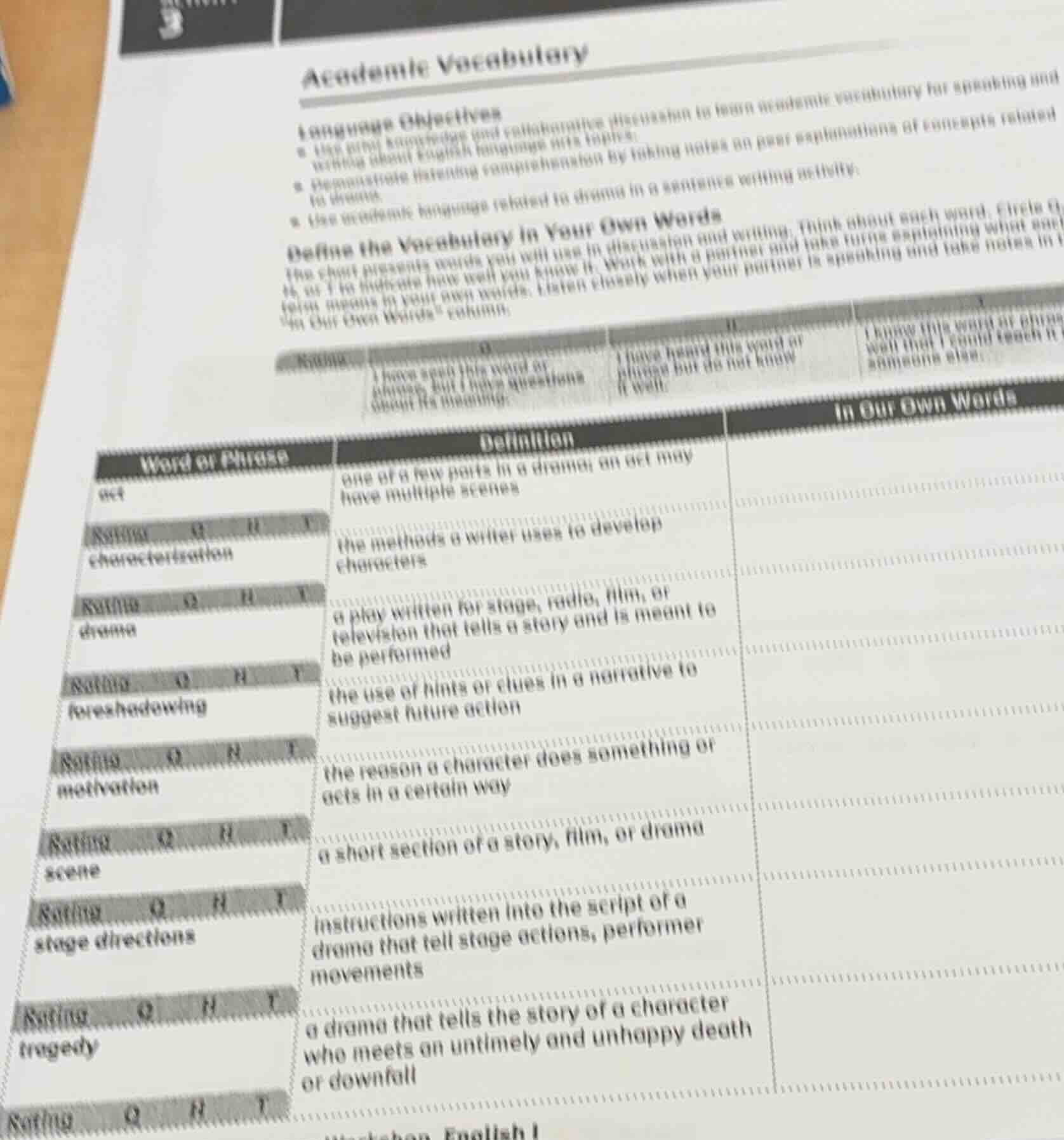
academic vocabularylanguage objectives- use prior knowledge and collaborative discussion to learn academic vocabulary for speaking and writing about english language arts topics.- demonstrate listening comprehension by taking notes on peer explanations of concepts related to drama.- use academic language related to drama in a sentence writing activity.define the vocabulary in your own wordsthe chart presents words you will use in discussion and writing. think about each word. circle q, h, or t to indicate how well you know it. work with a partner and take turns explaining what each term means in your own words. listen closely when your partner is speaking and take notes in the \in our own words\ column.| rating | q | h | t || ---- | ---- | ---- | ---- || | i have seen this word or phrase, but i have questions about its meaning. | i have heard this word or phrase but do not know it well. | i know this word or phrase well that i could teach it to someone else. || word or phrase | definition | in our own words || ---- | ---- | ---- || act | one of a few parts in a drama; an act may have multiple scenes | || characterization | the methods a writer uses to develop characters | || drama | a play written for stage, radio, film, or television that tells a story and is meant to be performed | || foreshadowing | the use of hints or clues in a narrative to suggest future action | || motivation | the reason a character does something or acts in a certain way | || scene | a short section of a story, film, or drama | || stage directions | instructions written into the script of a drama that tell stage actions, performer movements | || tragedy | a drama that tells the story of a character who meets an untimely and unhappy death or downfall | |
Below are the vocabulary terms rephrased in plain, own words, matching their given definitions:
- act: A large division of a play, which can be split into smaller scenes.
- characterization: The strategies an author uses to build and describe story characters.
- drama: A scripted story made to be acted out on stage, screen, or radio.
- foreshadowing: Small clues in a story that hint at what will happen later.
- motivation: The reason a character behaves or acts the way they do.
- scene: A short, self-contained part of a story, movie, or play.
- stage directions: Notes in a play script that tell actors and crew how to move or act on stage.
- tragedy: A play focused on a character who suffers an early, sad, or ruinous end.

Snap & solve any problem in the app
Get step-by-step solutions on Sovi AI
Photo-based solutions with guided steps
Explore more problems and detailed explanations
- act: A large section of a drama that can include smaller scenes
- characterization: The ways a writer builds and develops story characters
- drama: A performable scripted story for stage, screen, or radio
- foreshadowing: Story clues that hint at future events
- motivation: The reason behind a character's actions
- scene: A short, distinct part of a story, film, or play
- stage directions: Script instructions for stage actions and performer movements
- tragedy: A drama centered on a character's sad, untimely downfall or death