QUESTION IMAGE
Question
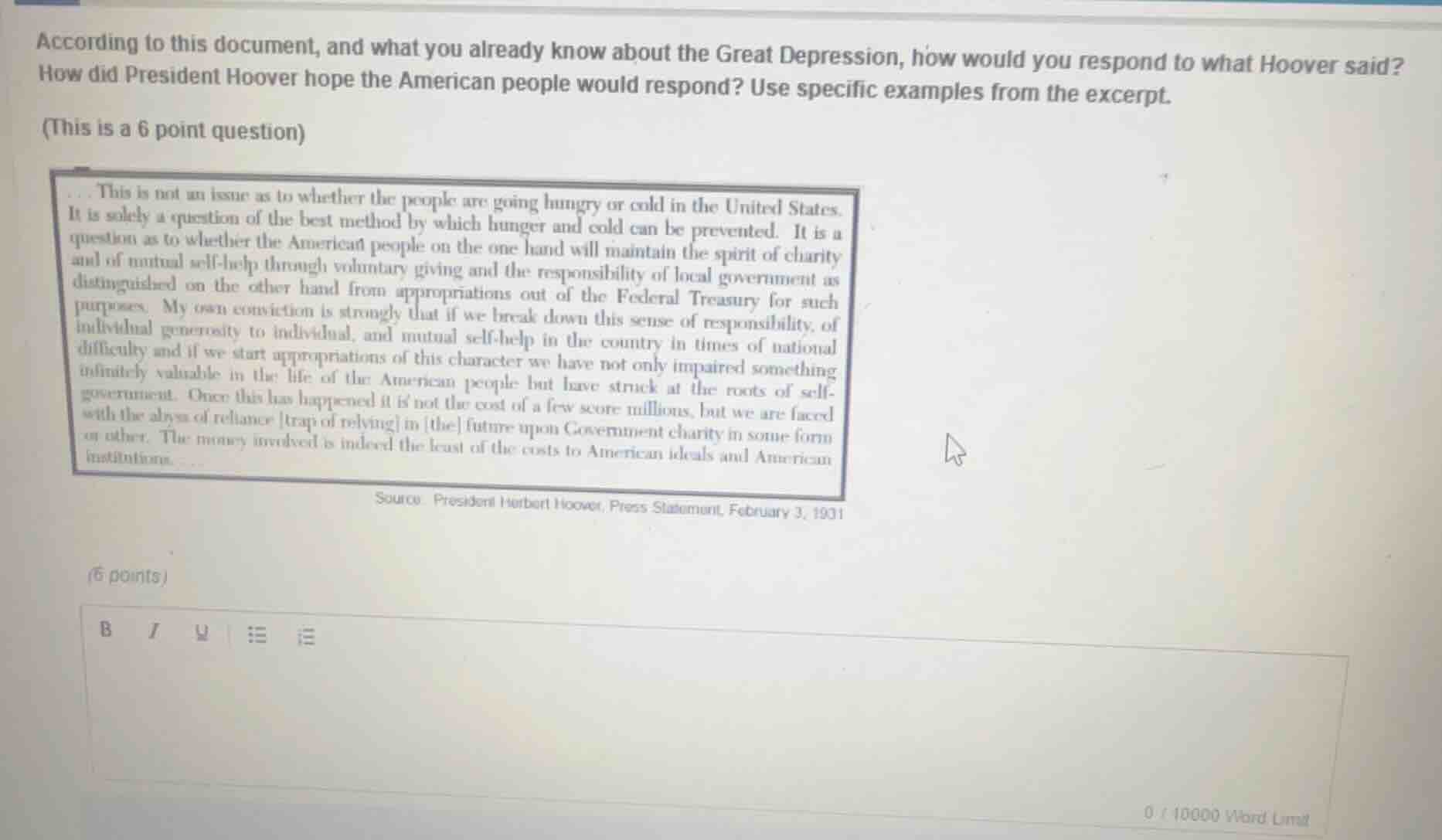
according to this document, and what you already know about the great depression, how would you respond to what hoover said? how did president hoover hope the american people would respond? use specific examples from the excerpt. (this is a 6 point question)... this is not an issue as to whether the people are going hungry or cold in the united states. it is solely a question of the best method by which hunger and cold can be prevented. it is a question as to whether the american people on the one hand will maintain the spirit of charity and of mutual self - help through voluntary giving and the responsibility of local government as distinguished on the other hand from appropriations out of the federal treasury for such purposes. my own conviction is strongly that if we break down this sense of responsibility, of individual generosity to individual, and mutual self - help in the country in times of national difficulty and if we start appropriations of this character we have not only impaired something infinitely valuable in the life of the american people but have struck at the roots of self - government. once this has happened it is not the cost of a few score millions, but we are faced with the abyss of reliance trap of relying in the future upon government charity in some form or other. the money involved is indeed the least of the costs to american ideals and american institutions.... source: president herbert hoover, press statement, february 3, 1931 (6 points)
- Hoover's desired response from Americans: He wanted citizens to rely on voluntary charity, mutual self-help, and local government support instead of federal aid. He emphasized maintaining individual generosity and local responsibility, arguing that federal appropriations would erode the spirit of self-reliance central to American ideals. Specific examples from the excerpt include his call to "maintain the spirit of charity and of mutual self-help through voluntary giving" and his framing of federal funds as a threat to "individual generosity" and "the roots of self-government."
- Counter-response (based on Great Depression context): A realistic response would note that Hoover's approach was insufficient for the scale of the Great Depression. The widespread poverty, mass unemployment, and collapse of local relief systems meant voluntary and local efforts could not meet the overwhelming need. Over time, this failure led to public demand for federal intervention, which was eventually implemented under Franklin D. Roosevelt's New Deal, as the crisis required large-scale, coordinated government support that local and private efforts could not provide.

Snap & solve any problem in the app
Get step-by-step solutions on Sovi AI
Photo-based solutions with guided steps
Explore more problems and detailed explanations
- President Hoover hoped Americans would respond by relying on voluntary charity, mutual self-help, and local government support rather than seeking federal financial aid. He stressed preserving individual generosity and local responsibility, warning that federal appropriations would destroy the core self-reliant character of American society and institutions.
- A critical response to Hoover's statement would highlight that his approach was inadequate for the unprecedented scale of the Great Depression. Voluntary and local relief efforts were overwhelmed by mass unemployment, widespread hunger, and systemic economic collapse. The crisis demonstrated that large-scale, coordinated federal intervention was necessary to support struggling Americans, a need that eventually led to the New Deal policies under President Roosevelt, as private and local resources could not address the national emergency.