QUESTION IMAGE
Question
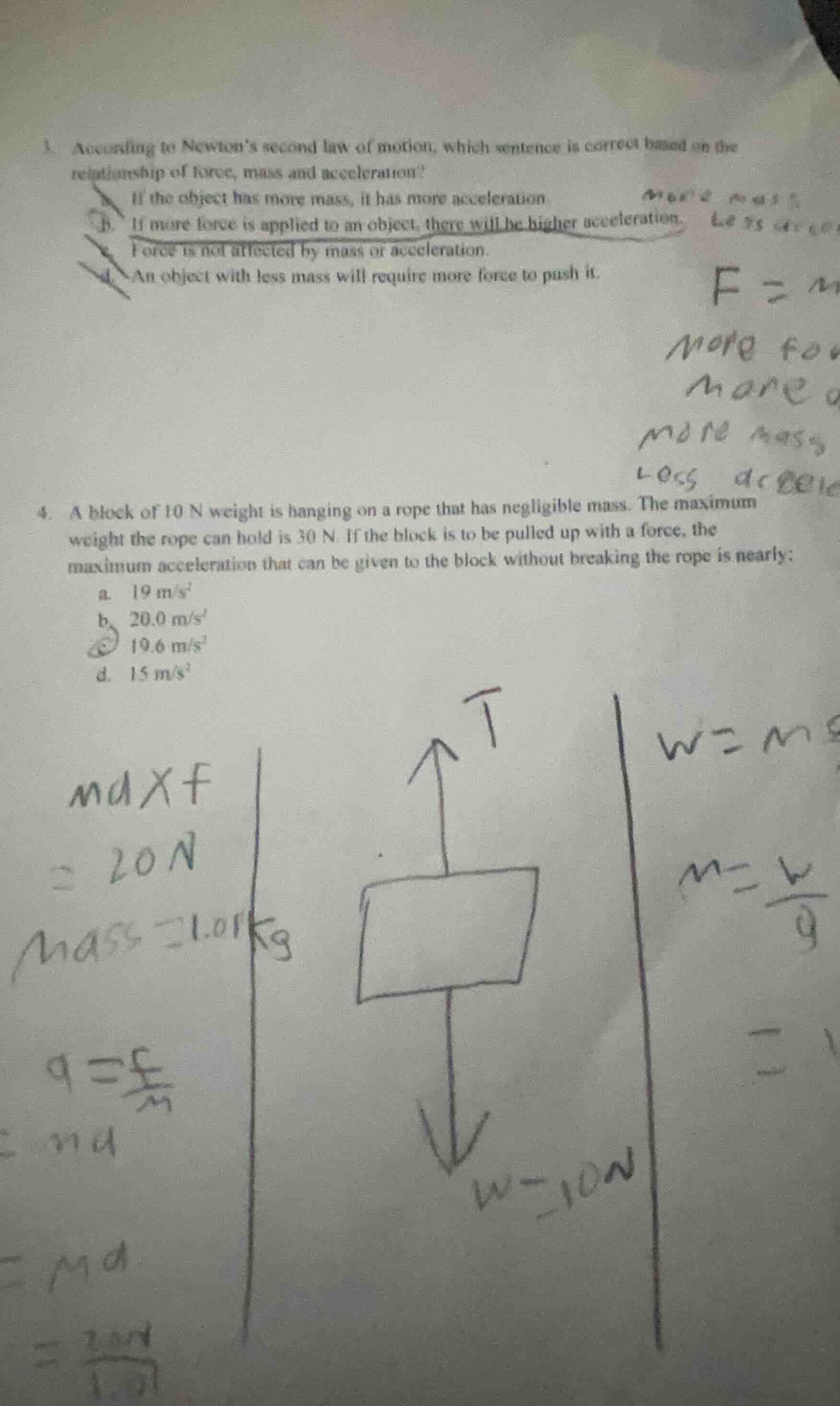
- according to newton’s second law of motion, which sentence is correct based on the relationship of force, mass and acceleration?
a. if the object has more mass, it has more acceleration
b. if more force is applied to an object, there will be higher acceleration.
c. force is not affected by mass or acceleration.
d. an object with less mass will require more force to push it.
- a block of 10 n weight is hanging on a rope that has negligible mass. the maximum weight the rope can hold is 30 n. if the block is to be pulled up with a force, the maximum acceleration that can be given to the block without breaking the rope is nearly:
a. 19 m/s²
b. 20.0 m/s²
c. 19.6 m/s²
d. 15 m/s²
Question 1
Newton's second law is \( F = ma \) (force equals mass times acceleration). For a fixed force, more mass means less acceleration (so A is wrong). If force \( F \) increases (with mass \( m \) constant), acceleration \( a \) increases (so B is correct). Force is related to mass and acceleration (so C is wrong). For a fixed acceleration, less mass requires less force (so D is wrong).
Step1: Find mass of the block
Weight \( W = mg \), so mass \( m=\frac{W}{g} \). Given \( W = 10\ N \), \( g = 9.8\ m/s^2 \), so \( m=\frac{10}{9.8}\approx1.02\ kg \).
Step2: Analyze forces on the block
The rope's tension \( T \) (maximum 30 N) and weight \( W \) (10 N) act on the block. Using Newton's second law: \( T - W = ma \).
Step3: Solve for acceleration \( a \)
Substitute \( T = 30\ N \), \( W = 10\ N \), \( m\approx1.02\ kg \) into \( a=\frac{T - W}{m} \). So \( a=\frac{30 - 10}{1.02}=\frac{20}{1.02}\approx19.6\ m/s^2 \).

Snap & solve any problem in the app
Get step-by-step solutions on Sovi AI
Photo-based solutions with guided steps
Explore more problems and detailed explanations
B. If more force is applied to an object, there will be higher acceleration.