QUESTION IMAGE
Question
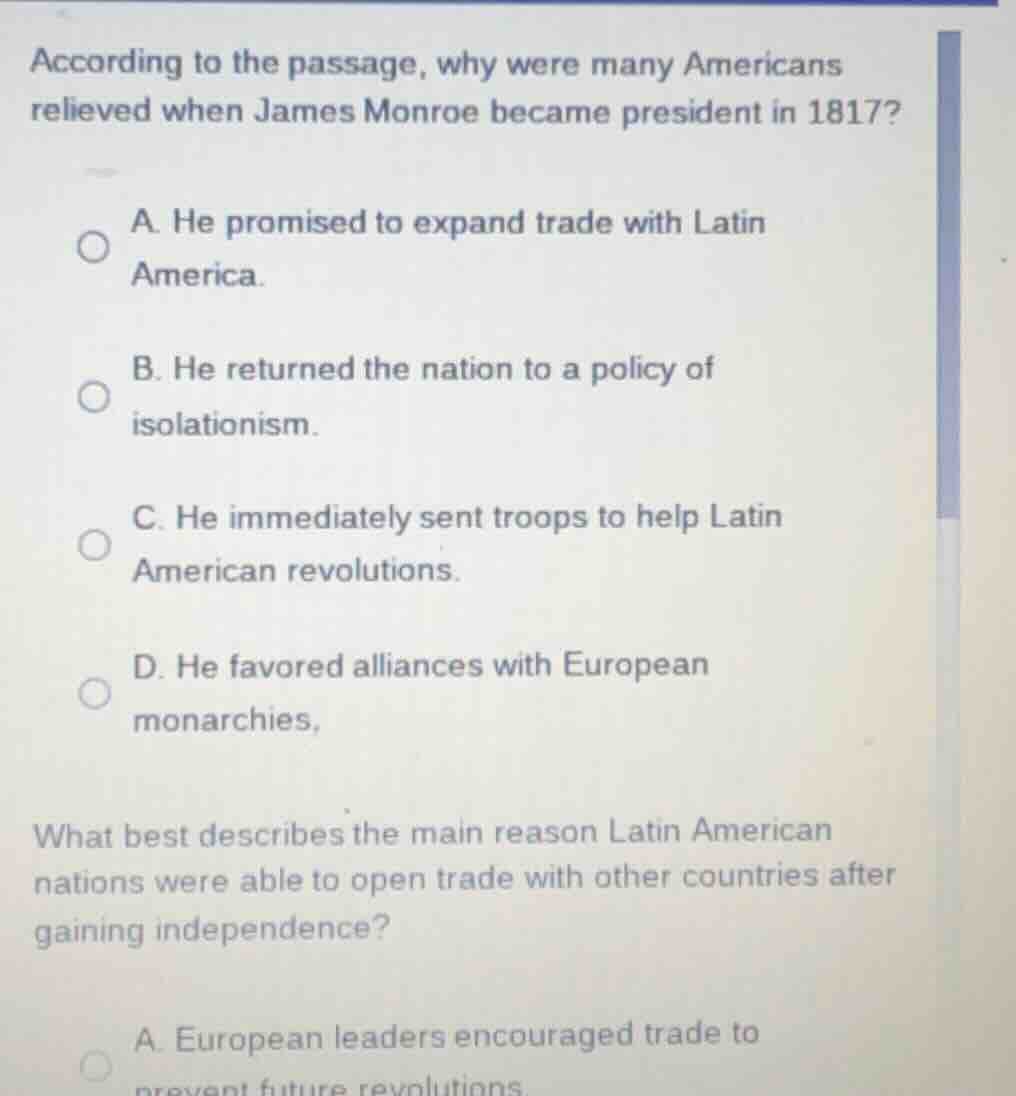
according to the passage, why were many americans relieved when james monroe became president in 1817?
a. he promised to expand trade with latin america.
b. he returned the nation to a policy of isolationism.
c. he immediately sent troops to help latin american revolutions.
d. he favored alliances with european monarchies.
what best describes the main reason latin american nations were able to open trade with other countries after gaining independence?
a. european leaders encouraged trade to prevent future revolutions.
Response
First Question (Why were many Americans relieved when James Monroe became president in 1817?):
Brief Explanations
- Option A: Monroe's focus with Latin America was more on the Monroe Doctrine (opposing European interference) rather than early trade expansion promises for relief.
- Option B: After the War of 1812 and previous foreign entanglements, returning to isolationism (staying out of European conflicts) would relieve Americans who wanted to focus on domestic affairs. Monroe's policies, including the Monroe Doctrine's non - interference stance in European affairs (and vice versa), aligned with isolationist tendencies.
- Option C: Monroe did not immediately send troops to help Latin American revolutions; the U.S. was more focused on its own position and non - European interference in the Americas.
- Option D: Monroe favored a policy of non - alliance with European monarchies, especially after seeing European interference in the Americas as a threat.
Brief Explanations
- Option A (visible part: "European leaders encouraged trade to prevent future revolutions"): European leaders were generally opposed to the Latin American revolutions (as they were against colonial uprisings and the spread of republicanism). They were more likely to try to re - establish control or at least not encourage trade to prevent revolutions. In general, after Latin American nations gained independence, their new status as independent states (able to enter into trade agreements) and the support from the U.S. (via the Monroe Doctrine which opposed European re - colonization) allowed them to open trade. But based on the given option A's description, it is incorrect as European leaders did not encourage trade to prevent revolutions. (If there were other options like "Their independence allowed them to negotiate trade agreements as sovereign states" or "The Monroe Doctrine protected them from European interference in trade negotiations", those would be more likely. But with the current cut - off, we can only assess the given option A as incorrect based on the visible text and historical context.)

Snap & solve any problem in the app
Get step-by-step solutions on Sovi AI
Photo-based solutions with guided steps
Explore more problems and detailed explanations
B. He returned the nation to a policy of isolationism.