QUESTION IMAGE
Question
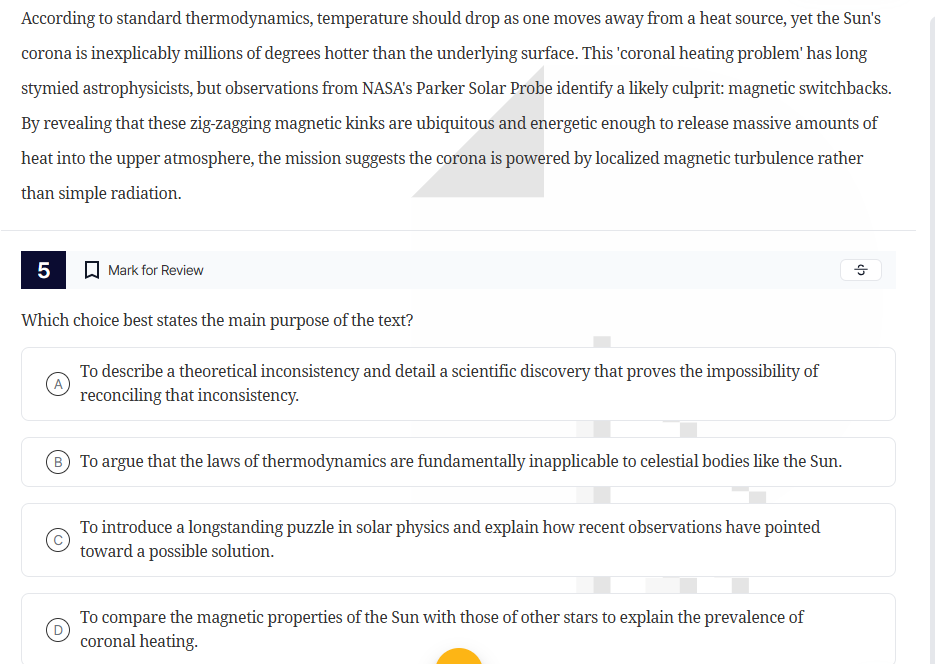
according to standard thermodynamics, temperature should drop as one moves away from a heat source, yet the suns corona is inexplicably millions of degrees hotter than the underlying surface. this coronal heating problem has long stymied astrophysicists, but observations from nasas parker solar probe identify a likely culprit: magnetic switchbacks. by revealing that these zig - zagging magnetic kinks are ubiquitous and energetic enough to release massive amounts of heat into the upper atmosphere, the mission suggests the corona is powered by localized magnetic turbulence rather than simple radiation.
5
mark for review
which choice best states the main purpose of the text?
a to describe a theoretical inconsistency and detail a scientific discovery that proves the impossibility of reconciling that inconsistency.
b to argue that the laws of thermodynamics are fundamentally inapplicable to celestial bodies like the sun.
c to introduce a long - standing puzzle in solar physics and explain how recent observations have pointed toward a possible solution.
d to compare the magnetic properties of the sun with those of other stars to explain the prevalence of coronal heating.
- Option A: The text doesn't prove the inconsistency is impossible to reconcile; it shows a possible solution, so A is wrong.
- Option B: The text doesn't argue thermodynamics is inapplicable to the Sun; it addresses a specific coronal heating problem, so B is wrong.
- Option C: The text first introduces the coronal heating problem (a long - standing puzzle in solar physics) and then explains how NASA's Parker Solar Probe observations (recent observations) point to a possible solution (magnetic switchbacks as the culprit), so C matches the main purpose.
- Option D: The text doesn't compare the Sun's magnetic properties with other stars; it focuses on the Sun's coronal heating and its possible solution, so D is wrong.

Snap & solve any problem in the app
Get step-by-step solutions on Sovi AI
Photo-based solutions with guided steps
Explore more problems and detailed explanations
C. To introduce a longstanding puzzle in solar physics and explain how recent observations have pointed toward a possible solution.