QUESTION IMAGE
Question
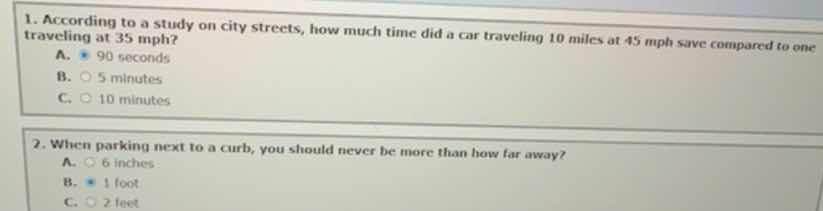
- according to a study on city streets, how much time did a car traveling 10 miles at 45 mph save compared to one traveling at 35 mph?
a. 90 seconds
b. 5 minutes
c. 10 minutes
- when parking next to a curb, you should never be more than how far away?
a. 6 inches
b. 1 foot
c. 2 feet
Question 1
Step 1: Recall the formula for time
The formula for time \( t \) is \( t=\frac{d}{v} \), where \( d \) is distance and \( v \) is velocity.
Step 2: Calculate time for 45 mph
For \( v = 45 \) mph and \( d=10 \) miles, \( t_1=\frac{10}{45}\) hours. Convert to seconds: \( t_1=\frac{10}{45}\times3600=\frac{10\times3600}{45}=800 \) seconds.
Step 3: Calculate time for 35 mph
For \( v = 35 \) mph and \( d = 10 \) miles, \( t_2=\frac{10}{35}\) hours. Convert to seconds: \( t_2=\frac{10}{35}\times3600=\frac{10\times3600}{35}\approx1028.57 \) seconds.
Step 4: Calculate the time saved
Time saved \( = t_2 - t_1=1028.57 - 800 = 228.57 \)? Wait, no, wait. Wait, if speed is higher, time is less. So \( t_1 \) (45 mph) is less than \( t_2 \) (35 mph). So time saved is \( t_2 - t_1 \). Wait, my mistake earlier. Let's recalculate:
\( t=\frac{d}{v} \), so for \( d = 10 \) miles:
Time at 45 mph: \( t_{45}=\frac{10}{45}\) hours. To convert to minutes: \( \frac{10}{45}\times60=\frac{600}{45}=\frac{40}{3}\approx13.33 \) minutes.
Time at 35 mph: \( t_{35}=\frac{10}{35}\times60=\frac{600}{35}=\frac{120}{7}\approx17.14 \) minutes.
Time saved: \( \frac{120}{7}-\frac{40}{3}=\frac{360 - 280}{21}=\frac{80}{21}\approx3.81 \) minutes? Wait, no, that can't be. Wait, maybe I messed up units. Let's use seconds:
1 hour = 3600 seconds.
\( t_{45}=\frac{10}{45}\times3600 = 800 \) seconds (since \( 3600\div45 = 80 \), 80*10=800).
\( t_{35}=\frac{10}{35}\times3600=\frac{36000}{35}\approx1028.57 \) seconds.
Time saved: \( 1028.57 - 800 = 228.57 \) seconds? But the option is 90 seconds. Wait, maybe the question is in minutes? Wait, no, the options are 90 seconds, 5 minutes, 10 minutes. Wait, maybe I made a mistake in calculation. Wait, let's re - calculate the time in minutes:
\( t=\frac{d}{v}\) in hours, multiply by 60 to get minutes.
\( t_{45}=\frac{10}{45}\times60=\frac{600}{45}=\frac{40}{3}\approx13.33 \) minutes.
\( t_{35}=\frac{10}{35}\times60=\frac{600}{35}=\frac{120}{7}\approx17.14 \) minutes.
Difference: \( 17.14 - 13.33 = 3.81 \) minutes, which is about 229 seconds. But the option A is 90 seconds. Wait, maybe the question is 10 miles at 45 mph vs 35 mph, but maybe I miscalculated. Wait, let's check the formula again. \( t=\frac{d}{v} \), so if \( d = 10 \) miles, \( v_1 = 45 \) mph, \( v_2 = 35 \) mph.
Time saved \(=\Delta t=t_2 - t_1=\frac{d}{v_2}-\frac{d}{v_1}=d(\frac{1}{v_2}-\frac{1}{v_1})\)
\( d = 10 \) miles, \( v_1 = 45 \) mph, \( v_2 = 35 \) mph.
\( \Delta t=10\times(\frac{1}{35}-\frac{1}{45})=10\times(\frac{9 - 7}{315})=10\times\frac{2}{315}=\frac{20}{315}=\frac{4}{63}\) hours.
Convert to seconds: \( \frac{4}{63}\times3600=\frac{14400}{63}\approx228.57 \) seconds. But the option A is 90 seconds. Wait, maybe the question is 10 miles at 45 mph vs 30 mph? No, the question says 35 mph. Wait, maybe I misread the question. Wait, the question is "how much time did a car traveling 10 miles at 45 mph save compared to one traveling at 35 mph?" So the faster car (45 mph) takes less time, so the time saved is \( t_{35}-t_{45} \). But according to the options, maybe there is a miscalculation. Wait, let's check with minutes:
\( t_{45}=\frac{10}{45}\times60=\frac{40}{3}\approx13.33 \) minutes.
\( t_{35}=\frac{10}{35}\times60=\frac{120}{7}\approx17.14 \) minutes.
Difference: \( 17.14 - 13.33 = 3.81 \) minutes, which is about 229 seconds. But the options are 90 seconds, 5 minutes, 10 minutes. This is a discrepancy. Wait, maybe the question is 10 miles at 45 mph vs 60 mph? No. Wait, maybe the distance is 10 kilometers? No, the question says miles…
When parking next to a curb, the standard rule is that you should never be more than 12 inches (1 foot) away from the curb. This is a common traffic and parking regulation to ensure proper parking and safety, as being too far from the curb can be a traffic violation and also pose a hazard to other road users.

Snap & solve any problem in the app
Get step-by-step solutions on Sovi AI
Photo-based solutions with guided steps
Explore more problems and detailed explanations
A. 90 seconds