QUESTION IMAGE
Question
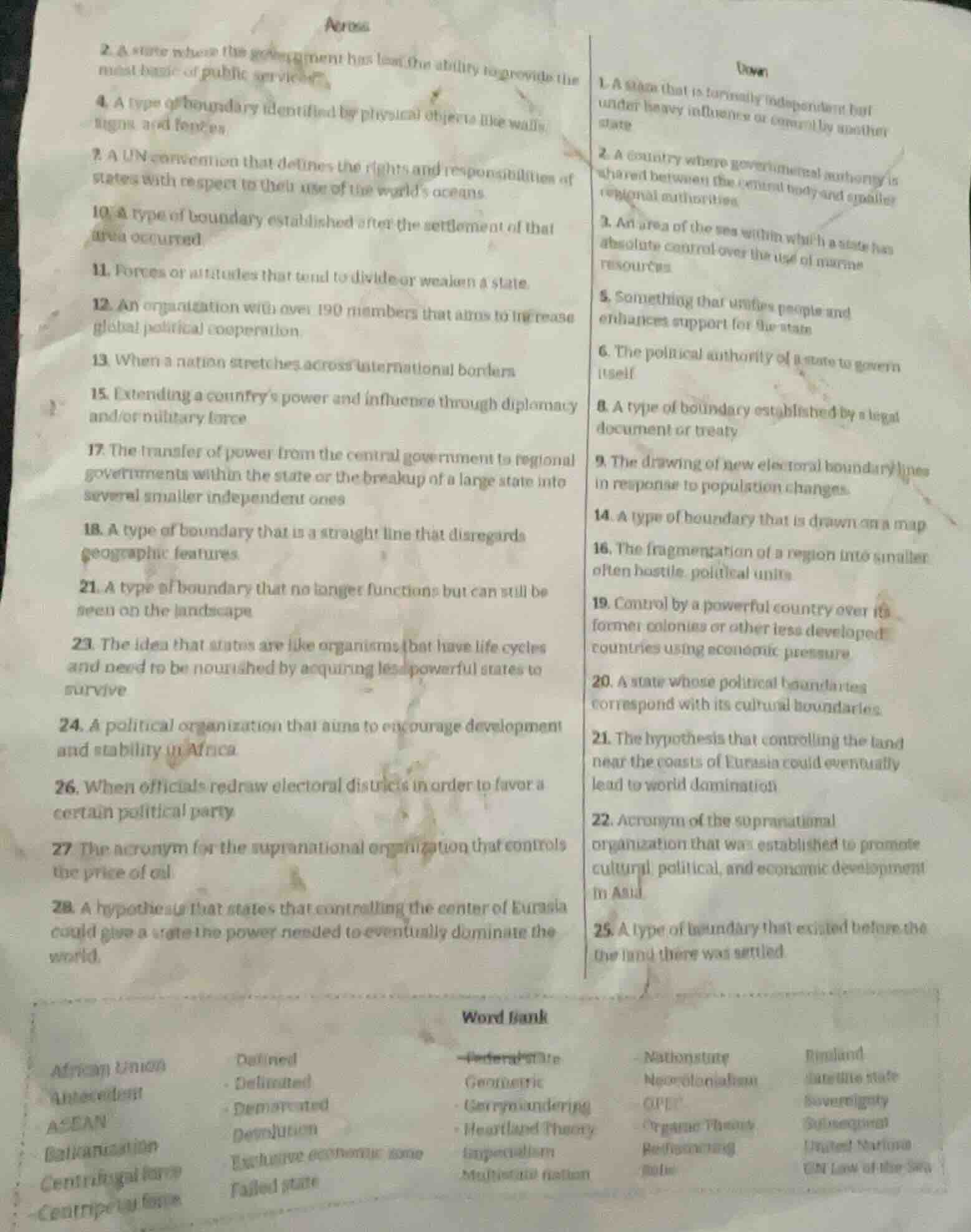
across
- a state where the government has lost the ability to provide the most basic of public services.
- a type of boundary identified by physical objects like walls, signs, and fences.
- a un convention that defines the rights and responsibilities of states with respect to their use of the world’s oceans.
- a type of boundary established after the settlement of that area occurred.
- forces or attitudes that tend to divide or weaken a state.
- an organization with over 190 members that aims to increase global political cooperation.
- when a nation stretches across international borders.
- extending a country’s power and influence through diplomacy and/or military force.
- the transfer of power from the central government to regional governments within the state or the breakup of a large state into several smaller independent ones.
- a type of boundary that is a straight line that disregards geographic features.
- a type of boundary that no longer functions but can still be seen on the landscape.
- the idea that states are like organisms that have life cycles and need to be nourished by acquiring less powerful states to survive.
- a political organization that aims to encourage development and stability in africa.
- when officials redraw electoral districts in order to favor a certain political party.
- the acronym for the supranational organization that controls the price of oil.
- a hypothesis that states that controlling the center of eurasia could give a state the power needed to eventually dominate the world.
down
- a state that is formally independent but under heavy influence or control by another state.
- a country where governmental authority is shared between the central body and smaller regional authorities.
- an area of the sea within which a state has absolute control over the use of marine resources.
- something that unifies people and enhances support for the state.
- the political authority of a state to govern itself.
- a type of boundary established by a legal document or treaty.
- the drawing of new electoral boundary lines in response to population changes.
- a type of boundary that is drawn on a map.
- the fragmentation of a region into smaller, often hostile, political units.
- control by a powerful country over its former colonies or other less developed countries using economic pressure.
- a state whose political boundaries correspond with its cultural boundaries.
- the hypothesis that controlling the land near the courts of eurasia could eventually lead to world domination.
- acronym of the supranational organization that was established to promote cultural, political, and economic development in asia.
- a type of boundary that existed before the the land there was settled.
word bank
african union, outlined, federal state, nation-state, finland,
antecedent, delineated, geographic, gerrymandering, neocolonialism, satellite state,
asean, demarcated, devolution, heartland theory, opec, sovereignty,
balkanization, exclusive economic zone, imperialism, organic theory, subnational,
centrifugal force, failed state, multinational nation, redistricting, united nations,
centripetal force, un law of the seas
To solve this matching exercise, we analyze each term in the "Across" and "Down" sections and match them with the appropriate term from the word bank by understanding their definitions:
Across:
- A state where the government has lost the ability to provide the most basic of public services → Failed state (matches the definition of a failed state).
- A type of boundary identified by physical objects like walls, signs, and fences → Demarcated (physical markers demarcate boundaries).
- A UN convention that defines the rights and responsibilities of states with respect to their use of the world’s oceans → UN Law of the Seas (the UN Convention on the Law of the Sea regulates ocean use).
- A type of boundary established after the settlement of that area occurred → Delimited (boundaries delimited after settlement).
- Forces or attitudes that tend to divide or weaken a state → Centrifugal force (centrifugal forces divide a state).
- An organization with over 190 members that aims to increase global political cooperation → United Nations (the UN has 193 members and promotes global cooperation).
- When a nation stretches across international borders → Multinational nation (a nation spanning multiple states).
- Extending a country’s power and influence through diplomacy and/or military force → Imperialism (imperialism involves extending power over other regions).
- The transfer of power from the central government to regional governments within the state or the breakup of a large state into several smaller independent ones → Devolution (devolution is the transfer of power to regions or state breakup).
- A type of boundary that is a straight line that disregards geographic features → Geometric (geometric boundaries are straight lines ignoring geography).
- A type of boundary that no longer functions but can still be seen on the landscape → Relic (relic boundaries are no longer functional but visible).
- The idea that states are like organisms that have life cycles and need to be nourished by acquiring less powerful states to survive → Organic Theory (organic theory views states as living organisms needing expansion).
- A political organization that aims to encourage development and stability in Africa → African Union (the AU focuses on African development and stability).
- When officials redraw electoral districts in order to favor a certain political party → Gerrymandering (gerrymandering is manipulating electoral districts for political gain).
- The acronym for the supranational organization that controls the price of oil → OPEC (OPEC (Organization of the Petroleum Exporting Countries) controls oil prices).
- A hypothesis that states that controlling the center of Eurasia could give a state the power needed to eventually dominate the world → Heartland Theory (Heartland Theory argues control of Eurasia’s heartland leads to global dominance).
Down:
- A state that is formally independent but under heavy influence or control by another state → Satellite state (satellite states are independent in name but controlled by another).
- A country where governmental authority is shared between the central body and equal regional authorities → Federal state (federal states share power between central and regional governments).
- An area of the sea within which a state has absolute control over the use of marine resources → Exclusive economic zone (EEZs give states control over marine resources).
- Something that unifies people and enhances…

Snap & solve any problem in the app
Get step-by-step solutions on Sovi AI
Photo-based solutions with guided steps
Explore more problems and detailed explanations
To solve this matching exercise, we analyze each term in the "Across" and "Down" sections and match them with the appropriate term from the word bank by understanding their definitions:
Across:
- A state where the government has lost the ability to provide the most basic of public services → Failed state (matches the definition of a failed state).
- A type of boundary identified by physical objects like walls, signs, and fences → Demarcated (physical markers demarcate boundaries).
- A UN convention that defines the rights and responsibilities of states with respect to their use of the world’s oceans → UN Law of the Seas (the UN Convention on the Law of the Sea regulates ocean use).
- A type of boundary established after the settlement of that area occurred → Delimited (boundaries delimited after settlement).
- Forces or attitudes that tend to divide or weaken a state → Centrifugal force (centrifugal forces divide a state).
- An organization with over 190 members that aims to increase global political cooperation → United Nations (the UN has 193 members and promotes global cooperation).
- When a nation stretches across international borders → Multinational nation (a nation spanning multiple states).
- Extending a country’s power and influence through diplomacy and/or military force → Imperialism (imperialism involves extending power over other regions).
- The transfer of power from the central government to regional governments within the state or the breakup of a large state into several smaller independent ones → Devolution (devolution is the transfer of power to regions or state breakup).
- A type of boundary that is a straight line that disregards geographic features → Geometric (geometric boundaries are straight lines ignoring geography).
- A type of boundary that no longer functions but can still be seen on the landscape → Relic (relic boundaries are no longer functional but visible).
- The idea that states are like organisms that have life cycles and need to be nourished by acquiring less powerful states to survive → Organic Theory (organic theory views states as living organisms needing expansion).
- A political organization that aims to encourage development and stability in Africa → African Union (the AU focuses on African development and stability).
- When officials redraw electoral districts in order to favor a certain political party → Gerrymandering (gerrymandering is manipulating electoral districts for political gain).
- The acronym for the supranational organization that controls the price of oil → OPEC (OPEC (Organization of the Petroleum Exporting Countries) controls oil prices).
- A hypothesis that states that controlling the center of Eurasia could give a state the power needed to eventually dominate the world → Heartland Theory (Heartland Theory argues control of Eurasia’s heartland leads to global dominance).
Down:
- A state that is formally independent but under heavy influence or control by another state → Satellite state (satellite states are independent in name but controlled by another).
- A country where governmental authority is shared between the central body and equal regional authorities → Federal state (federal states share power between central and regional governments).
- An area of the sea within which a state has absolute control over the use of marine resources → Exclusive economic zone (EEZs give states control over marine resources).
- Something that unifies people and enhances support for the state → Centripetal force (centripetal forces unify a state).
- The political authority of a state to govern itself → Sovereignty (sovereignty is a state’s right to self - govern).
- A type of boundary established by a legal document or treaty → Delimited (boundaries delimited by legal documents).
- The drawing of new electoral boundary lines in response to population changes → Redistricting (redistricting is redrawing electoral boundaries due to population shifts).
- A type of boundary that is drawn on a map → Demarcated (boundaries demarcated on maps).
- The fragmentation of a region into smaller, often hostile, political units → Balkanization (Balkanization is the fragmentation of a region into hostile units).
- Control by a powerful country over its former colonies or other less developed countries using economic pressure → Neocolonialism (neocolonialism uses economic means to control former colonies).
- A state whose political boundaries correspond with its cultural boundaries → Nation - state (a nation - state has political and cultural boundaries aligned).
- The hypothesis that controlling the land near the courts of Eurasia could eventually lead to world domination → Rimland Theory (Rimland Theory focuses on controlling Eurasia’s rim for global dominance).
- Acronym of the supranational organization that was established to promote cultural, political, and economic development in Asia → ASEAN (ASEAN (Association of Southeast Asian Nations) promotes Asian development).
- A type of boundary that existed before the land there was settled → Antecedent (antecedent boundaries existed before settlement).
Final Matches (Selected Examples for Clarity):
- Across 2: Failed state
- Across 4: Demarcated
- Across 12: United Nations
- Down 1: Satellite state
- Down 2: Federal state
- Down 12: ASEAN
(Note: For a complete answer, all terms would be matched, but the above examples illustrate the process. The full matching requires pairing each "Across" and "Down" clue with the correct word - bank term based on their definitions.)