QUESTION IMAGE
Question
activity 15-1: chapter review
complete the following after carefully studying the corresponding textbook chapter.
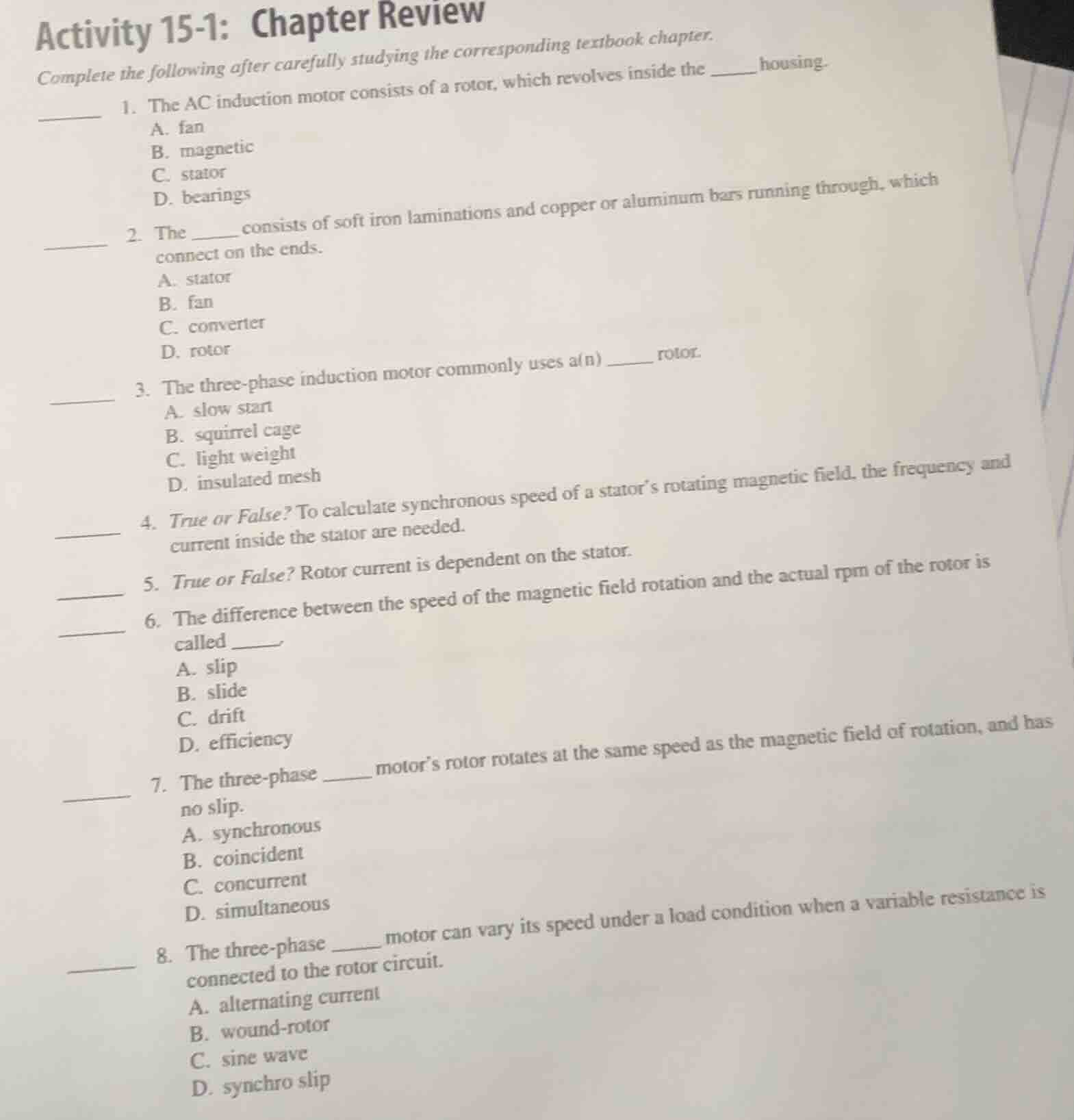
- the ac induction motor consists of a rotor, which revolves inside the ______ housing.
a. fan
b. magnetic
c. stator
d. bearings
- the ______ consists of soft iron laminations and copper or aluminum bars running through, which connect on the ends.
a. stator
b. fan
c. converter
d. rotor
- the three-phase induction motor commonly uses a(n) ______ rotor.
a. slow start
b. squirrel cage
c. light weight
d. insulated mesh
- true or false? to calculate synchronous speed of a stators rotating magnetic field, the frequency and current inside the stator are needed.
- true or false? rotor current is dependent on the stator.
- the difference between the speed of the magnetic field rotation and the actual rpm of the rotor is called ______.
a. slip
b. slide
c. drift
d. efficiency
- the three-phase ______ motors rotor rotates at the same speed as the magnetic field of rotation, and has no slip.
a. synchronous
b. coincident
c. concurrent
d. simultaneous
- the three-phase ______ motor can vary its speed under a load condition when a variable resistance is connected to the rotor circuit.
a. alternating current
b. wound-rotor
c. sine wave
d. synchro slip
Brief Explanations
- AC induction motors have a rotating rotor inside the stationary stator housing.
- The rotor uses soft iron laminations with conductive bars.
- Squirrel cage rotors are the standard for 3-phase induction motors.
- Synchronous speed formula only needs frequency and number of poles, not stator current.
- Rotor current is induced by the stator's magnetic field, so it depends on the stator.
- Slip is defined as the difference between magnetic field and rotor speed.
- Synchronous motors have rotors matching the magnetic field speed, no slip.
- Wound-rotor motors use rotor circuit resistance to adjust speed under load.

Snap & solve any problem in the app
Get step-by-step solutions on Sovi AI
Photo-based solutions with guided steps
Explore more problems and detailed explanations
- C. stator
- D. rotor
- B. squirrel cage
- False
- True
- A. slip
- A. synchronous
- B. wound-rotor