QUESTION IMAGE
Question
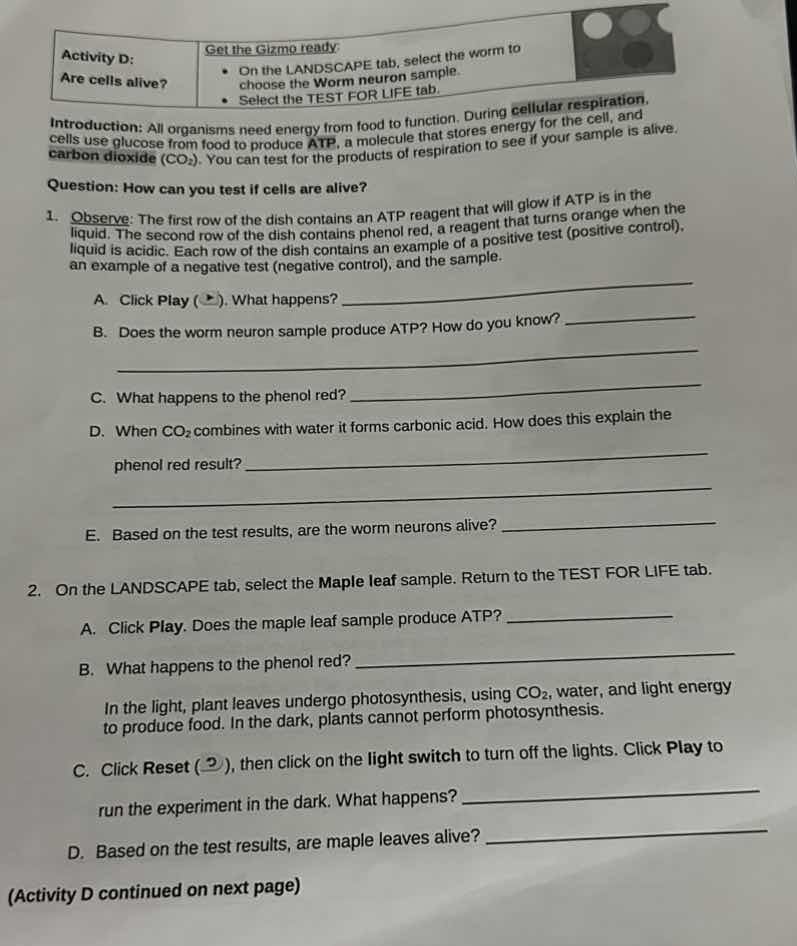
activity d: are cells alive? get the gizmo ready: - on the landscape tab, select the worm to choose the worm neuron sample. - select the test for life tab. introduction: all organisms need energy from food to function. during cellular respiration, cells use glucose from food to produce atp, a molecule that stores energy for the cell, and carbon dioxide (co₂). you can test for the products of respiration to see if your sample is alive. question: how can you test if cells are alive? 1. observe: the first row of the dish contains an atp reagent that will glow if atp is in the liquid. the second row of the dish contains phenol red, a reagent that turns orange when the liquid is acidic. each row of the dish contains an example of a positive test (positive control), an example of a negative test (negative control), and the sample. a. click play (▶). what happens? __________________ b. does the worm neuron sample produce atp? how do you know? ________________ c. what happens to the phenol red? ________________ d. when co₂ combines with water it forms carbonic acid. how does this explain the phenol red result? ________________ e. based on the test results, are the worm neurons alive? ________________ 2. on the landscape tab, select the maple leaf sample. return to the test for life tab. a. click play. does the maple leaf sample produce atp? ________________ b. what happens to the phenol red? ________________ in the light, plant leaves undergo photosynthesis, using co₂, water, and light energy to produce food. in the dark, plants cannot perform photosynthesis. c. click reset (⟳), then click on the light switch to turn off the lights. click play to run the experiment in the dark. what happens? ________________ d. based on the test results, are maple leaves alive? __________________ (activity d continued on next page)
These answers are based on the biological principles of cellular respiration (a marker of living cells, producing ATP and CO₂) and photosynthesis in plants. ATP reagent glows in the presence of ATP, and phenol red turns orange in acidic conditions (caused by carbonic acid from CO₂ + water).

Snap & solve any problem in the app
Get step-by-step solutions on Sovi AI
Photo-based solutions with guided steps
Explore more problems and detailed explanations
1.
A. The ATP reagent in the sample row glows, and the phenol red in the sample row turns orange; the positive control shows the same changes, while the negative control shows no change.
B. Yes. The ATP reagent in the worm neuron sample row glows, which indicates ATP is present.
C. It turns orange.
D. CO₂ from cellular respiration mixes with water in the phenol red solution to form carbonic acid, which makes the solution acidic, causing phenol red to turn orange.
E. Yes.
2.
A. Yes, the ATP reagent glows, indicating ATP production.
B. It stays red (or shows no color change) in the light, because the plant uses CO₂ for photosynthesis, so little CO₂ builds up to form acid.
C. The ATP reagent still glows, and the phenol red turns orange, because the plant performs cellular respiration in the dark, producing CO₂ that forms carbonic acid.
D. Yes.