QUESTION IMAGE
Question
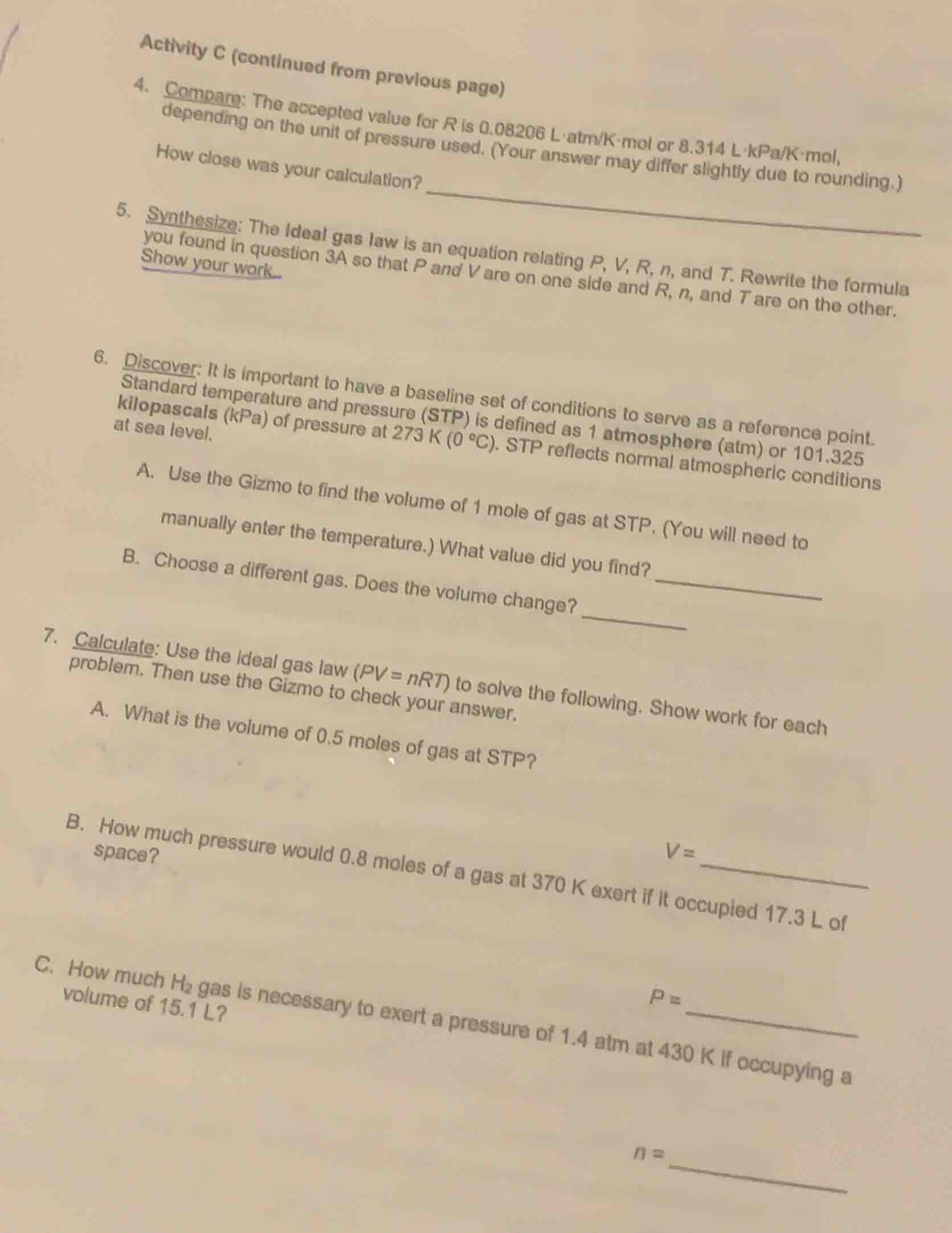
activity c (continued from previous page)
- compare: the accepted value for ( r ) is ( 0.08206 , \text{l·atm/k·mol} ) or ( 8.314 , \text{l·kpa/k·mol} ), depending on the unit of pressure used. (your answer may differ slightly due to rounding.)
how close was your calculation?
- synthesize: the ideal gas law is an equation relating ( p ), ( v ), ( r ), ( n ), and ( t ). rewrite the formula you found in question 3a so that ( p ) and ( v ) are on one side and ( r ), ( n ), and ( t ) are on the other.
show your work.
- discover: it is important to have a baseline set of conditions to serve as a reference point. standard temperature and pressure (stp) is defined as 1 atmosphere (atm) or 101.325 kilopascals (kpa) of pressure at ( 273 , \text{k} ) (( 0 , ^circ\text{c} )). stp reflects normal atmospheric conditions at sea level.
a. use the gizmo to find the volume of 1 mole of gas at stp. (you will need to manually enter the temperature.) what value did you find?
b. choose a different gas. does the volume change?
- calculate: use the ideal gas law (( pv = nrt )) to solve the following. show work for each problem. then use the gizmo to check your answer.
a. what is the volume of 0.5 moles of gas at stp?
( v = )
b. how much pressure would 0.8 moles of a gas at ( 370 , \text{k} ) exert if it occupied ( 17.3 , \text{l} ) of space?
( p = )
c. how much ( \text{h}_2 ) gas is necessary to exert a pressure of ( 1.4 , \text{atm} ) at ( 430 , \text{k} ) if occupying a volume of ( 15.1 , \text{l} )?
( n = )
7A Solution:
Step1: Recall STP conditions and ideal gas law
STP is \( P = 1\ \text{atm} \), \( T = 273\ \text{K} \), \( n = 0.5\ \text{mol} \). Ideal gas law: \( PV = nRT \), solve for \( V \): \( V=\frac{nRT}{P} \). \( R = 0.08206\ \text{L·atm/K·mol} \).
Step2: Substitute values into formula
\( n = 0.5\ \text{mol} \), \( R = 0.08206\ \text{L·atm/K·mol} \), \( T = 273\ \text{K} \), \( P = 1\ \text{atm} \).
\( V=\frac{0.5\ \text{mol} \times 0.08206\ \text{L·atm/K·mol} \times 273\ \text{K}}{1\ \text{atm}} \)
Calculate numerator: \( 0.5 \times 0.08206 \times 273 = 0.5 \times 22.40238 = 11.20119 \)
So \( V = 11.2\ \text{L} \) (or more precisely \( 11.201\ \text{L} \))
Step1: Rearrange ideal gas law for \( P \)
From \( PV = nRT \), \( P=\frac{nRT}{V} \). Given \( n = 0.8\ \text{mol} \), \( T = 370\ \text{K} \), \( V = 17.3\ \text{L} \), \( R = 0.08206\ \text{L·atm/K·mol} \) (or use \( 8.314\ \text{L·kPa/K·mol} \), but let's use atm for consistency, or convert units. Let's use \( R = 0.08206 \))
Step2: Substitute values
\( P=\frac{0.8\ \text{mol} \times 0.08206\ \text{L·atm/K·mol} \times 370\ \text{K}}{17.3\ \text{L}} \)
Calculate numerator: \( 0.8 \times 0.08206 \times 370 = 0.8 \times 30.3622 = 24.28976 \)
Divide by \( 17.3 \): \( \frac{24.28976}{17.3} \approx 1.404\ \text{atm} \) (or convert to kPa: \( 1\ \text{atm} = 101.325\ \text{kPa} \), so \( 1.404 \times 101.325 \approx 142.2\ \text{kPa} \), but using \( R = 8.314 \): \( P=\frac{0.8 \times 8.314 \times 370}{17.3} = \frac{0.8 \times 3076.18}{17.3} = \frac{2460.944}{17.3} \approx 142.2\ \text{kPa} \), which is \( 1.404\ \text{atm} \) as \( 142.2 / 101.325 \approx 1.404 \))
Step3: Calculate
\( 0.8 \times 0.08206 \times 370 = 24.28976 \); \( 24.28976 / 17.3 \approx 1.40\ \text{atm} \) (or more precisely \( 1.404\ \text{atm} \) or \( 142\ \text{kPa} \))
Step1: Rearrange ideal gas law for \( n \)
From \( PV = nRT \), \( n=\frac{PV}{RT} \). Given \( P = 1.4\ \text{atm} \), \( V = 15.1\ \text{L} \), \( T = 430\ \text{K} \), \( R = 0.08206\ \text{L·atm/K·mol} \)
Step2: Substitute values
\( n=\frac{1.4\ \text{atm} \times 15.1\ \text{L}}{0.08206\ \text{L·atm/K·mol} \times 430\ \text{K}} \)
Calculate numerator: \( 1.4 \times 15.1 = 21.14 \)
Denominator: \( 0.08206 \times 430 = 35.2858 \)
\( n=\frac{21.14}{35.2858} \approx 0.60\ \text{mol} \) (more precisely \( 0.60\ \text{mol} \) or \( 0.599\ \text{mol} \))

Snap & solve any problem in the app
Get step-by-step solutions on Sovi AI
Photo-based solutions with guided steps
Explore more problems and detailed explanations
\( V = 11.2\ \text{L} \) (or \( 11.20\ \text{L} \) depending on rounding)