QUESTION IMAGE
Question
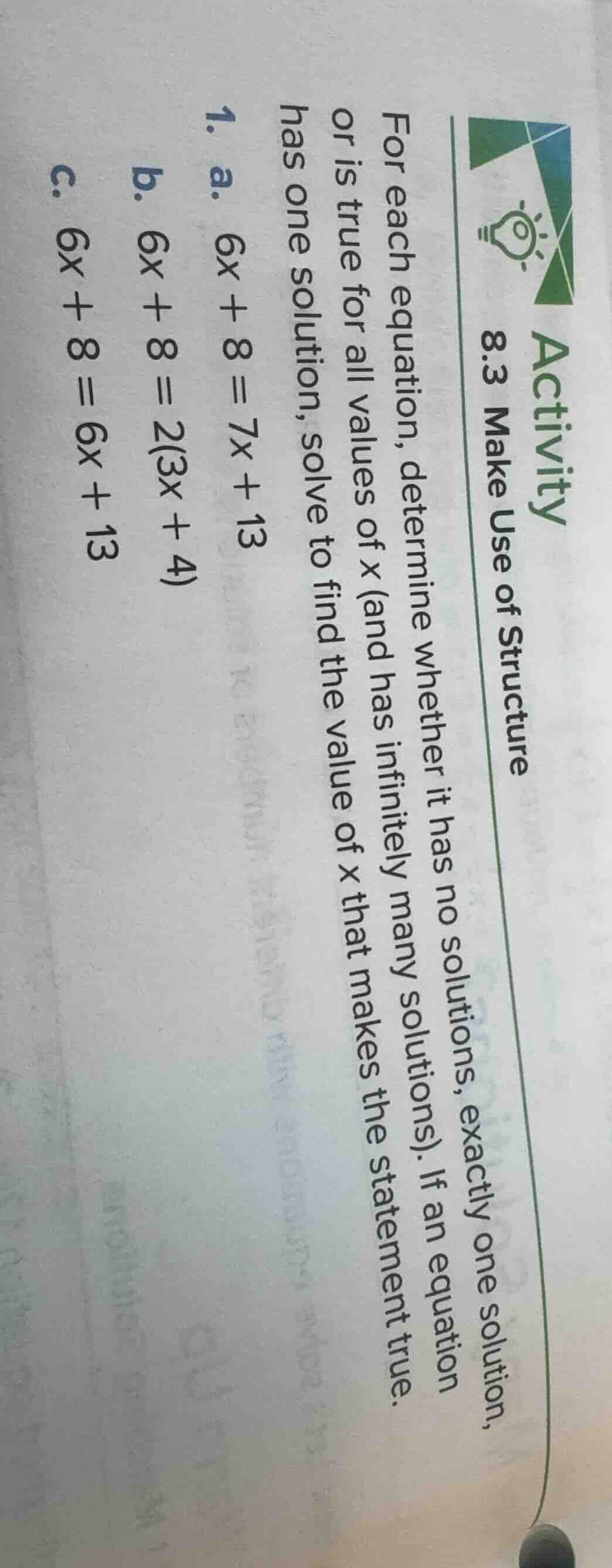
activity 8.3 make use of structure for each equation, determine whether it has no solutions, exactly one solution, or is true for all values of x (and has infinitely many solutions). if an equation has one solution, solve to find the value of x that makes the statement true. 1. a. $6x + 8 = 7x + 13$ b. $6x + 8 = 2(3x + 4)$ c. $6x + 8 = 6x + 13$
Step1: Isolate x terms (a)
Subtract $6x$ from both sides:
$6x + 8 - 6x = 7x + 13 - 6x$
$8 = x + 13$
Step2: Solve for x (a)
Subtract 13 from both sides:
$8 - 13 = x + 13 - 13$
$x = -5$
Step3: Simplify right side (b)
Expand the parentheses:
$6x + 8 = 2(3x) + 2(4)$
$6x + 8 = 6x + 8$
Step4: Analyze equality (b)
Subtract $6x + 8$ from both sides:
$6x + 8 - (6x + 8) = 6x + 8 - (6x + 8)$
$0 = 0$
Step5: Isolate constant terms (c)
Subtract $6x$ from both sides:
$6x + 8 - 6x = 6x + 13 - 6x$
$8 = 13$

Snap & solve any problem in the app
Get step-by-step solutions on Sovi AI
Photo-based solutions with guided steps
Explore more problems and detailed explanations
a. Exactly one solution: $x = -5$
b. True for all values of $x$ (infinitely many solutions)
c. No solutions