QUESTION IMAGE
Question
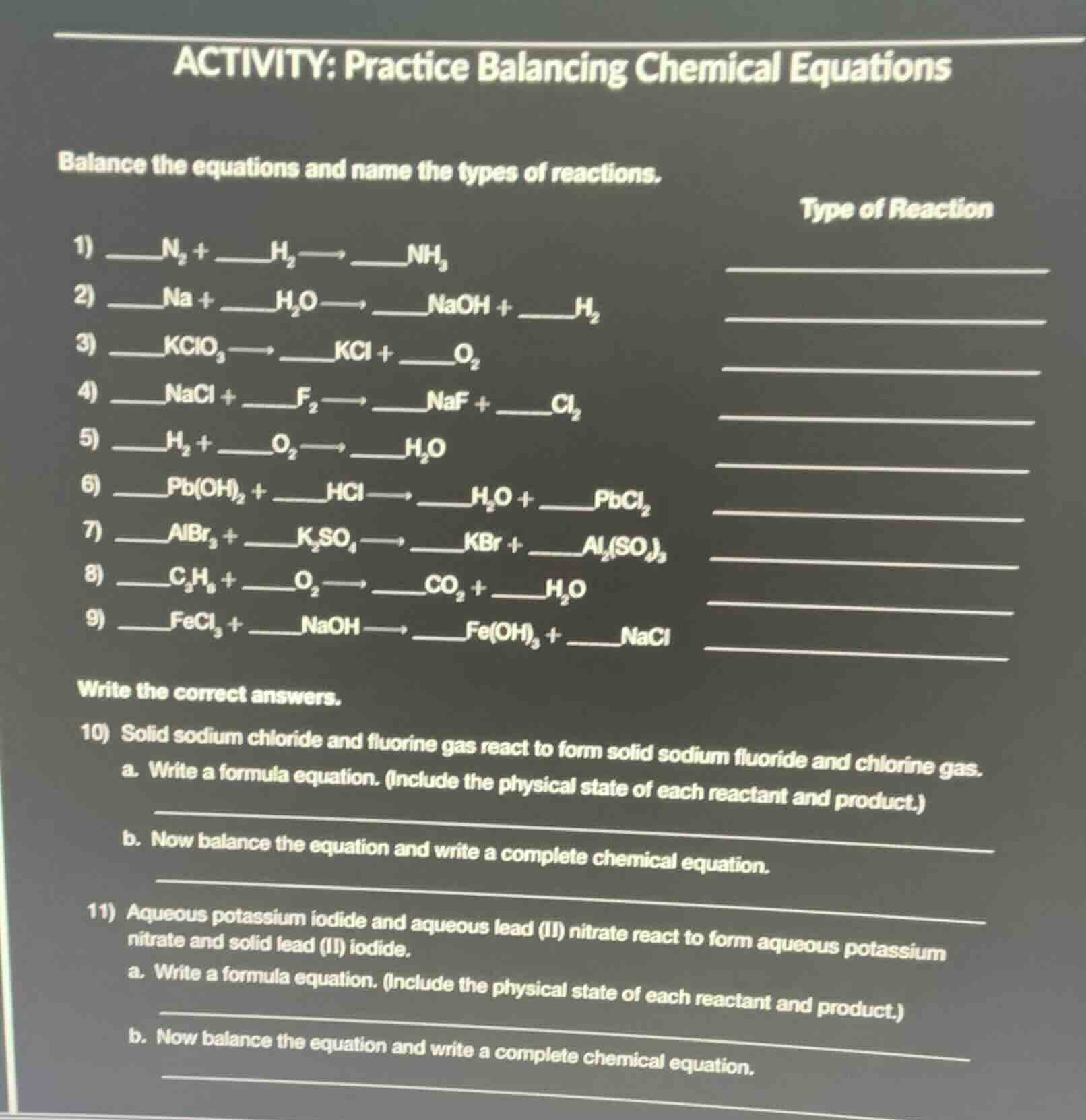
activity: practice balancing chemical equations
balance the equations and name the types of reactions.
- __n₂ + h₂ —→ __nh₃ \t\t\t\ttype of reaction
- __na + h₂o —→ naoh + __h₂ \t\t\t\t
- __kclo₃ —→ kcl + __o₂ \t\t\t\t
- __nacl + f₂ —→ naf + __cl₂ \t\t\t\t
- __h₂ + o₂ —→ __h₂o \t\t\t\t
- __pb(oh)₂ + hcl —→ h₂o + __pbcl₂ \t\t\t\t
- __albr₃ + k₂so₄ —→ kbr + __al₂(so₄)₃ \t\t\t\t
- __c₃h₈ + o₂ —→ co₂ + __h₂o \t\t\t\t
- __fecl₃ + naoh —→ fe(oh)₃ + __nacl \t\t\t\t
write the correct answers.
- solid sodium chloride and fluorine gas react to form solid sodium fluoride and chlorine gas.
a. write a formula equation. (include the physical state of each reactant and product.)
b. now balance the equation and write a complete chemical equation.
- aqueous potassium iodide and aqueous lead (ii) nitrate react to form aqueous potassium nitrate and solid lead (ii) iodide.
a. write a formula equation. (include the physical state of each reactant and product.)
b. now balance the equation and write a complete chemical equation.
Step1: Balance equation 1, classify reaction
$1\text{N}_2 + 3\text{H}_2 \longrightarrow 2\text{NH}_3$
Reaction type: Synthesis (Combination)
Step2: Balance equation 2, classify reaction
$2\text{Na} + 2\text{H}_2\text{O} \longrightarrow 2\text{NaOH} + 1\text{H}_2$
Reaction type: Single Displacement
Step3: Balance equation 3, classify reaction
$2\text{KClO}_3 \longrightarrow 2\text{KCl} + 3\text{O}_2$
Reaction type: Decomposition
Step4: Balance equation 4, classify reaction
$2\text{NaCl} + 1\text{F}_2 \longrightarrow 2\text{NaF} + 1\text{Cl}_2$
Reaction type: Single Displacement
Step5: Balance equation 5, classify reaction
$2\text{H}_2 + 1\text{O}_2 \longrightarrow 2\text{H}_2\text{O}$
Reaction type: Synthesis (Combination)
Step6: Balance equation 6, classify reaction
$1\text{Pb(OH)}_2 + 2\text{HCl} \longrightarrow 2\text{H}_2\text{O} + 1\text{PbCl}_2$
Reaction type: Double Displacement (Neutralization)
Step7: Balance equation 7, classify reaction
$2\text{AlBr}_3 + 3\text{K}_2\text{SO}_4 \longrightarrow 6\text{KBr} + 1\text{Al}_2(\text{SO}_4)_3$
Reaction type: Double Displacement
Step8: Balance equation 8, classify reaction
$1\text{C}_3\text{H}_8 + 5\text{O}_2 \longrightarrow 3\text{CO}_2 + 4\text{H}_2\text{O}$
Reaction type: Combustion
Step9: Balance equation 9, classify reaction
$1\text{FeCl}_3 + 3\text{NaOH} \longrightarrow 1\text{Fe(OH)}_3 + 3\text{NaCl}$
Reaction type: Double Displacement
Step10a: Write unbalanced state equation
$\text{NaCl}(s) + \text{F}_2(g) \longrightarrow \text{NaF}(s) + \text{Cl}_2(g)$
Step10b: Balance state equation
$2\text{NaCl}(s) + \text{F}_2(g) \longrightarrow 2\text{NaF}(s) + \text{Cl}_2(g)$
Step11a: Write unbalanced state equation
$\text{KI}(aq) + \text{Pb(NO}_3\text{)}_2(aq) \longrightarrow \text{KNO}_3(aq) + \text{PbI}_2(s)$
Step11b: Balance state equation
$2\text{KI}(aq) + \text{Pb(NO}_3\text{)}_2(aq) \longrightarrow 2\text{KNO}_3(aq) + \text{PbI}_2(s)$

Snap & solve any problem in the app
Get step-by-step solutions on Sovi AI
Photo-based solutions with guided steps
Explore more problems and detailed explanations
- Balanced equation: $\boldsymbol{1\text{N}_2 + 3\text{H}_2 \longrightarrow 2\text{NH}_3}$; Reaction type: Synthesis (Combination)
- Balanced equation: $\boldsymbol{2\text{Na} + 2\text{H}_2\text{O} \longrightarrow 2\text{NaOH} + 1\text{H}_2}$; Reaction type: Single Displacement
- Balanced equation: $\boldsymbol{2\text{KClO}_3 \longrightarrow 2\text{KCl} + 3\text{O}_2}$; Reaction type: Decomposition
- Balanced equation: $\boldsymbol{2\text{NaCl} + 1\text{F}_2 \longrightarrow 2\text{NaF} + 1\text{Cl}_2}$; Reaction type: Single Displacement
- Balanced equation: $\boldsymbol{2\text{H}_2 + 1\text{O}_2 \longrightarrow 2\text{H}_2\text{O}}$; Reaction type: Synthesis (Combination)
- Balanced equation: $\boldsymbol{1\text{Pb(OH)}_2 + 2\text{HCl} \longrightarrow 2\text{H}_2\text{O} + 1\text{PbCl}_2}$; Reaction type: Double Displacement (Neutralization)
- Balanced equation: $\boldsymbol{2\text{AlBr}_3 + 3\text{K}_2\text{SO}_4 \longrightarrow 6\text{KBr} + 1\text{Al}_2(\text{SO}_4)_3}$; Reaction type: Double Displacement
- Balanced equation: $\boldsymbol{1\text{C}_3\text{H}_8 + 5\text{O}_2 \longrightarrow 3\text{CO}_2 + 4\text{H}_2\text{O}}$; Reaction type: Combustion
- Balanced equation: $\boldsymbol{1\text{FeCl}_3 + 3\text{NaOH} \longrightarrow 1\text{Fe(OH)}_3 + 3\text{NaCl}}$; Reaction type: Double Displacement
10a) Unbalanced formula equation: $\boldsymbol{\text{NaCl}(s) + \text{F}_2(g) \longrightarrow \text{NaF}(s) + \text{Cl}_2(g)}$
10b) Balanced complete equation: $\boldsymbol{2\text{NaCl}(s) + \text{F}_2(g) \longrightarrow 2\text{NaF}(s) + \text{Cl}_2(g)}$
11a) Unbalanced formula equation: $\boldsymbol{\text{KI}(aq) + \text{Pb(NO}_3\text{)}_2(aq) \longrightarrow \text{KNO}_3(aq) + \text{PbI}_2(s)}$
11b) Balanced complete equation: $\boldsymbol{2\text{KI}(aq) + \text{Pb(NO}_3\text{)}_2(aq) \longrightarrow 2\text{KNO}_3(aq) + \text{PbI}_2(s)}$