QUESTION IMAGE
Question
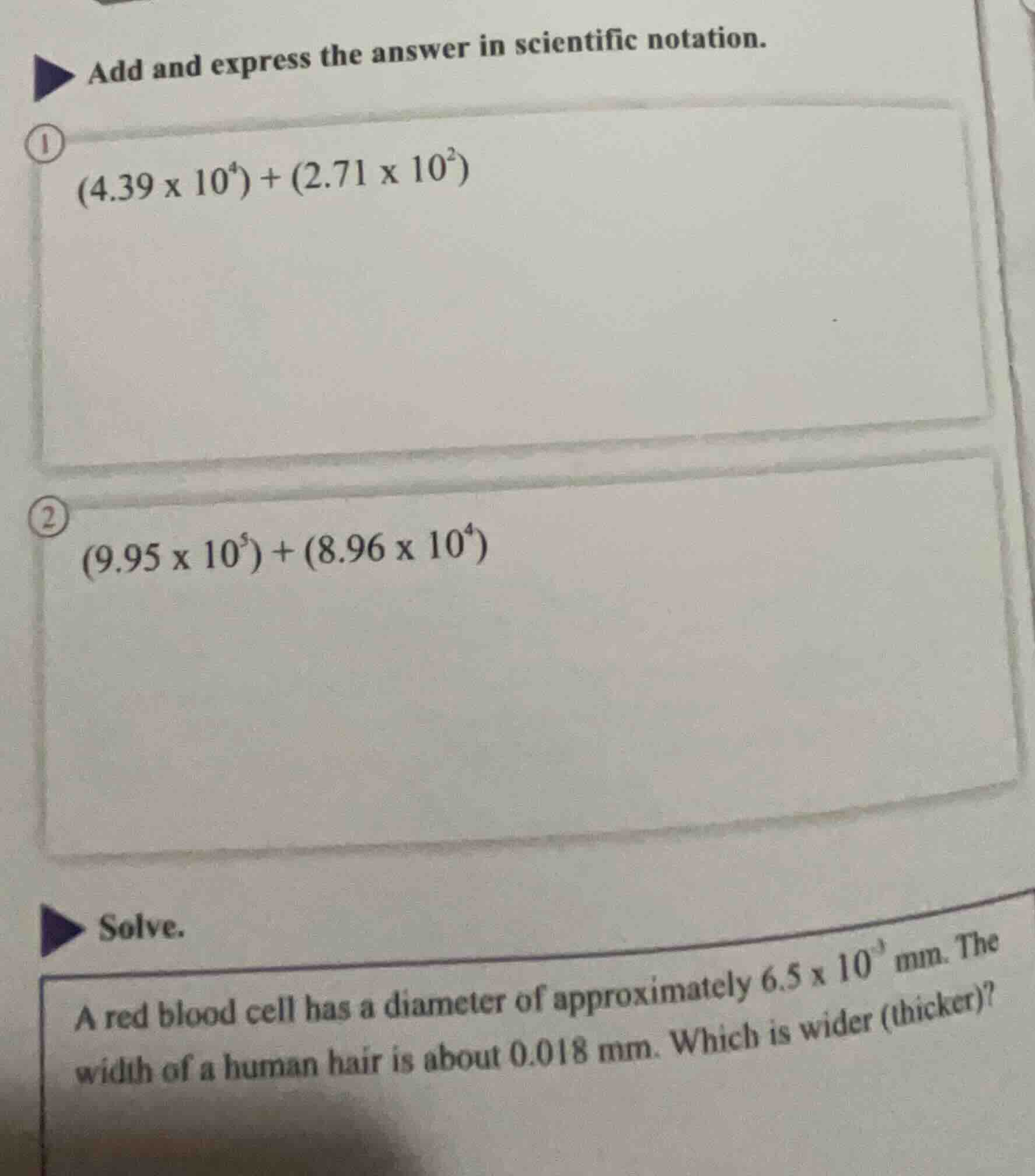
add and express the answer in scientific notation.
①
$(4.39 \times 10^4) + (2.71 \times 10^2)$
②
$(9.95 \times 10^5) + (8.96 \times 10^4)$
solve.
a red blood cell has a diameter of approximately $6.5 \times 10^{-3}$ mm. the width of a human hair is about 0.018 mm. which is wider (thicker)?
Problem 1:
Step1: Convert to same exponent
To add numbers in scientific notation, we first make the exponents the same. We can rewrite \(2.71\times10^{2}\) as \(0.0271\times10^{4}\) (since \(10^{2}=10^{- 2}\times10^{4}\), so \(2.71\times10^{2}=2.71\times10^{-2}\times10^{4} = 0.0271\times10^{4}\))
Step2: Add the coefficients
Now we add the coefficients of the terms with the same exponent (\(10^{4}\)): \(4.39\times10^{4}+0.0271\times10^{4}=(4.39 + 0.0271)\times10^{4}\)
Calculating \(4.39+0.0271 = 4.4171\)
So the sum is \(4.4171\times10^{4}\)
Step1: Convert to same exponent
Rewrite \(8.96\times10^{4}\) as \(0.896\times10^{5}\) (because \(10^{4}=10^{-1}\times10^{5}\), so \(8.96\times10^{4}=8.96\times10^{-1}\times10^{5}=0.896\times10^{5}\))
Step2: Add the coefficients
Add the coefficients of the terms with exponent \(10^{5}\): \(9.95\times10^{5}+0.896\times10^{5}=(9.95 + 0.896)\times10^{5}\)
Calculating \(9.95 + 0.896=10.846\)
But in scientific notation, the coefficient should be between \(1\) and \(10\). So we rewrite \(10.846\times10^{5}\) as \(1.0846\times10^{6}\) (since \(10.846 = 1.0846\times10^{1}\), so \(10.846\times10^{5}=1.0846\times10^{1}\times10^{5}=1.0846\times10^{6}\))
First, convert the width of human hair to scientific notation. \(0.018\space mm = 1.8\times10^{-2}\space mm\) (because we move the decimal point 2 places to the right to get a number between \(1\) and \(10\), so \(0.018=1.8\times10^{-2}\))
The diameter of red blood cell is \(6.5\times10^{-3}\space mm\)
Now compare the exponents of \(10\) in scientific notation. For \(6.5\times10^{-3}\) and \(1.8\times10^{-2}\), we can rewrite \(1.8\times10^{-2}\) as \(18\times10^{-3}\)
Now compare \(6.5\times10^{-3}\) and \(18\times10^{-3}\). Since \(18>6.5\), \(1.8\times10^{-2}>6.5\times10^{-3}\)
So the human hair is wider.

Snap & solve any problem in the app
Get step-by-step solutions on Sovi AI
Photo-based solutions with guided steps
Explore more problems and detailed explanations
\(4.4171\times10^{4}\)