QUESTION IMAGE
Question
additional details were added for this assignment.
is △ pmr similar to △ smn? if so, which
postulate or theorem proves these two triangles are
similar?
△ pmr is similar to △ smn by the
ssa similarity theorem.
△ pmr is similar to △ smn by the
sas similarity theorem.
△ pmr is similar to △ smn by the
sss similarity theorem.
△ pmr is not similar to△ smn.
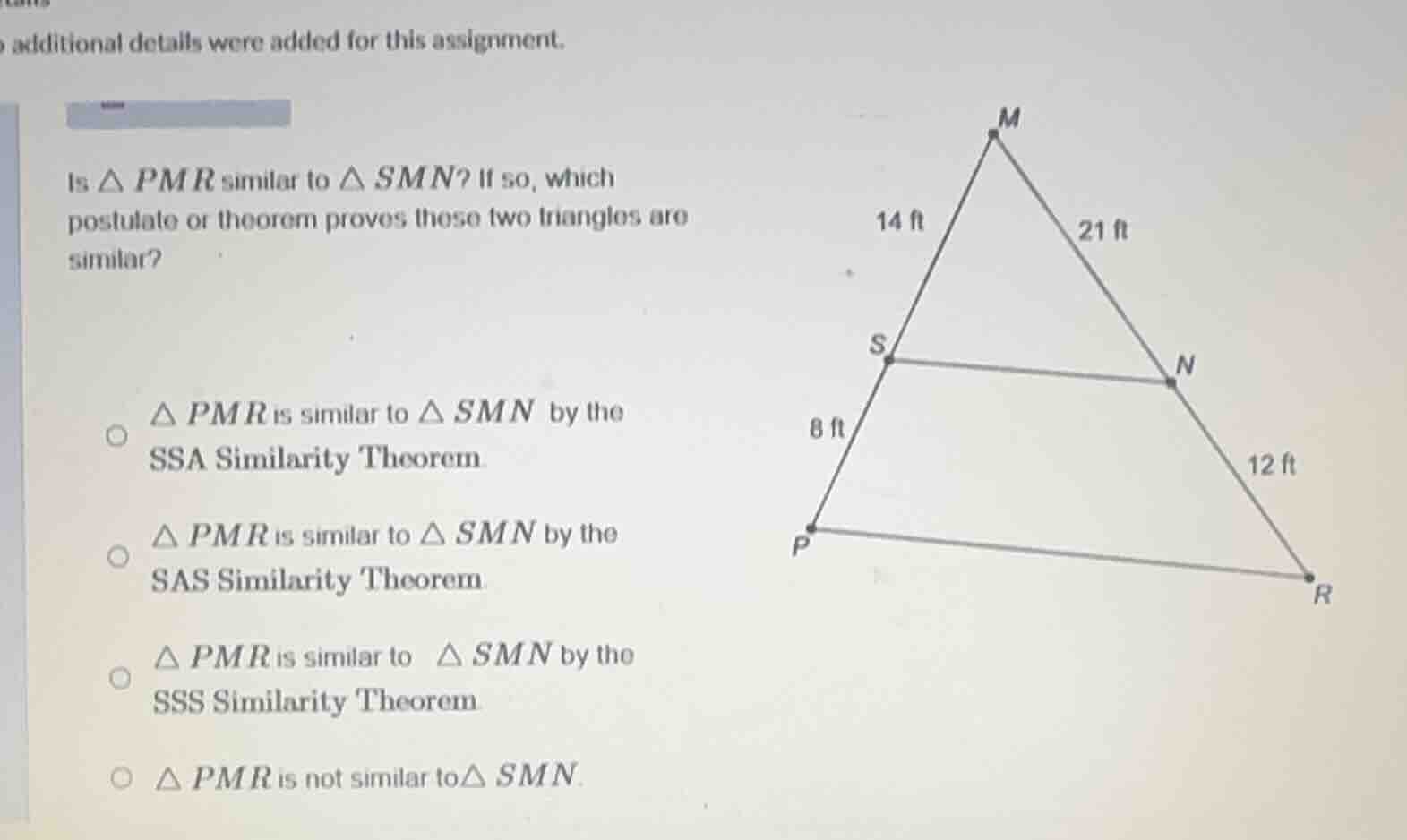
(image of triangle pmr with point s on pm, point n on mr; lengths: ms=14 ft, mn=21 ft, sp=8 ft, nr=12 ft)
Step1: Calculate ratios of corresponding sides
First, find the ratios of the sides of \( \triangle PMR \) and \( \triangle SMN \). For side \( PM \) and \( SM \): \( PM = PS + SM = 8 + 14 = 22 \)? Wait, no, wait. Wait, \( SM = 14 \) ft, \( PS = 8 \) ft, so \( PM = SM + PS = 14 + 8 = 22 \)? Wait, no, looking at the diagram, \( M \) to \( S \) is 14 ft, \( S \) to \( P \) is 8 ft, so \( PM = 14 + 8 = 22 \)? Wait, no, maybe \( PM \) is \( SM + SP \), so \( PM = 14 + 8 = 22 \)? Wait, no, maybe I misread. Wait, \( SM = 14 \) ft, \( SP = 8 \) ft, so \( PM = SM + SP = 14 + 8 = 22 \) ft? Wait, no, the other side: \( MN \) is \( 21 \) ft, \( NR \) is \( 12 \) ft, so \( MR = MN + NR = 21 + 12 = 33 \) ft? Wait, no, maybe the triangles are \( \triangle PMR \) and \( \triangle SMN \), so the corresponding sides are \( PM \) and \( SM \), \( MR \) and \( MN \), and the included angle is \( \angle M \) (common angle). Let's check the ratios:
\( \frac{PM}{SM} = \frac{14 + 8}{14} = \frac{22}{14} = \frac{11}{7} \)? Wait, no, maybe I got the sides wrong. Wait, the diagram: \( S \) is on \( PM \), \( N \) is on \( MR \). So \( PM \) is the side from \( P \) to \( M \), with \( S \) between \( P \) and \( M \): \( PS = 8 \) ft, \( SM = 14 \) ft, so \( PM = PS + SM = 8 + 14 = 22 \) ft. \( MR \) is from \( M \) to \( R \), with \( N \) between \( M \) and \( R \): \( MN = 21 \) ft, \( NR = 12 \) ft, so \( MR = MN + NR = 21 + 12 = 33 \) ft. Now, \( \triangle PMR \) and \( \triangle SMN \): angle at \( M \) is common (so \( \angle M \cong \angle M \)). Now, check the ratios of the sides around the common angle:
\( \frac{SM}{PM} = \frac{14}{22} = \frac{7}{11} \)
\( \frac{MN}{MR} = \frac{21}{33} = \frac{7}{11} \)
So the ratios of the two sides around the common angle are equal (\( \frac{7}{11} \)) and the included angle is equal (common angle), so by SAS Similarity Theorem, the triangles are similar. Wait, but let's check the options. The options are SSA (not a similarity theorem), SAS, SSS, or not similar. Wait, SAS Similarity Theorem states that if two sides of one triangle are proportional to two sides of another triangle and the included angles are congruent, then the triangles are similar. Here, \( \angle M \) is common, so included angle, and \( \frac{SM}{PM} = \frac{MN}{MR} = \frac{7}{11} \), so SAS Similarity. Wait, but let's recheck the side lengths. Wait, maybe I mixed up the triangles. Wait, \( \triangle PMR \) and \( \triangle SMN \): \( PM \) is \( 14 + 8 = 22 \), \( SM \) is \( 14 \); \( MR \) is \( 21 + 12 = 33 \), \( MN \) is \( 21 \). So \( \frac{SM}{PM} = 14/22 = 7/11 \), \( \frac{MN}{MR} = 21/33 = 7/11 \). So the two sides around \( \angle M \) are proportional, and \( \angle M \) is common, so SAS Similarity. Wait, but the option says " \( \triangle PMR \) is similar to \( \triangle SMN \) by the SAS Similarity Theorem". Wait, but let's check the other option: SSS. For SSS, we need all three sides proportional. Let's check the third side: \( PR \) and \( SN \). But we don't know \( PR \) or \( SN \), so we can't use SSS. SSA is not a similarity theorem (SSA is for congruence only in some cases, but not similarity). So the correct answer is the SAS Similarity Theorem.
Wait, but maybe I made a mistake in the side lengths. Wait, maybe \( PM \) is \( SM = 14 \) and \( SP = 8 \), so \( PM = 14 \), \( SM = 14 \)? No, that can't be. Wait, no, the diagram: \( S \) is on \( PM \), so \( PM \) is split into \( PS = 8 \) and \( SM = 14 \), so \( PM = 8 + 14 = 22 \). \( N \) is on \( MR \), so \( MR \) is split into \( MN = 21 \) and \( NR = 12…

Snap & solve any problem in the app
Get step-by-step solutions on Sovi AI
Photo-based solutions with guided steps
Explore more problems and detailed explanations
\( \triangle PMR \) is similar to \( \triangle SMN \) by the SAS Similarity Theorem. So the correct option is: \( \triangle PMR \) is similar to \( \triangle SMN \) by the SAS Similarity Theorem.