QUESTION IMAGE
Question
additive and multiplicative representations
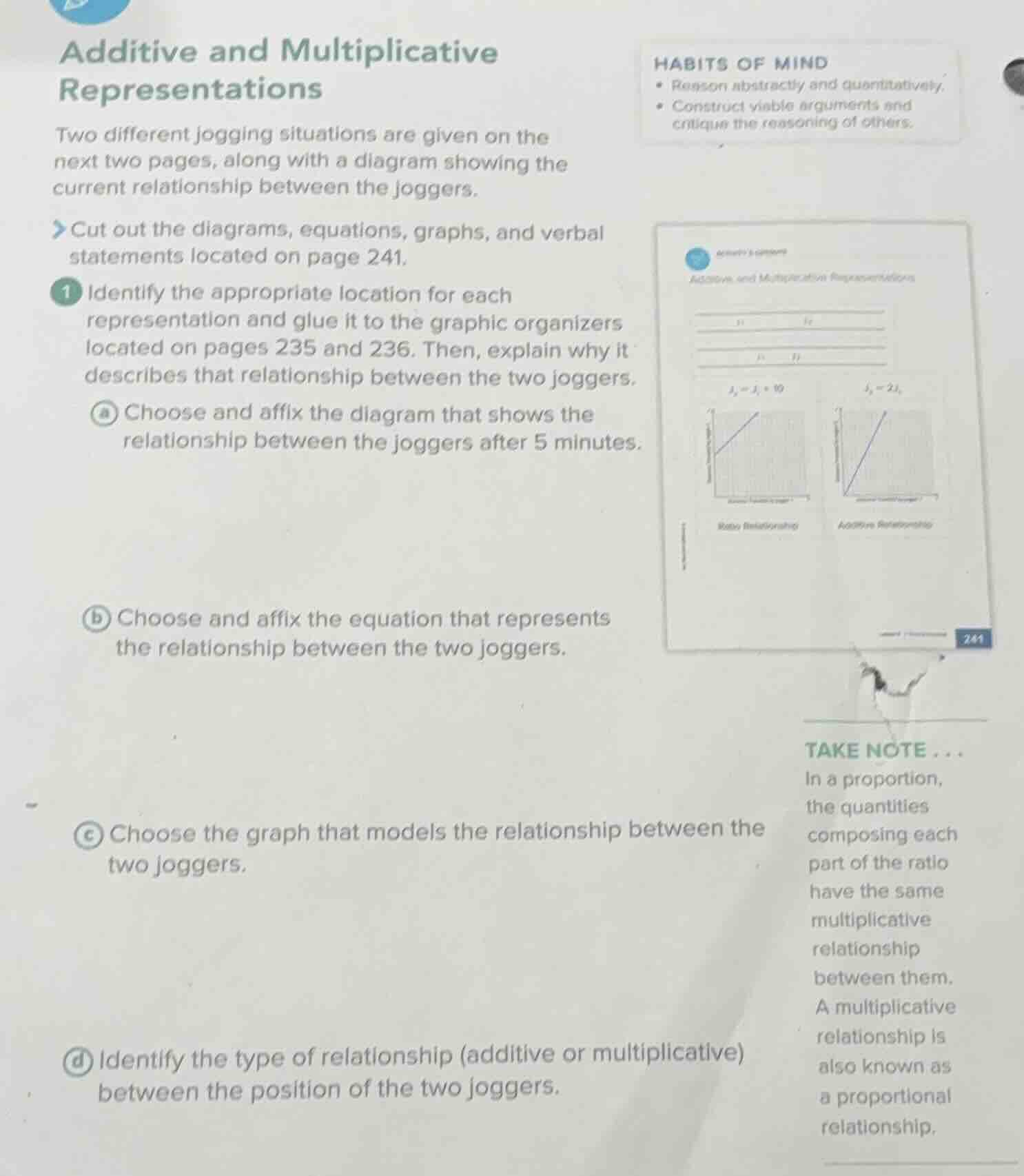
two different jogging situations are given on the
next two pages, along with a diagram showing the
current relationship between the joggers.
cut out the diagrams, equations, graphs, and verbal
statements located on page 241.
1 identify the appropriate location for each
representation and glue it to the graphic organizers
located on pages 235 and 236. then, explain why it
describes that relationship between the two joggers.
① choose and affix the diagram that shows the
relationship between the joggers after 5 minutes.
② choose and affix the equation that represents
the relationship between the two joggers.
③ choose the graph that models the relationship between the
two joggers.
④ identify the type of relationship (additive or multiplicative)
between the position of the two joggers.
habits of mind
- reason abstractly and quantitatively.
- construct viable arguments and
critique the reasoning of others.
take note...
in a proportion,
the quantities
composing each
part of the ratio
have the same
multiplicative
relationship
between them.
a multiplicative
relationship is
also known as
a proportional
relationship.
To solve these sub - questions, we analyze each part based on the concepts of additive and multiplicative relationships:
Sub - question (a)
- First, we need to understand the motion of the two joggers. If we assume the positions of the joggers are related either additively (e.g., \(y=x + 10\)) or multiplicatively (e.g., \(y = 2x\)). After 5 minutes, we calculate the positions for both types of relationships.
- For an additive relationship like \(y=x + 10\), if \(x\) is the position of one jogger, \(y\) is the position of the other. After 5 minutes, if \(x\) has a certain value (say \(x = 5\) units of distance), \(y=5 + 10=15\) units.
- For a multiplicative relationship like \(y = 2x\), if \(x = 5\) units, \(y=2\times5 = 10\) units.
- Then, we look at the diagrams on page 241. The diagram that shows the correct positions of the two joggers after 5 minutes based on their relationship (additive or multiplicative) should be chosen. We affix the diagram that matches the calculated positions. For example, if the relationship is additive (\(y=x + 10\)), we choose the diagram where the vertical distance between the two joggers' paths is constant (since in an additive relationship, the difference is constant), and if it is multiplicative (\(y = 2x\)), the ratio of the two positions is constant.
- Recall the definitions of additive and multiplicative relationships. An additive relationship has the form \(y=x + b\) (where \(b\) is a constant), and a multiplicative relationship has the form \(y=kx\) (where \(k\) is a non - zero constant).
- If the position of one jogger (\(y\)) and the position of the other jogger (\(x\)) have a relationship where \(y - x=\text{constant}\), then the equation is additive (e.g., \(y=x + 10\)). If \(\frac{y}{x}=\text{constant}\), then the equation is multiplicative (e.g., \(y = 2x\)).
- We look at the equations on page 241. If the relationship between the two joggers' positions is such that one position is a constant multiple of the other, we choose the multiplicative equation (e.g., \(y = 2x\)), and if it is a constant addition, we choose the additive equation (e.g., \(y=x + 10\)). Then we affix the correct equation.
- For a linear relationship:
- An additive relationship (\(y=x + b\)) has a graph with a slope of 1 and a non - zero y - intercept. For example, the graph of \(y=x + 10\) has a y - intercept of 10 and a slope of 1.
- A multiplicative relationship (\(y = kx\)) has a graph that passes through the origin (since when \(x = 0\), \(y = 0\)) and has a slope of \(k\). For example, the graph of \(y = 2x\) passes through \((0,0)\) and has a slope of 2.
- We look at the graphs on page 241. If the graph passes through the origin, it represents a multiplicative relationship, and if it has a non - zero y - intercept, it represents an additive relationship. We choose the graph that matches the relationship (additive or multiplicative) between the two joggers.

Snap & solve any problem in the app
Get step-by-step solutions on Sovi AI
Photo-based solutions with guided steps
Explore more problems and detailed explanations
Affix the diagram (from page 241) that shows the positions of the two joggers after 5 minutes based on their relationship (additive or multiplicative). If the relationship is additive (e.g., \(y=x + 10\)), the diagram with a constant vertical gap between the two joggers' paths; if multiplicative (e.g., \(y = 2x\)), the diagram with a constant ratio of the two joggers' positions.