QUESTION IMAGE
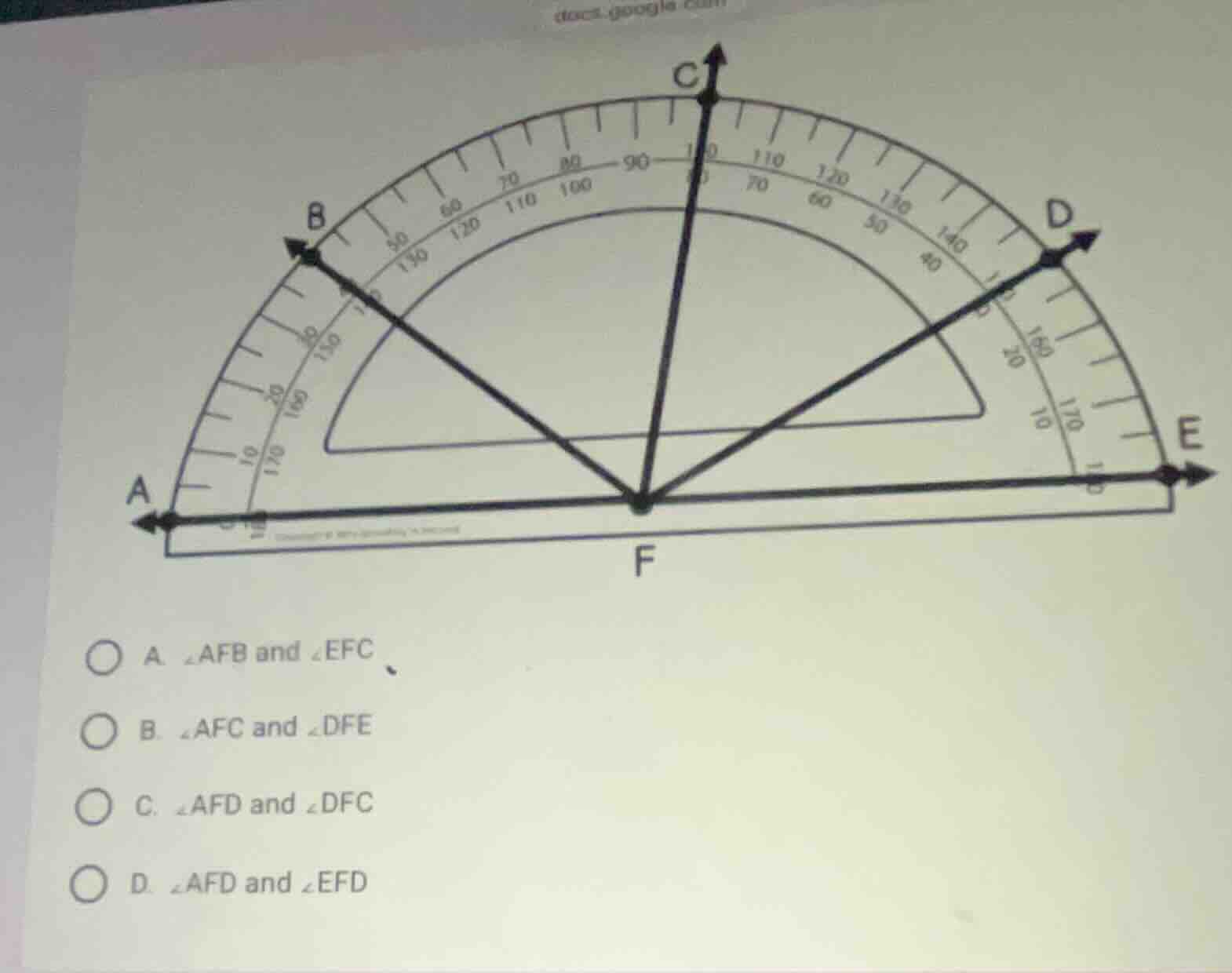
Question
a. ∠afb and ∠efc
b. ∠afc and ∠dfe
c. ∠afd and ∠dfc
d. ∠afd and ∠efd
Step1: Analyze Option A
$\angle AFB$: From the protractor, $\angle AFB$ seems to be, say, let's check the measure. Wait, actually, we can see that $\angle AFB$ and $\angle EFC$: Let's see the straight line $AE$ (since $A$ and $E$ are on a straight line, so $\angle AFE = 180^\circ$). Wait, maybe better to check if they are supplementary or complementary? Wait, no, the question is probably about which angles are supplementary or maybe vertical? Wait, no, let's check each option.
Option A: $\angle AFB$ and $\angle EFC$. Let's see, $\angle AFB$: looking at the protractor, $FB$ is at some angle, $FC$ is at 100? Wait, no, the protractor has two scales. Wait, the straight line is $AFE$, so $AF$ is 0 (or 180) and $FE$ is 0 (or 180). Let's check the angles:
$\angle AFB$: Let's say $FB$ is at 40 degrees from $AF$? Wait, no, the protractor marks: from $AF$ (left) to $FB$: the inner scale? Wait, maybe the key is to see if the angles add up to 180 or 90, but maybe it's about linear pairs or supplementary. Wait, no, the options are pairs of angles. Let's check Option D: $\angle AFD$ and $\angle EFD$. Wait, $AFE$ is a straight line (180 degrees), so $\angle AFD + \angle EFD = \angle AFE = 180^\circ$? Wait, no, $\angle AFD$ and $\angle EFD$: if $FD$ is a ray between $AF$ and $FE$, then $\angle AFD + \angle EFD = \angle AFE = 180^\circ$, so they are supplementary (form a linear pair). Wait, but let's check other options.
Option A: $\angle AFB$ and $\angle EFC$: Do they add up to 180? Unlikely. Option B: $\angle AFC$ and $\angle DFE$: $\angle AFC$ is, say, 100 degrees (from $AF$ to $FC$), $\angle DFE$ is, say, 30 degrees? No. Option C: $\angle AFD$ and $\angle DFC$: Do they add up to 90 or 180? $\angle AFD$ is, say, 150, $\angle DFC$ is 30? No. Option D: $\angle AFD$ and $\angle EFD$: Since $AFE$ is a straight line, $\angle AFD + \angle EFD = 180^\circ$, so they are supplementary (form a linear pair). Wait, but let's confirm.
Wait, the straight line is $AFE$, so any angle on a straight line with a common side forms a linear pair (supplementary). So $\angle AFD$ and $\angle EFD$ share the side $FD$ and their other sides are $AF$ and $FE$, which are a straight line. So they are supplementary (add to 180), so they form a linear pair. So Option D is correct.
Wait, maybe I made a mistake. Let's re-examine:
$\angle AFD$: from $AF$ to $FD$, and $\angle EFD$: from $FD$ to $FE$. Since $AF$ and $FE$ are a straight line, $\angle AFD + \angle EFD = 180^\circ$, so they are supplementary (linear pair). So Option D is correct.
Step2: Confirm Other Options
Option A: $\angle AFB$ and $\angle EFC$: Do they add to 180? Unlikely. $\angle AFB$ is, say, 40 degrees, $\angle EFC$ is 90? No. Option B: $\angle AFC$ and $\angle DFE$: $\angle AFC$ is 100, $\angle DFE$ is 30? No. Option C: $\angle AFD$ and $\angle DFC$: $\angle AFD$ is 150, $\angle DFC$ is 30? No. Option D: $\angle AFD$ and $\angle EFD$: Sum to 180, so they are supplementary (linear pair). So D is correct.

Snap & solve any problem in the app
Get step-by-step solutions on Sovi AI
Photo-based solutions with guided steps
Explore more problems and detailed explanations
D. $\angle AFD$ and $\angle EFD$