QUESTION IMAGE
Question
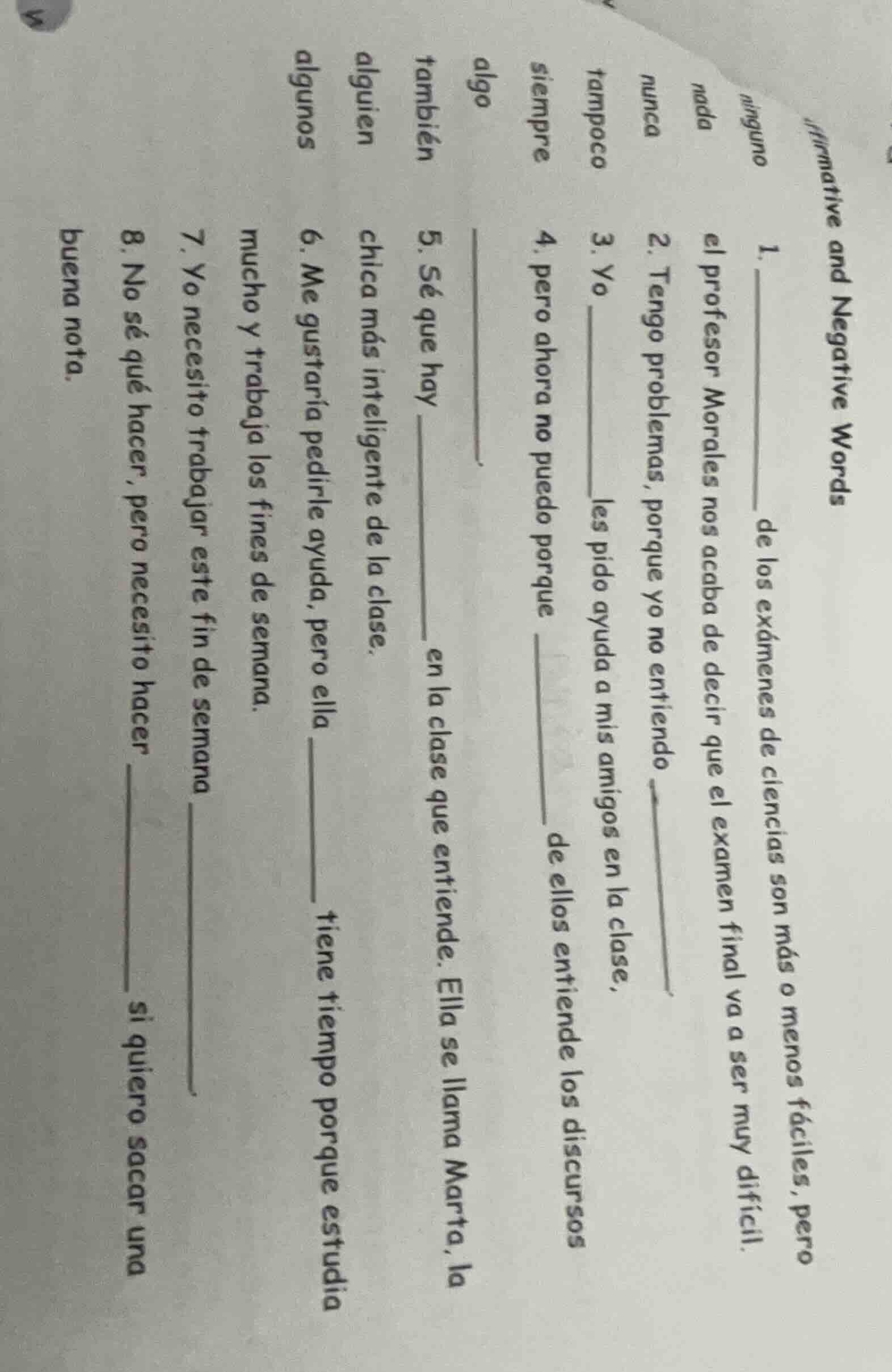
affirmative and negative words
- ____ de los exámenes de ciencias son más o menos fáciles, pero el profesor morales nos acaba de decir que el examen final va a ser muy difícil.
- tengo problemas, porque yo no entiendo ____.
- yo ____ les pido ayuda a mis amigos en la clase,
- pero ahora no puedo porque ____ de ellos entiende los discursos
algo
____.
- sé que hay ____ en la clase que entiende. ella se llama marta, la chica más inteligente de la clase.
- me gustaría pedirle ayuda, pero ella ____ tiene tiempo porque estudia
alguien
algunos
mucho y trabaja los fines de semana.
- yo necesito trabajar este fin de semana ____.
- no sé qué hacer, pero necesito hacer ____ si quiero sacar una
buena nota.
To solve these fill - in - the - blank questions, we need to understand the meaning of each Spanish indefinite word and the context of the sentence.
Question 1
The sentence is “____ de los exámenes de ciencias son más o menos fáciles, pero el profesor Morales nos acaba de decir que el examen final va a ser muy difícil.” The word “ninguno” is used in the singular to mean “none” when referring to masculine nouns (exámenes is masculine plural, but “ninguno” can be used in this context to say “none of the science exams...”). So we fill in “Ninguno”.
Question 2
The sentence is “Tengo problemas, porque yo no entiendo ____.” The word “nada” means “nothing”. In the context of “I don't understand anything”, we use “nada”. So we fill in “nada”.
Question 3
The sentence is “Yo ____ les pido ayuda a mis amigos en la clase.” The word “siempre” means “always”. The context is about the frequency of asking friends for help in class, so “siempre” fits. We fill in “siempre”.
Question 4
The sentence is “pero ahora no puedo porque ____ de ellos entiende los discursos.” The word “ninguno” (in the context of “none of them”), since “ellos” is masculine plural, “ninguno” (used as “ninguno de ellos”) means “none of them”. So we fill in “ninguno”.
Question 5
The sentence is “Sé que hay ____ en la clase que entiende. Ella se llama Marta, la chica más inteligente de la clase.” The word “alguien” means “someone”. The context is “I know there is someone in the class who understands”, so we fill in “alguien”.
Question 6
The sentence is “Me gustaría pedirle ayuda, pero ella ____ tiene tiempo porque estudia mucho y trabaja los fines de semana.” The word “tampoco” means “neither, nor, also not”. In the context “she also doesn't have time”, we use “tampoco”. So we fill in “tampoco”.
Question 7
The sentence is “Yo necesito trabajar este fin de semana ____.” The word “algo” means “something” (in the sense of “I need to work this weekend on something”). So we fill in “algo”.
Question 8
The sentence is “No sé qué hacer, pero necesito hacer ____ si quiero sacar una buena nota.” The word “algo” means “something”. The context is “I need to do something if I want to get a good grade”, so we fill in “algo”.

Snap & solve any problem in the app
Get step-by-step solutions on Sovi AI
Photo-based solutions with guided steps
Explore more problems and detailed explanations
s:
- Ninguno
- nada
- siempre
- ninguno
- alguien
- tampoco
- algo
- algo