QUESTION IMAGE
Question
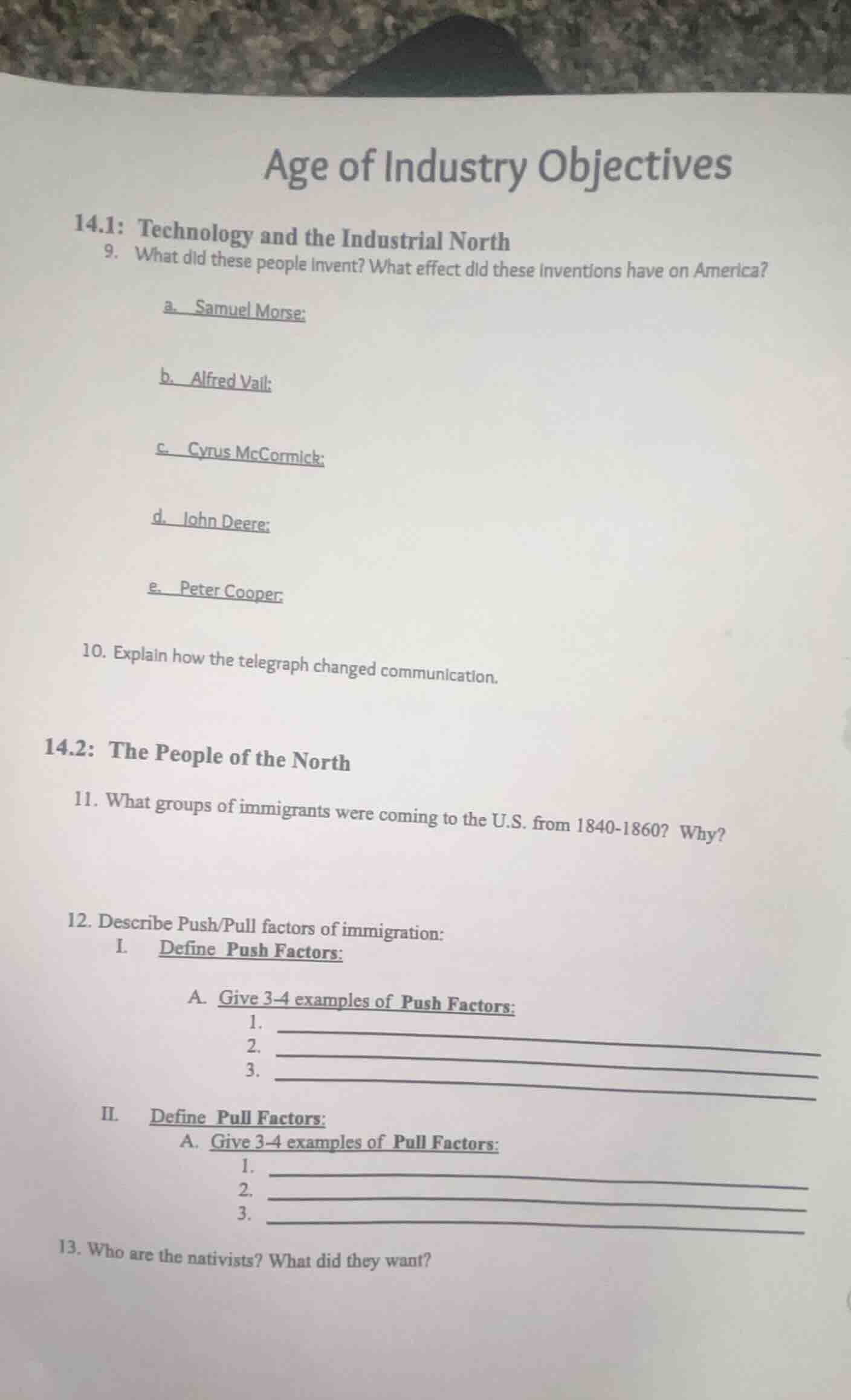
age of industry objectives
14.1: technology and the industrial north
- what did these people invent? what effect did these inventions have on america?
a. samuel morse:
b. alfred vail:
c. cyrus mccormick:
d. john deere:
e. peter cooper:
- explain how the telegraph changed communication.
14.2: the people of the north
- what groups of immigrants were coming to the u.s. from 1840 - 1860? why?
- describe push/pull factors of immigration:
i. define push factors:
a. give 3 - 4 examples of push factors:
1.
2.
3.
ii. define pull factors:
a. give 3 - 4 examples of pull factors:
1.
2.
3.
- who are the nativists? what did they want?
For Question 9:
Covers key 19th-century American inventors, their creations, and national impacts.
a. Samuel Morse developed the electric telegraph and Morse Code, enabling fast long-distance communication.
b. Alfred Vail refined Morse Code into a practical, easy-to-use system for the telegraph.
c. Cyrus McCormick invented the mechanical reaper, revolutionizing grain harvesting.
d. John Deere created the steel plow, making farming in tough Midwestern soils feasible.
e. Peter Cooper built the first American steam locomotive, the Tom Thumb, spurring rail development.
For Question 10:
Explains the telegraph's core transformation of communication speed and connectivity.
For Question 11:
Covers the main immigrant groups to the U.S. 1840-1860 and their motivations.
For Question 12:
Defines immigration push/pull factors and provides common historical examples.
For Question 13:
Defines nativists and outlines their core political/social goals.

Snap & solve any problem in the app
Get step-by-step solutions on Sovi AI
Photo-based solutions with guided steps
Explore more problems and detailed explanations
9.
a. Invented: Electric telegraph and Morse Code. Effect: Enabled near-instant long-distance communication across America, unifying the nation's communication networks and supporting business, news, and government coordination.
b. Invented: Refined the Morse Code system (created a simplified, efficient dot-dash system based on letter frequency). Effect: Made the telegraph practical and accessible, accelerating its widespread adoption across the U.S.
c. Invented: Mechanical reaper. Effect: Dramatically increased grain harvesting speed, reduced labor needs, allowed large-scale commercial farming in the Midwest, and boosted America's agricultural output and economic growth.
d. Invented: Steel plow. Effect: Made cultivating the hard, rocky soil of the American Midwest possible, encouraging westward expansion of farming and transforming the region into the nation's breadbasket.
e. Invented: The Tom Thumb, the first American-built steam locomotive. Effect: Demonstrated the feasibility of rail travel in the U.S., spurring the growth of the railroad industry which connected regions, enabled fast transport of goods/people, and fueled industrialization.
10.
The telegraph eliminated the delay of mail-based long-distance communication, allowing messages to be sent and received in hours instead of days or weeks. It connected distant cities, businesses, and government offices, creating a national communication network that supported economic integration, faster spread of news, and better coordination of national activities.
11.
The main groups were Irish immigrants (fleeing the Great Famine) and German immigrants (escaping political unrest and seeking economic opportunity). Irish immigrants came primarily to escape mass starvation from the potato blight that devastated Ireland's food supply. German immigrants sought political freedom after failed revolutions in Germany, as well as access to cheap farmland and economic opportunities in the growing U.S. industrial and agricultural sectors.
12.
I. Push Factors: Conditions in a person's home country that force them to leave.
A. Examples:
- Famine or food shortages (e.g., Irish Potato Famine)
- Political persecution or war
- Lack of economic opportunities/jobs
II. Pull Factors: Conditions in a new country that attract people to move there.
A. Examples:
- Availability of cheap or free farmland
- Economic opportunities in factories or industries
- Political freedom and stability
13.
Nativists were native-born American citizens (mostly white, Protestant) who opposed immigration. They wanted to limit immigration, restrict the rights of immigrants (such as voting or holding public office), and preserve the dominance of native-born, Protestant culture and power in the U.S.