QUESTION IMAGE
Question
algebra 1
assignment 6.6
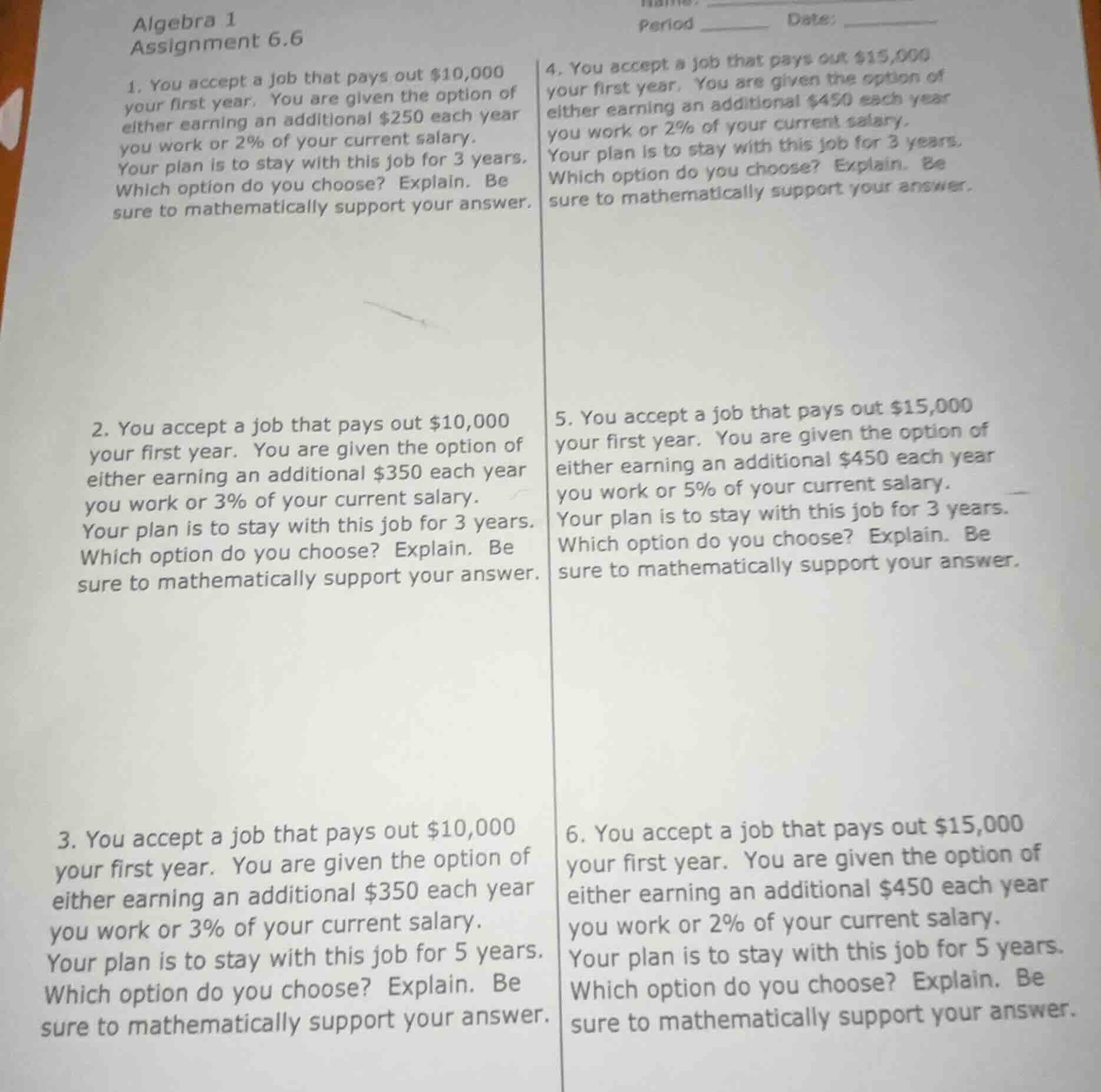
- you accept a job that pays out $10,000 your first year. you are given the option of either earning an additional $250 each year you work or 2% of your current salary. your plan is to stay with this job for 3 years. which option do you choose? explain. be sure to mathematically support your answer.
- you accept a job that pays out $10,000 your first year. you are given the option of either earning an additional $350 each year you work or 3% of your current salary. your plan is to stay with this job for 3 years. which option do you choose? explain. be sure to mathematically support your answer.
- you accept a job that pays out $10,000 your first year. you are given the option of either earning an additional $350 each year you work or 3% of your current salary. your plan is to stay with this job for 5 years. which option do you choose? explain. be sure to mathematically support your answer.
- you accept a job that pays out $15,000 your first year. you are given the option of either earning an additional $450 each year you work or 2% of your current salary. your plan is to stay with this job for 3 years. which option do you choose? explain. be sure to mathematically support your answer.
- you accept a job that pays out $15,000 your first year. you are given the option of either earning an additional $450 each year you work or 5% of your current salary. your plan is to stay with this job for 3 years. which option do you choose? explain. be sure to mathematically support your answer.
- you accept a job that pays out $15,000 your first year. you are given the option of either earning an additional $450 each year you work or 2% of your current salary. your plan is to stay with this job for 5 years. which option do you choose? explain. be sure to mathematically support your answer.
---
Problem 1
Step1: Calculate flat raise total
First year: $\$10,000$
Second year: $\$10,000 + \$250 = \$10,250$
Third year: $\$10,250 + \$250 = \$10,500$
Total: $\$10,000 + \$10,250 + \$10,500 = \$30,750$
Step2: Calculate percentage raise total
First year: $\$10,000$
Second year: $\$10,000 \times 1.02 = \$10,200$
Third year: $\$10,200 \times 1.02 = \$10,404$
Total: $\$10,000 + \$10,200 + \$10,404 = \$30,604$
Step3: Compare totals
$\$30,750 > \$30,604$, so flat raise is better.
---
Problem 2
Step1: Calculate flat raise total
First year: $\$10,000$
Second year: $\$10,000 + \$350 = \$10,350$
Third year: $\$10,350 + \$350 = \$10,700$
Total: $\$10,000 + \$10,350 + \$10,700 = \$31,050$
Step2: Calculate percentage raise total
First year: $\$10,000$
Second year: $\$10,000 \times 1.03 = \$10,300$
Third year: $\$10,300 \times 1.03 = \$10,609$
Total: $\$10,000 + \$10,300 + \$10,609 = \$30,909$
Step3: Compare totals
$\$31,050 > \$30,909$, so flat raise is better.
---
Problem 3
Step1: Calculate flat raise total
First year: $\$10,000$
Second year: $\$10,000 + \$350 = \$10,350$
Third year: $\$10,350 + \$350 = \$10,700$
Fourth year: $\$10,700 + \$350 = \$11,050$
Fifth year: $\$11,050 + \$350 = \$11,400$
Total: $\$10,000 + \$10,350 + \$10,700 + \$11,050 + \$11,400 = \$53,500$
Step2: Calculate percentage raise total
First year: $\$10,000$
Second year: $\$10,000 \times 1.03 = \$10,300$
Third year: $\$10,300 \times 1.03 = \$10,609$
Fourth year: $\$10,609 \times 1.03 = \$10,927.27$
Fifth year: $\$10,927.27 \times 1.03 = \$11,255.09$
Total: $\$10,000 + \$10,300 + \$10,609 + \$10,927.27 + \$11,255.09 = \$53,091.36$
Step3: Compare totals
$\$53,500 > \$53,091.36$, so flat raise is better.
---
Problem 4
Step1: Calculate flat raise total
First year: $\$15,000$
Second year: $\$15,000 + \$450 = \$15,450$
Third year: $\$15,450 + \$450 = \$15,900$
Total: $\$15,000 + \$15,450 + \$15,900 = \$46,350$
Step2: Calculate percentage raise total
First year: $\$15,000$
Second year: $\$15,000 \times 1.02 = \$15,300$
Third year: $\$15,300 \times 1.02 = \$15,606$
Total: $\$15,000 + \$15,300 + \$15,606 = \$45,906$
Step3: Compare totals
$\$46,350 > \$45,906$, so flat raise is better.
---
Problem 5
Step1: Calculate flat raise total
First year: $\$15,000$
Second year: $\$15,000 + \$450 = \$15,450$
Third year: $\$15,450 + \$450 = \$15,900$
Total: $\$15,000 + \$15,450 + \$15,900 = \$46,350$
Step2: Calculate percentage raise total
First year: $\$15,000$
Second year: $\$15,000 \times 1.05 = \$15,750$
Third year: $\$15,750 \times 1.05 = \$16,537.50$
Total: $\$15,000 + \$15,750 + \$16,537.50 = \$47,287.50$
Step3: Compare totals
$\$47,287.50 > \$46,350$, so percentage raise is better.
---
Problem 6
Step1: Calculate flat raise total
First year: $\$15,000$
Second year: $\$15,000 + \$450 = \$15,450$
Third year: $\$15,450 + \$450 = \$15,900$
Fourth year: $\$15,900 + \$450 = \$16,350$
Fifth year: $\$16,350 + \$450 = \$16,800$
Total: $\$15,000 + \$15,450 + \$15,900 + \$16,350 + \$16,800 = \$79,500$
Step2: Calculate percentage raise total
First year: $\$15,000$
Second year: $\$15,000 \times 1.02 = \$15,300$
Third year: $\$15,300 \times 1.02 = \$15,606$
Fourth year: $\$15,606 \times 1.02 = \$15,918.12$
Fifth year: $\$15,918.12 \times 1.02 = \$16,236.48$
Total: $\$15,000 + \$15,300 + \$15,606 + \$15,918.12 + \$16,236.48 = \$78,060.60$
Step3: Compare totals
$\$79,500 > \$78,060.60$, so flat raise is better.

Snap & solve any problem in the app
Get step-by-step solutions on Sovi AI
Photo-based solutions with guided steps
Explore more problems and detailed explanations
- Choose the \$250 annual flat raise; total earnings over 3 years are \$30,750, which is more than the 2% raise's total of \$30,604.
- Choose the \$350 annual flat raise; total earnings over 3 years are \$31,050, which is more than the 3% raise's total of \$30,909.
- Choose the \$350 annual flat raise; total earnings over 5 years are \$53,500, which is more than the 3% raise's total of \$53,091.36.
- Choose the \$450 annual flat raise; total earnings over 3 years are \$46,350, which is more than the 2% raise's total of \$45,906.
- Choose the 5% annual percentage raise; total earnings over 3 years are \$47,287.50, which is more than the \$450 flat raise's total of \$46,350.
- Choose the \$450 annual flat raise; total earnings over 5 years are \$79,500, which is more than the 2% raise's total of \$78,060.60.