QUESTION IMAGE
Question
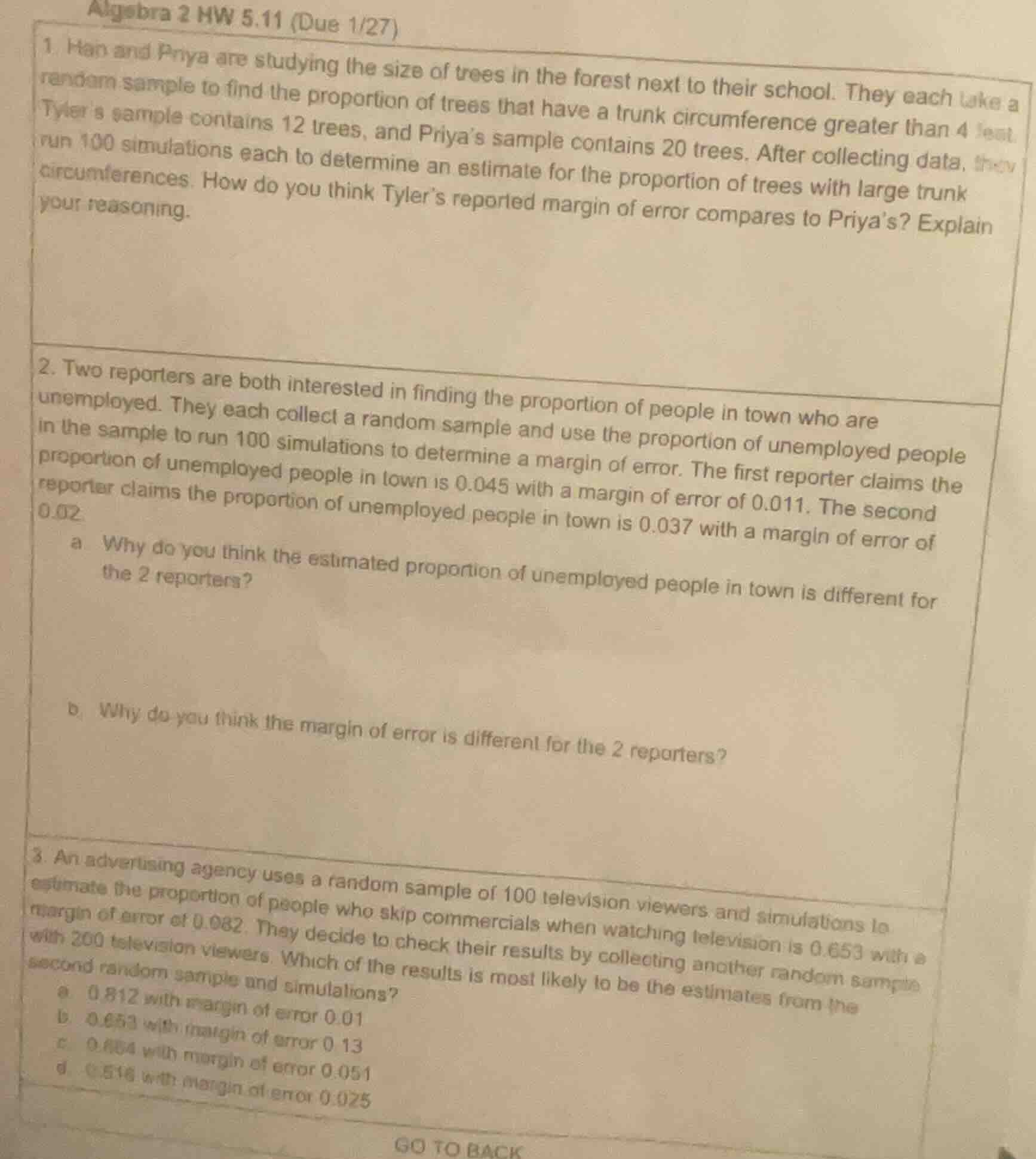
algebra 2 hw 5.11 (due 1/27)
- han and priya are studying the size of trees in the forest next to their school. they each take a random sample to find the proportion of trees that have a trunk circumference greater than 4 feet. tyler’s sample contains 12 trees, and priya’s sample contains 20 trees. after collecting data, they run 100 simulations each to determine an estimate for the proportion of trees with large trunk circumferences. how do you think tyler’s reported margin of error compares to priya’s? explain your reasoning.
- two reporters are both interested in finding the proportion of people in town who are unemployed. they each collect a random sample and use the proportion of unemployed people in the sample to run 100 simulations to determine a margin of error. the first reporter claims the proportion of unemployed people in town is 0.045 with a margin of error of 0.011. the second reporter claims the proportion of unemployed people in town is 0.037 with a margin of error of 0.02
a. why do you think the estimated proportion of unemployed people in town is different for the 2 reporters?
b. why do you think the margin of error is different for the 2 reporters?
- an advertising agency uses a random sample of 100 television viewers and simulations to estimate the proportion of people who skip commercials when watching television is 0.653 with a margin of error of 0.082. they decide to check their results by collecting another random sample with 200 television viewers. which of the results is most likely to be the estimates from the second random sample and simulations?
a. 0.812 with margin of error 0.01
b. 0.653 with margin of error 0.13
c. 0.604 with margin of error 0.051
d. 0.518 with margin of error 0.025
- For estimating proportions, larger sample sizes lead to smaller margins of error. Priya's sample (20 trees) is larger than Tyler's (12 trees), so Tyler's margin of error will be wider.
- a. Random samples from the same population will naturally have slight differences in their sample proportions, leading to different estimated population proportions.
b. Margin of error depends on sample size (larger samples have smaller margins) and the sample proportion itself. The two reporters likely used different sample sizes, or their sample proportions differed enough to change the margin of error.
- A larger sample size (200 vs. 100) should result in a smaller margin of error than the original 0.082. The estimated proportion should be close to the original 0.653, as both samples are random from the same population. Option c meets both criteria: the proportion is near 0.653, and the margin of error (0.051) is smaller than 0.082.

Snap & solve any problem in the app
Get step-by-step solutions on Sovi AI
Photo-based solutions with guided steps
Explore more problems and detailed explanations
- Tyler's margin of error will be larger than Priya's.
- a. Random sampling variability causes the difference.
b. Differences in sample size or sample proportion cause this.
- c. 0.664 with margin of error 0.051