QUESTION IMAGE
Question
algebra 2 - 2.1.1 skills practice
name:
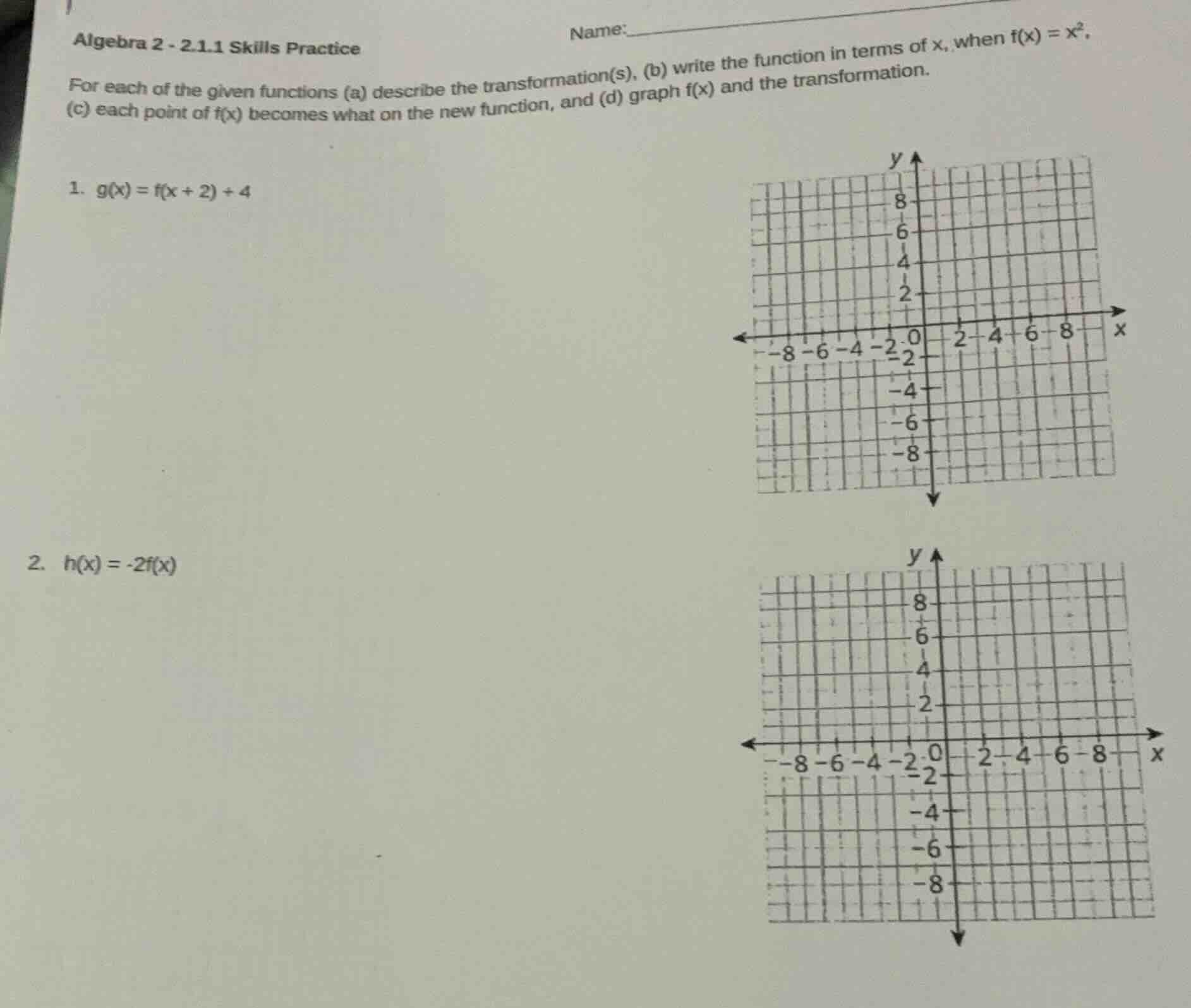
for each of the given functions (a) describe the transformation(s), (b) write the function in terms of x, when f(x) = x²,
(c) each point of f(x) becomes what on the new function, and (d) graph f(x) and the transformation.
- g(x) = f(x + 2) + 4
- h(x) = -2f(x)
Problem 1: \( g(x) = f(x + 2) + 4 \) with \( f(x) = x^2 \)
Part (a): Describe the transformation(s)
Step 1: Analyze horizontal shift
For a function \( f(x + h) \), if \( h > 0 \), the graph shifts left by \( h \) units. Here, we have \( f(x + 2) \), so the graph of \( f(x) \) shifts left by 2 units.
Step 2: Analyze vertical shift
For a function \( f(x) + k \), if \( k > 0 \), the graph shifts up by \( k \) units. Here, we have \( f(x + 2) + 4 \), so after the horizontal shift, the graph shifts up by 4 units.
(a):
The graph of \( f(x)=x^2 \) undergoes a horizontal shift 2 units to the left and a vertical shift 4 units up.
Part (b): Write the function in terms of \( x \)
Step 1: Substitute \( f(x) = x^2 \) into \( g(x) \)
We know \( f(x)=x^2 \), so \( f(x + 2)=(x + 2)^2 \). Then \( g(x)=f(x + 2)+4=(x + 2)^2+4 \).
Step 2: Expand \( (x + 2)^2 \) (optional, but to simplify)
\( (x + 2)^2=x^2+4x + 4 \), so \( g(x)=x^2+4x + 4+4=x^2+4x + 8 \)
(b):
Substitute \( f(x)=x^2 \) into \( g(x)=f(x + 2)+4 \). First, \( f(x + 2)=(x + 2)^2 \), then add 4. So \( g(x)=(x + 2)^2+4=x^2+4x + 8 \)
Part (c): Each point of \( f(x) \) becomes what on the new function
Let a point on \( f(x) \) be \( (x,y) \) where \( y = f(x)=x^2 \).
For the horizontal shift \( x\to x - 2 \) (since we have \( x+2\) in the function, to find the original \( x \) from the new \( x' \), we solve \( x'=x + 2\Rightarrow x=x' - 2 \)) and vertical shift \( y\to y + 4 \) (since we add 4 to the function value). Wait, actually, if the transformation is \( g(x)=f(x + 2)+4 \), then a point \( (a,b) \) on \( f(x) \) (so \( b = f(a)=a^2 \)) will map to a point \( (a - 2,b + 4) \) on \( g(x) \)? Wait, no. Let's think again. If we have \( g(x)=f(x + 2)+4 \), then for a given \( x \) in \( g(x) \), the input to \( f \) is \( x + 2 \). So if \( (t,f(t)) \) is a point on \( f(x) \), then in \( g(x) \), when \( x=t - 2 \), \( g(t - 2)=f((t - 2)+2)+4=f(t)+4 \). So the point \( (t,f(t)) \) on \( f(x) \) maps to the point \( (t - 2,f(t)+4) \) on \( g(x) \). In other words, if a point on \( f(x) \) is \( (x,y) \) (so \( y = x^2 \)), then the corresponding point on \( g(x) \) is \( (x - 2,y + 4) \).
(c):
If a point on \( f(x)=x^2 \) is \( (x,y) \) (where \( y = x^2 \)), then the corresponding point on \( g(x) \) is \( (x - 2,y + 4) \). This is because the horizontal shift left by 2 units means we subtract 2 from the \( x \)-coordinate, and the vertical shift up by 4 units means we add 4 to the \( y \)-coordinate.
Part (d): Graph \( f(x) \) and the transformation
- Graph of \( f(x)=x^2 \): It is a parabola opening upwards with vertex at \( (0,0) \), passing through points like \( (1,1) \), \( (- 1,1) \), \( (2,4) \), \( (-2,4) \) etc.
- Graph of \( g(x)=(x + 2)^2+4 \): The vertex of \( g(x) \) is at \( (-2,4) \) (from the vertex form \( y=a(x - h)^2+k \), here \( h=-2 \), \( k = 4 \)). It is also a parabola opening upwards (since the coefficient of \( x^2 \) is positive) with vertex at \( (-2,4) \), passing through points like \( (-1,5) \) (when \( x=-1 \), \( g(-1)=(-1 + 2)^2+4=1 + 4=5 \)), \( (-3,5) \) (when \( x=-3 \), \( g(-3)=(-3 + 2)^2+4=1 + 4=5 \)), \( (0,8) \) (when \( x = 0 \), \( g(0)=(0 + 2)^2+4=4 + 4=8 \)) etc. We can plot these points and draw the parabola.
Problem 2: \( h(x)=-2f(x) \) with \( f(x)=x^2 \)
Part (a): Describe the transformation(s)
Step 1: Analyze vertical stretch/compression and reflection
For a function \( af(x) \), if \( |a|>1 \), it is a vertical stretch by a factor of \( |a| \), and if \( a<0 \), it is a reflection over the \( x \)-axis. Here, \( a=-2 \), so the graph of \( f(x) \) is reflected over the \( x \)-axis and vertically stretched by a factor of 2.

Snap & solve any problem in the app
Get step-by-step solutions on Sovi AI
Photo-based solutions with guided steps
Explore more problems and detailed explanations
(c):
If a point on \( f(x)=x^2 \) is \( (x,y) \) (where \( y = x^2 \)), then the corresponding point on \( h(x) \) is \( (x,-2y) \). This is because there is no horizontal transformation (so \( x \)-coordinate stays the same), and the vertical transformation involves multiplying the \( y \)-coordinate by - 2 (reflection over \( x \)-axis and stretch by factor 2).
Part (d): Graph \( f(x) \) and the transformation
- Graph of \( f(x)=x^2 \): Parabola opening upwards with vertex at \( (0,0) \), passing through \( (1,1) \), \( (-1,1) \), \( (2,4) \), \( (-2,4) \) etc.
- Graph of \( h(x)=-2x^2 \): It is a parabola opening downwards (because of the negative sign) with vertex at \( (0,0) \), and vertically stretched by a factor of 2. So it passes through points like \( (1,-2) \) (since \( h(1)=-2\times1^2=-2 \)), \( (-1,-2) \), \( (2,-8) \) (since \( h(2)=-2\times2^2=-8 \)), \( (-2,-8) \) etc. We can plot these points and draw the parabola.
Final Answers (Summarized)
For \( g(x)=f(x + 2)+4 \)
(a) Horizontal shift left 2 units, vertical shift up 4 units.
(b) \( g(x)=(x + 2)^2+4=x^2+4x + 8 \)
(c) A point \( (x,y) \) on \( f(x) \) becomes \( (x - 2,y + 4) \) on \( g(x) \)
(d) Graph \( f(x)=x^2 \) (upward parabola, vertex (0,0)) and \( g(x)=(x + 2)^2+4 \) (upward parabola, vertex (-2,4))
For \( h(x)=-2f(x) \)
(a) Reflection over \( x \)-axis, vertical stretch by factor 2.
(b) \( h(x)=-2x^2 \)
(c) A point \( (x,y) \) on \( f(x) \) becomes \( (x,-2y) \) on \( h(x) \)
(d) Graph \( f(x)=x^2 \) (upward parabola, vertex (0,0)) and \( h(x)=-2x^2 \) (downward parabola, vertex (0,0))