QUESTION IMAGE
Question
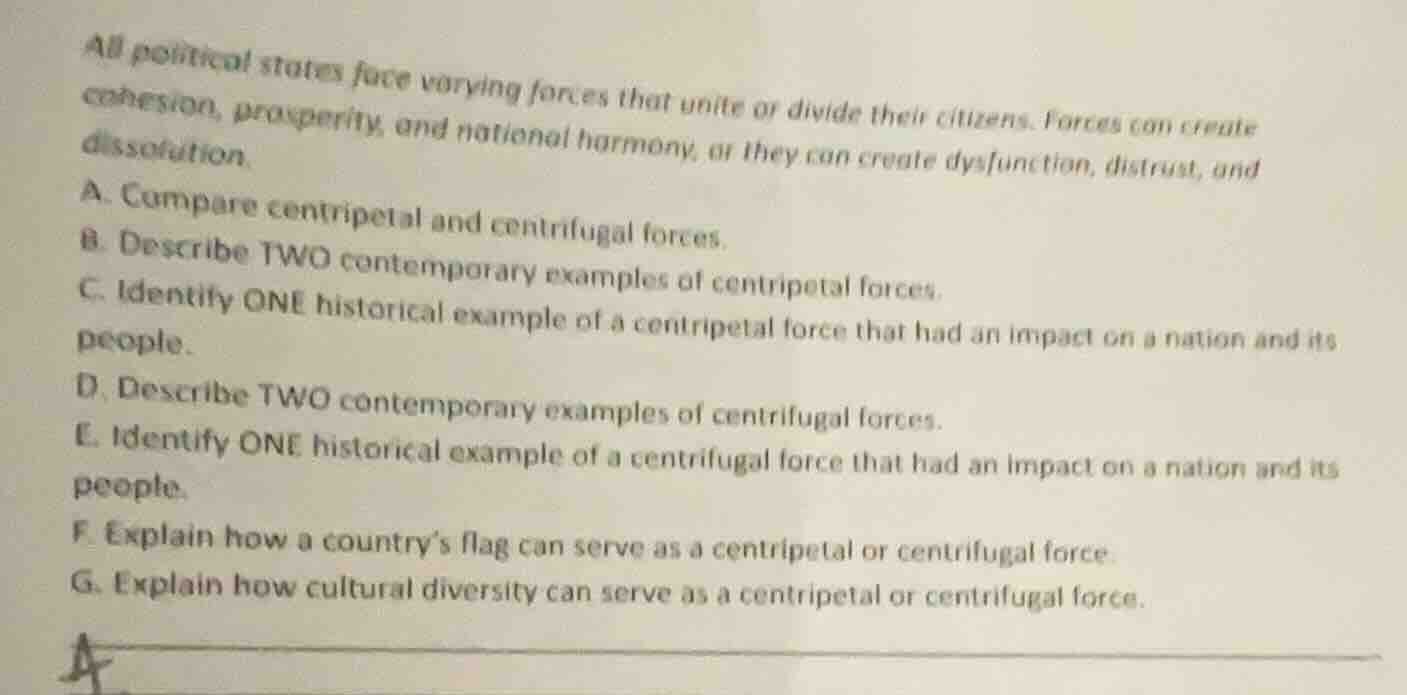
all political states face varying forces that unite or divide their citizens. forces can create cohesion, prosperity, and national harmony, or they can create dysfunction, distrust, and dissolution.
a. compare centripetal and centrifugal forces.
b. describe two contemporary examples of centripetal forces.
c. identify one historical example of a centripetal force that had an impact on a nation and its people.
d. describe two contemporary examples of centrifugal forces.
e. identify one historical example of a centrifugal force that had an impact on a nation and its people.
f. explain how a country’s flag can serve as a centripetal or centrifugal force.
g. explain how cultural diversity can serve as a centripetal or centrifugal force.
Part A
Centripetal forces are those that unify a state, like a shared national language or a common history. Centrifugal forces divide, such as ethnic separatism or regional economic disparities. Centripetal forces promote national cohesion; centrifugal forces threaten it. For example, a strong national identity (centripetal) vs. a separatist movement (centrifugal).
Contemporary centripetal forces include a shared digital culture (social media uniting people) and national sports teams (e.g., a country’s World Cup team rallying citizens). Another is a national vaccination campaign (uniting for public health).
Historical centripetal forces: Post - WWII Japan’s adoption of a new constitution (1947) with democratic values united citizens under a shared governance framework, rebuilding national identity after defeat. Or India’s independence movement (1947) led by Gandhi, uniting diverse groups against British rule.

Snap & solve any problem in the app
Get step-by-step solutions on Sovi AI
Photo-based solutions with guided steps
Explore more problems and detailed explanations
Centripetal forces (e.g., shared language, national identity) unify a state, fostering cohesion, prosperity, and harmony. Centrifugal forces (e.g., ethnic separatism, regional economic inequality) divide, causing dysfunction, distrust, and potential dissolution.