QUESTION IMAGE
Question
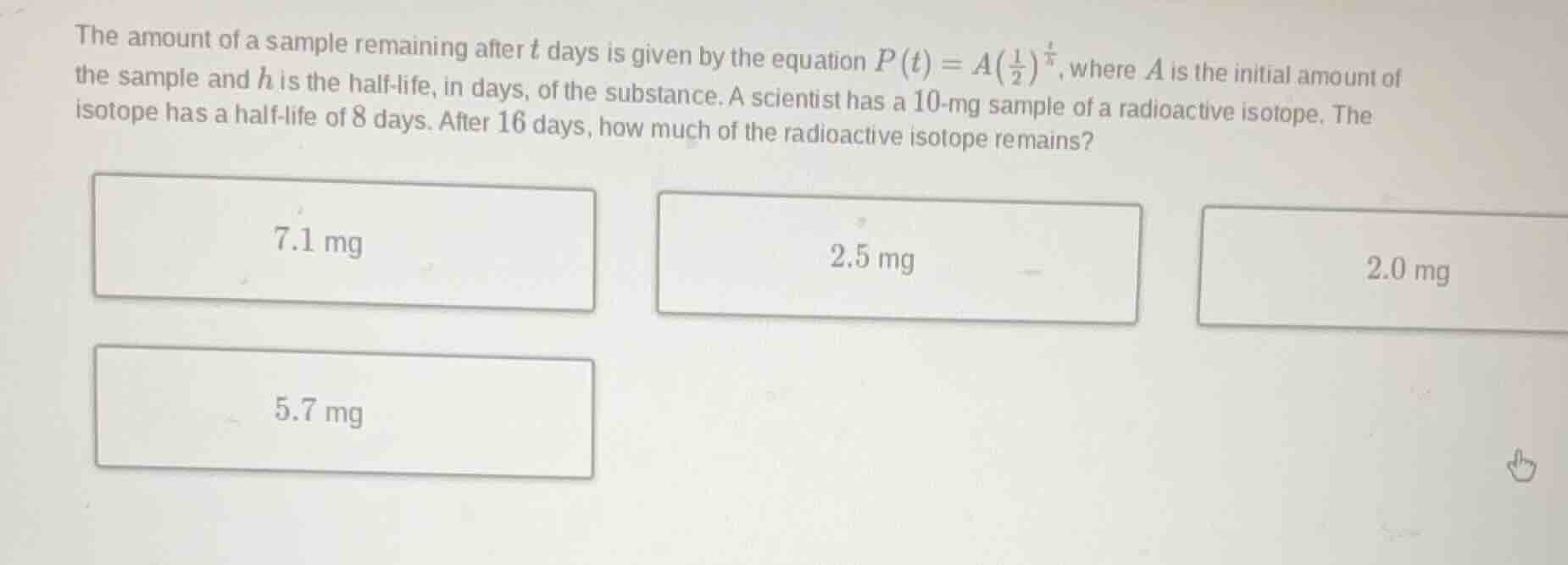
the amount of a sample remaining after t days is given by the equation $p(t) = a(\frac{1}{2})^{\frac{t}{h}}$, where a is the initial amount of the sample and h is the half-life, in days, of the substance. a scientist has a 10-mg sample of a radioactive isotope. the isotope has a half-life of 8 days. after 16 days, how much of the radioactive isotope remains? 7.1 mg 2.5 mg 2.0 mg 5.7 mg
Step1: Identify given values
We know that \( A = 10 \) mg (initial amount), \( h = 8 \) days (half - life), and \( t = 16 \) days (time elapsed). The formula for the amount remaining is \( P(t)=A(\frac{1}{2})^{\frac{t}{h}} \).
Step2: Substitute values into the formula
Substitute \( A = 10 \), \( t = 16 \), and \( h = 8 \) into the formula:
\( P(16)=10\times(\frac{1}{2})^{\frac{16}{8}} \)
Step3: Simplify the exponent
First, simplify \( \frac{16}{8}=2 \). So the equation becomes \( P(16)=10\times(\frac{1}{2})^{2} \)
Step4: Calculate the power
Calculate \( (\frac{1}{2})^{2}=\frac{1}{2}\times\frac{1}{2}=\frac{1}{4} \)
Step5: Multiply by the initial amount
Now, multiply 10 by \( \frac{1}{4} \): \( 10\times\frac{1}{4}=\frac{10}{4} = 2.5 \) mg

Snap & solve any problem in the app
Get step-by-step solutions on Sovi AI
Photo-based solutions with guided steps
Explore more problems and detailed explanations
2.5 mg