QUESTION IMAGE
Question
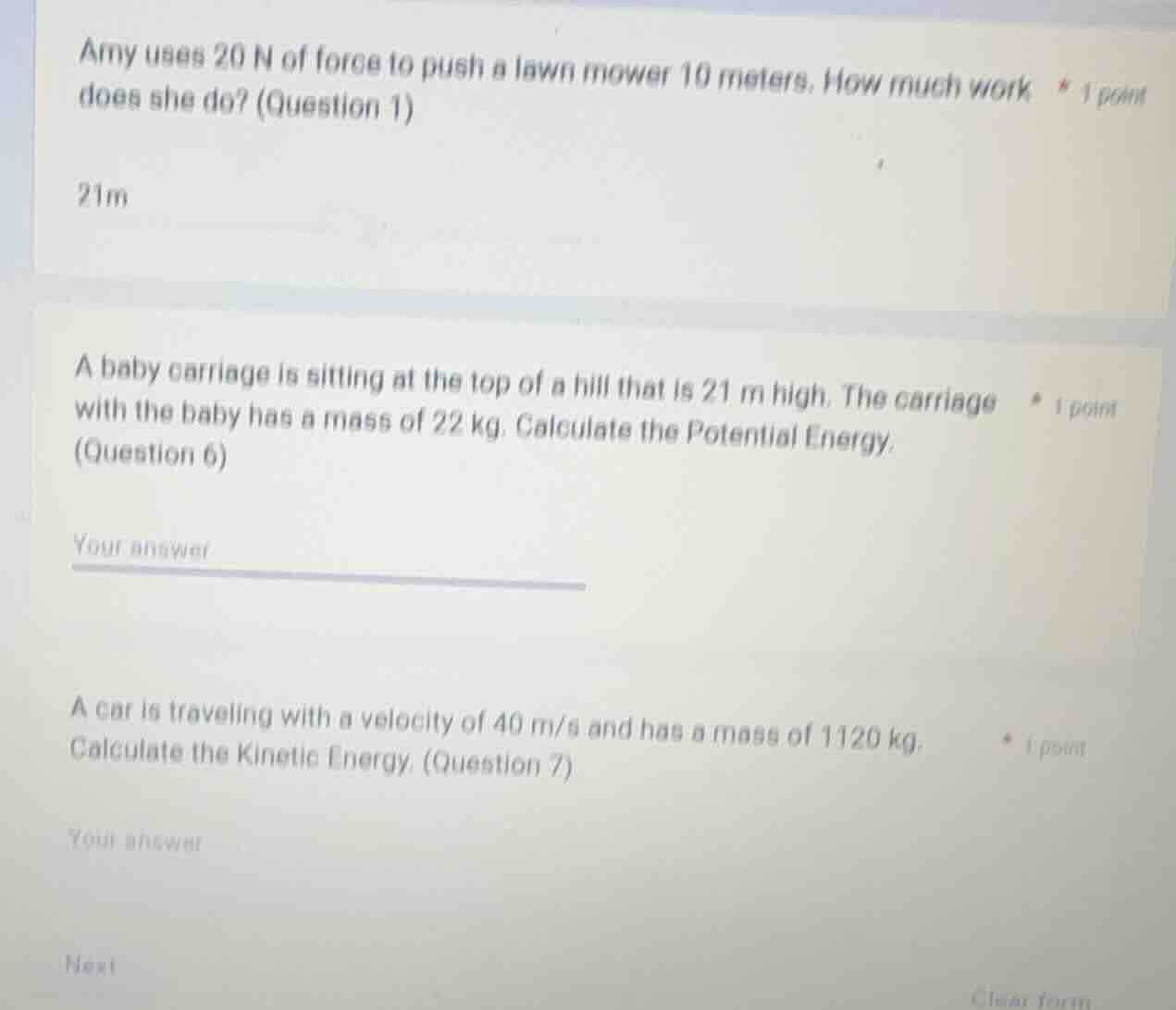
amy uses 20 n of force to push a lawn mower 10 meters. how much work does she do? (question 1)
21m
a baby carriage is sitting at the top of a hill that is 21 m high. the carriage with the baby has a mass of 22 kg. calculate the potential energy. (question 6)
your answer
a car is traveling with a velocity of 40 m/s and has a mass of 1120 kg. calculate the kinetic energy. (question 7)
your answer
next
Question 1: Work Calculation
Step1: Recall Work Formula
Work ($W$) is calculated as $W = F \times d$, where $F$ is force and $d$ is distance.
Step2: Substitute Values
Given $F = 20\ N$ and $d = 10\ m$, so $W = 20 \times 10$.
Step3: Calculate Result
$20 \times 10 = 200\ J$ (Joules, unit of work).
Step1: Recall PE Formula
Gravitational Potential Energy ($PE$) is $PE = mgh$, where $m$ is mass, $g = 9.8\ m/s^2$ (acceleration due to gravity), and $h$ is height.
Step2: Substitute Values
Given $m = 22\ kg$, $g = 9.8\ m/s^2$, $h = 21\ m$. So $PE = 22 \times 9.8 \times 21$.
Step3: Calculate Result
First, $22 \times 9.8 = 215.6$. Then, $215.6 \times 21 = 4527.6\ J$.
Step1: Recall KE Formula
Kinetic Energy ($KE$) is $KE = \frac{1}{2}mv^2$, where $m$ is mass and $v$ is velocity.
Step2: Substitute Values
Given $m = 1120\ kg$, $v = 40\ m/s$. So $KE = \frac{1}{2} \times 1120 \times (40)^2$.
Step3: Calculate Result
First, $(40)^2 = 1600$. Then, $\frac{1}{2} \times 1120 = 560$. Then, $560 \times 1600 = 896000\ J$.

Snap & solve any problem in the app
Get step-by-step solutions on Sovi AI
Photo-based solutions with guided steps
Explore more problems and detailed explanations
200 Joules