QUESTION IMAGE
Question
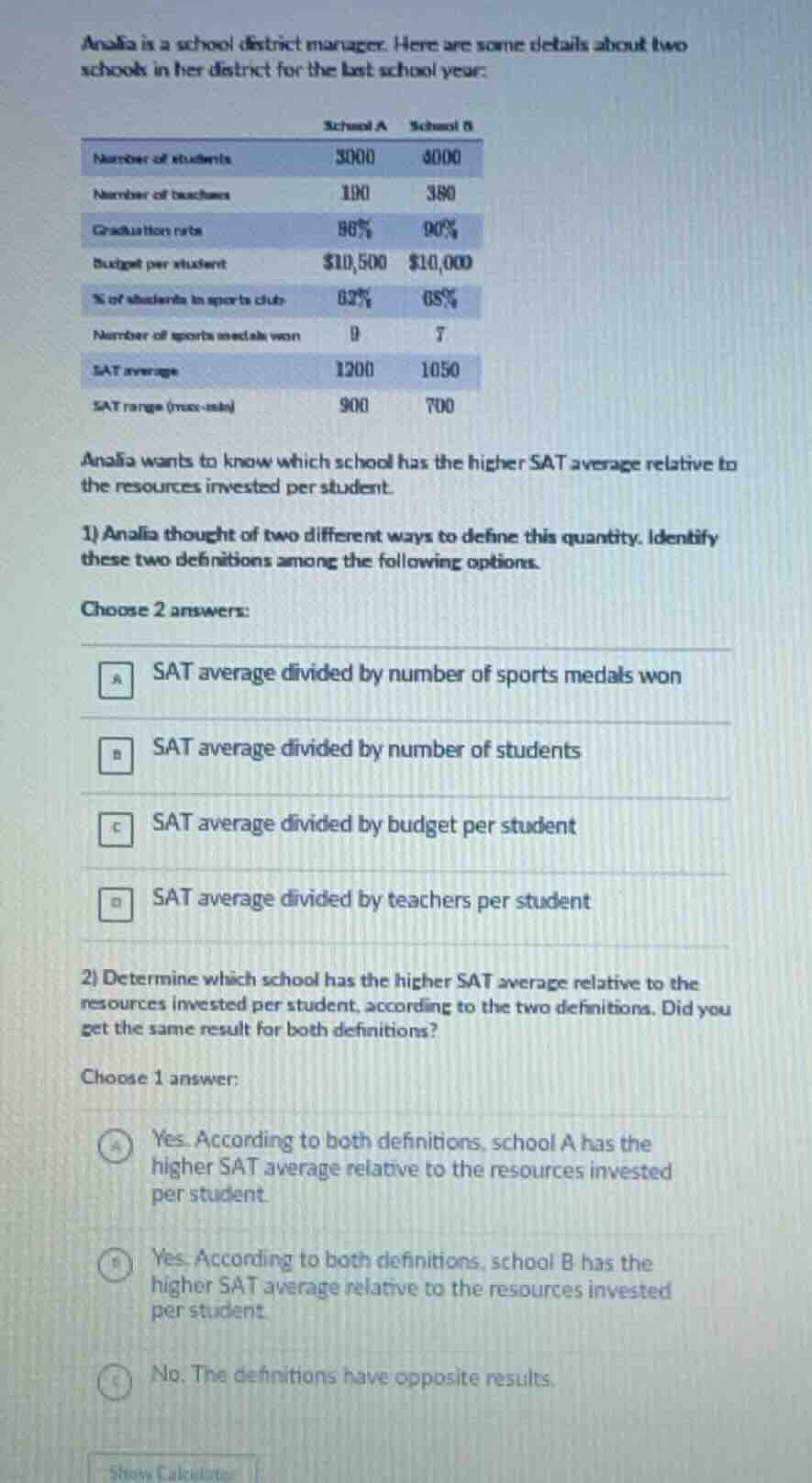
analia is a school district manager. here are some details about two schools in her district for the last school year: school a school b number of students 3000 4000 number of teachers 180 380 graduation rate 86% 90% budget per student $10,500 $10,000 % of students in sports club 0.2% 0.8% number of sports medals won 9 7 sat average 1200 1050 sat range (max - min) 900 700 analia wants to know which school has the higher sat average relative to the resources invested per student. 1) analia thought of two different ways to define this quantity. identify these two definitions among the following options. choose 2 answers: a sat average divided by number of sports medals won b sat average divided by number of students c sat average divided by budget per student d sat average divided by teachers per student 2) determine which school has the higher sat average relative to the resources invested per student, according to the two definitions. did you get the same result for both definitions? choose 1 answer: a yes. according to both definitions, school a has the higher sat average relative to the resources invested per student. b yes. according to both definitions, school b has the higher sat average relative to the resources invested per student. c no. the definitions have opposite results.
Question 1
We need to find two definitions that relate SAT average to resources invested per student. Let's analyze each option:
- Option A: Relates SAT average to sports medals, not resources per student. Eliminate.
- Option B: Relates SAT average to number of students. Number of students isn't a direct measure of resources per student, but teachers per student (which is related to number of students and number of teachers) could be a resource measure. Wait, no—wait, the other option is budget per student. Wait, let's re - evaluate. The problem is about resources invested per student. Resources could be budget per student or the number of teachers per student (since teachers are a resource).
- Option C: SAT average divided by budget per student. Budget per student is a direct measure of resources invested per student. So this is a valid definition.
- Option D: SAT average divided by teachers per student. Teachers per student is calculated as (number of teachers)/ (number of students), and teachers are a resource. So this is also a valid definition as it relates SAT average to a resource (teachers) per student. Wait, but the original options: let's check again. Wait, the options are:
- A: SAT average / sports medals (not resource)
- B: SAT average / number of students (not a resource measure directly)
- C: SAT average / budget per student (budget is a resource per student)
- D: SAT average / teachers per student (teachers are a resource, teachers per student is a resource per student measure)
Wait, maybe I misread. Let's re - express: The question is about resources invested per student. Resources can be budget (option C) or the number of teachers per student (option D, since teachers are a resource, and teachers per student is (number of teachers)/number of students). Option B is SAT average divided by number of students, which is not a resource per student measure. Option A is about sports medals, not resources. So the two correct options are C and D? Wait, no, the original problem's options: let's check again.
Wait, the problem says "resources invested per student". Resources could be budget per student (option C) or the number of teachers per student (option D, as teachers are a resource). So the two definitions are:
- Option C: SAT average divided by budget per student (relates SAT to budget resource per student)
- Option D: SAT average divided by teachers per student (relates SAT to teacher resource per student)
Wait, but let's check the options again. The options are:
A. SAT average / sports medals
B. SAT average / number of students
C. SAT average / budget per student
D. SAT average / teachers per student
So the correct two are C and D. Wait, but maybe I made a mistake. Wait, the problem says "two different ways to define this quantity" (SAT average relative to resources invested per student). Resources invested per student can be measured by budget per student (option C) or by the number of teachers per student (option D, since teachers are a resource, and teachers per student is (number of teachers)/number of students). Option B is SAT average divided by number of students, which is not a resource per student measure. Option A is about sports medals, not resources. So the two correct options are C and D.
Step 1: Calculate for Definition C (SAT average / budget per student)
- School A: $\frac{1200}{10500}\approx0.1143$
- School B: $\frac{1050}{10000} = 0.105$
- School A has a higher ratio.
Step 2: Calculate for Definition D (SAT average / teachers per student)
- Calculate teachers per student:
- School A: $\frac{180}{3000}=0.06$
- School B: $\frac{380}{4000}=0.095$
- Calculate the ratio:
- School A: $\frac{1200}{0.06}=20000$
- School B: $\frac{1050}{0.095}\approx11052.63$
- School A has a higher ratio.

Snap & solve any problem in the app
Get step-by-step solutions on Sovi AI
Photo-based solutions with guided steps
Explore more problems and detailed explanations
C. SAT average divided by budget per student, D. SAT average divided by teachers per student
Question 2
First, we need to calculate for both schools using the two definitions (C and D).
Definition 1: SAT average / budget per student
- School A:
- SAT average = 1200, budget per student = $10,500
- Ratio = $\frac{1200}{10500}\approx0.1143$
- School B:
- SAT average = 1050, budget per student = $10,000
- Ratio = $\frac{1050}{10000} = 0.105$
School A has a higher ratio for this definition.
Definition 2: SAT average / teachers per student
First, calculate teachers per student for each school:
- School A:
- Number of teachers = 180, number of students = 3000
- Teachers per student = $\frac{180}{3000}=0.06$
- Ratio = $\frac{1200}{0.06}=20000$
- School B:
- Number of teachers = 380, number of students = 4000
- Teachers per student = $\frac{380}{4000}=0.095$
- Ratio = $\frac{1050}{0.095}\approx11052.63$
School A has a higher ratio for this definition as well? Wait, no, wait:
Wait, teachers per student for School A: 180/3000 = 0.06, School B: 380/4000 = 0.095.
SAT average / teachers per student:
School A: 1200 / 0.06 = 20000
School B: 1050 / 0.095 ≈ 11052.63
So for both definitions (C and D), School A has a higher ratio. Wait, but the options for question 2 are:
A. Yes, School A
B. Yes, School B
C. No, opposite results
Wait, but let's recalculate:
For definition C (SAT average / budget per student):
School A: 1200 / 10500 ≈ 0.1143
School B: 1050 / 10000 = 0.105
School A is higher.
For definition D (SAT average / teachers per student):
School A: 1200 / (180/3000)=1200/(0.06) = 20000
School B: 1050 / (380/4000)=1050/(0.095)≈11052.63
School A is higher. So according to both definitions, School A has the higher SAT average relative to resources invested per student. So the answer for question 2 is A.
But wait, maybe I made a mistake in the definition for question 1. Let's re - check question 1. The problem says "two different ways to define this quantity (SAT average relative to resources invested per student)". The options are:
A. SAT average / sports medals (not resource)
B. SAT average / number of students (not resource per student)
C. SAT average / budget per student (budget is resource per student)
D. SAT average / teachers per student (teachers are resource, teachers per student is resource per student)
So the two correct options for question 1 are C and D.
Question 1 Answer:
C. SAT average divided by budget per student, D. SAT average divided by teachers per student