QUESTION IMAGE
Question
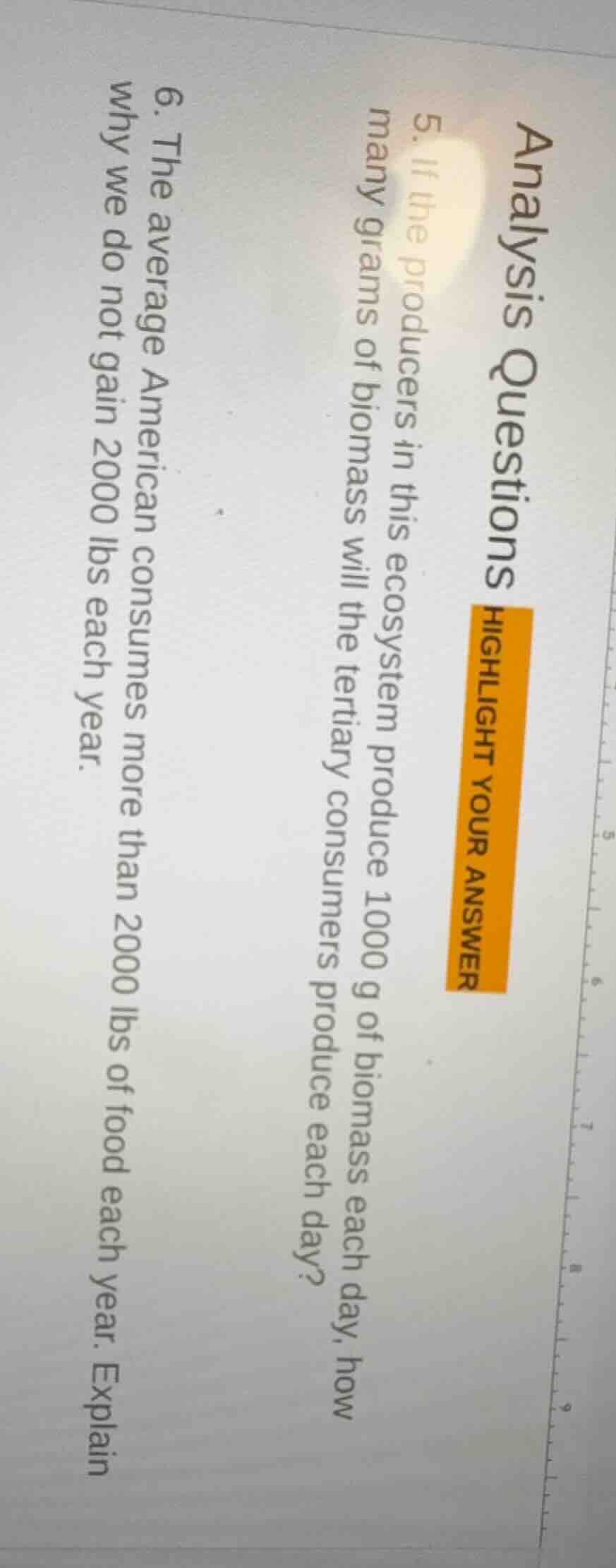
analysis questions highlight your answer 5. if the producers in this ecosystem produce 1000 g of biomass each day, how many grams of biomass will the tertiary consumers produce each day? 6. the average american consumes more than 2000 lbs of food each year. explain why we do not gain 2000 lbs each year.
Step1: Apply 10% biomass transfer rule
Producers (trophic level 1) to primary consumers (level 2): $1000 \times 0.1 = 100$ g
Step2: Calculate secondary consumer biomass
Primary to secondary consumers (level 3): $100 \times 0.1 = 10$ g
Step3: Calculate tertiary consumer biomass
Secondary to tertiary consumers (level 4): $10 \times 0.1 = 1$ g
---
Step1: Explain energy loss in digestion
Most food energy is lost as heat, used for bodily functions (movement, metabolism, reproduction), or excreted as waste, not converted to body mass.
Step2: Note incomplete biomass conversion
Only ~10% of consumed energy/biomass is stored as new body tissue; the rest is lost from the organism.

Snap & solve any problem in the app
Get step-by-step solutions on Sovi AI
Photo-based solutions with guided steps
Explore more problems and detailed explanations
- 1 gram of biomass per day
- We do not gain 2000 lbs yearly because most of the food we eat is used for energy (metabolism, movement), lost as heat, or excreted as waste. Only a small fraction (roughly 10%) of the food's biomass/energy is converted into new body mass.