QUESTION IMAGE
Question
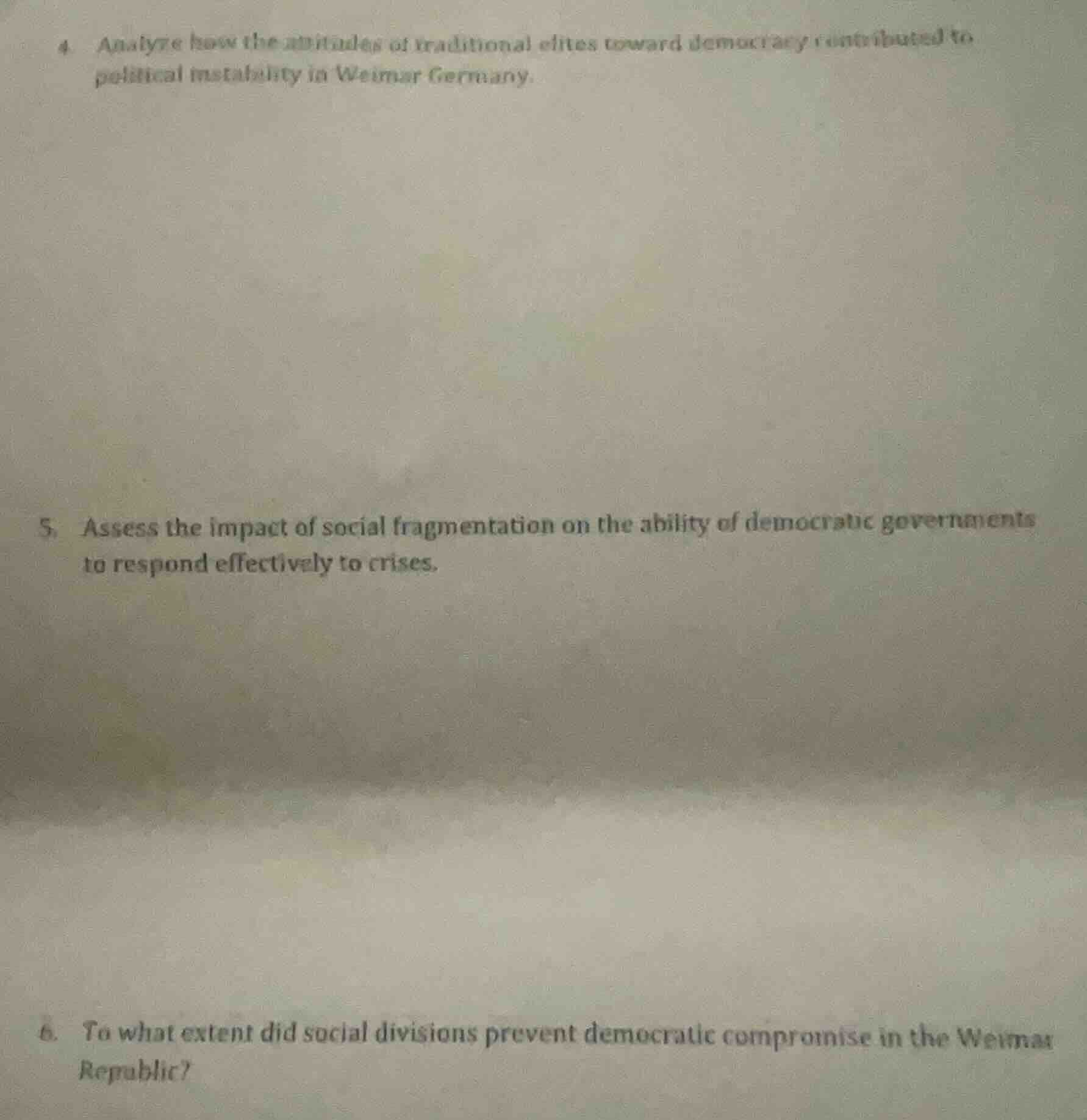
- analyze how the attitudes of traditional elites toward democracy contributed to political instability in weimar germany.
- assess the impact of social fragmentation on the ability of democratic governments to respond effectively to crises.
- to what extent did social divisions prevent democratic compromise in the weimar republic?
Question 4
- Elite Attitudes: Traditional elites (military, aristocracy, industrialists) in Weimar Germany often held anti - democratic views. They associated democracy with the defeat in WWI and the Treaty of Versailles, seeing it as weak.
- Political Instability Link: Their lack of support for the democratic system led to actions like undermining the government, supporting anti - democratic groups, and creating a climate of distrust in the Weimar Republic's institutions. This weakened the government's ability to govern effectively, leading to frequent crises and instability.
- Social Fragmentation Definition: It refers to the division of society into distinct groups with different interests, values, and identities (e.g., class, ethnic, ideological divisions).
- Impact on Democratic Governments:
- Policy - making: Fragmented societies have diverse and conflicting interests, making it hard for democratic governments to reach consensus on crisis - response policies. For example, in a society divided by class, different classes may have opposing views on economic crisis measures (e.g., austerity vs. welfare spending).
- Implementation: Even if policies are made, the lack of social cohesion makes it difficult to implement them effectively as different groups may resist. Also, fragmented societies may have low levels of trust in government, reducing compliance with crisis - related measures.
- Political Polarization: Social fragmentation can lead to political polarization, with parties representing different fragments. This can lead to gridlock in government, as seen in some democracies during economic or public health crises, where parties can't agree on a unified response.
- Social Divisions in Weimar: Weimar Germany had deep social divisions, including class divisions (workers vs. industrialists), ideological divisions (communists vs. fascists vs. centrists), and regional/religious divisions.
- Prevention of Democratic Compromise:
- Class Divisions: The working class, supported by communist and socialist parties, and the capitalist class, supported by conservative parties, had opposing economic interests. This made it hard to compromise on economic policies (e.g., labor rights, business regulations) essential for democratic governance.
- Ideological Divisions: Extreme left (communists) and extreme right (Nazis and other right - wing groups) rejected the democratic system and were unwilling to compromise with centrist or moderate parties. They saw the Weimar Republic as illegitimate, and their presence in the political arena made it difficult for moderate parties to find common ground for compromise.
- Consequences: The lack of compromise led to a breakdown in the political process, with frequent government collapses, as parties couldn't agree on key issues like the budget, social welfare, and foreign policy. This weakened the democratic system and contributed to its eventual downfall.

Snap & solve any problem in the app
Get step-by-step solutions on Sovi AI
Photo-based solutions with guided steps
Explore more problems and detailed explanations
Traditional elites in Weimar Germany, including the military, old aristocracy, and industrialists, had negative attitudes toward democracy. They blamed the democratic Weimar government for Germany's defeat in WWI and the harsh Treaty of Versailles, viewing democracy as weak and unpatriotic. Their lack of support for the democratic system manifested in several ways: they undermined the government's authority (e.g., the military's lack of full allegiance), supported anti - democratic and extremist groups (like right - wing paramilitaries), and spread propaganda against the republic. This created a climate of political distrust, weakened the government's ability to implement policies, and led to frequent cabinet crises and a lack of stable governance, thus contributing significantly to political instability.