QUESTION IMAGE
Question
analyzing a table to determine the type of function
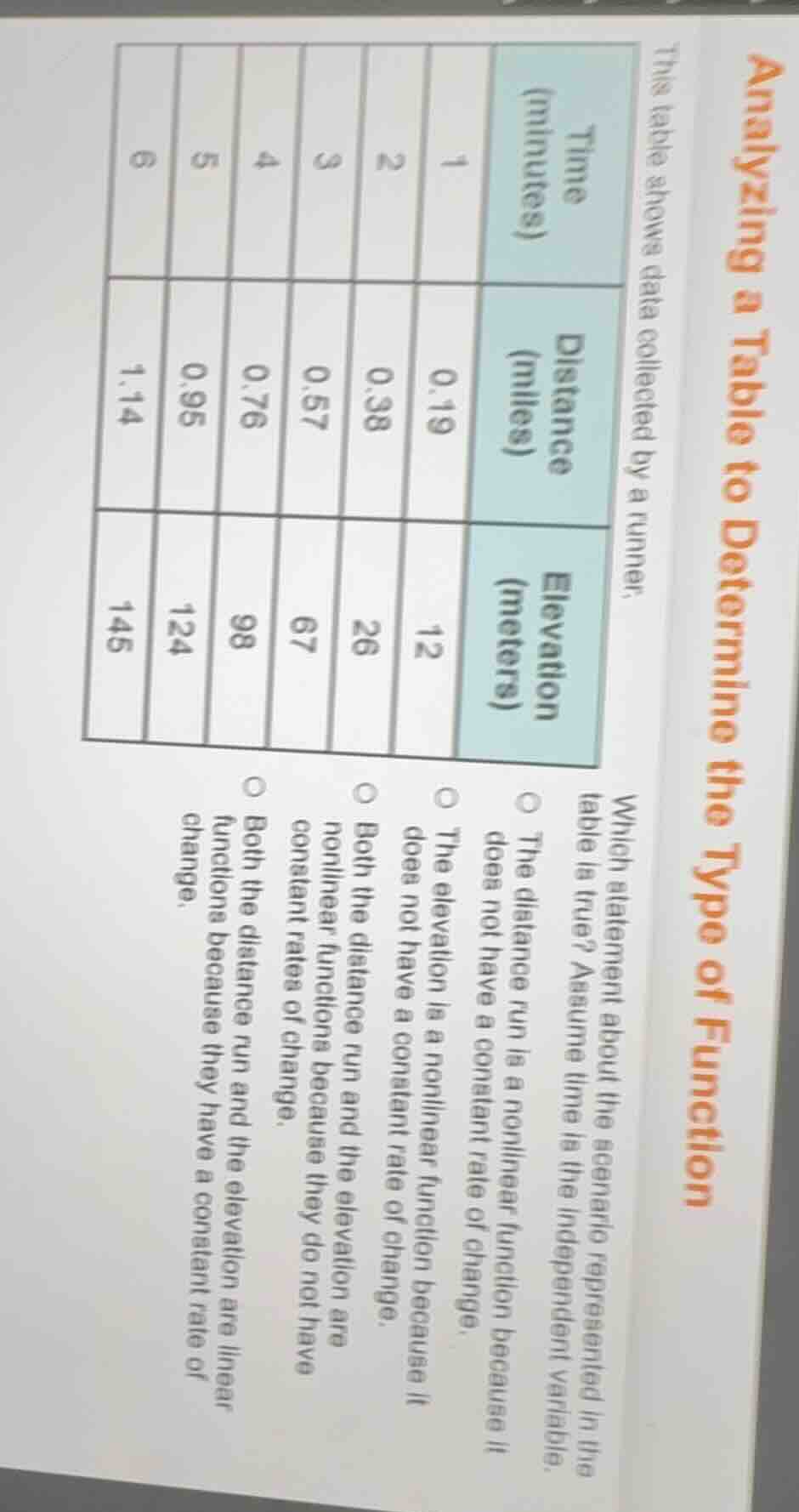
this table shows data collected by a runner.
| time (minutes) | 1 | 2 | 3 | 4 | 5 | 6 |
|---|---|---|---|---|---|---|
| elevation (meters) | 12 | 26 | 67 | 98 | 124 | 145 |
which statement about the scenario represented in the table is true? assume time is the independent variable.
- the distance run is a nonlinear function because it does not have a constant rate of change.
- the elevation is a nonlinear function because it does not have a constant rate of change.
- both the distance run and the elevation are nonlinear functions because they do not have constant rates of change.
- both the distance run and the elevation are linear functions because they have a constant rate of change.
To solve this, we analyze the rate of change for distance and elevation with respect to time.
Step 1: Analyze Distance (miles) over Time (minutes)
The time increases by 1 minute each time (from 1 to 2, 2 to 3, etc.).
- From \( t = 1 \) to \( t = 2 \): \( \Delta \text{Distance} = 0.38 - 0.19 = 0.19 \) miles
- From \( t = 2 \) to \( t = 3 \): \( \Delta \text{Distance} = 0.57 - 0.38 = 0.19 \) miles
- From \( t = 3 \) to \( t = 4 \): \( \Delta \text{Distance} = 0.76 - 0.57 = 0.19 \) miles
- From \( t = 4 \) to \( t = 5 \): \( \Delta \text{Distance} = 0.95 - 0.76 = 0.19 \) miles
- From \( t = 5 \) to \( t = 6 \): \( \Delta \text{Distance} = 1.14 - 0.95 = 0.19 \) miles
The distance has a constant rate of change (0.19 miles per minute), so distance is a linear function.
Step 2: Analyze Elevation (meters) over Time (minutes)
Time increases by 1 minute each time.
- From \( t = 1 \) to \( t = 2 \): \( \Delta \text{Elevation} = 26 - 12 = 14 \) meters
- From \( t = 2 \) to \( t = 3 \): \( \Delta \text{Elevation} = 67 - 26 = 41 \) meters
- From \( t = 3 \) to \( t = 4 \): \( \Delta \text{Elevation} = 98 - 67 = 31 \) meters
- From \( t = 4 \) to \( t = 5 \): \( \Delta \text{Elevation} = 124 - 98 = 26 \) meters
- From \( t = 5 \) to \( t = 6 \): \( \Delta \text{Elevation} = 145 - 124 = 21 \) meters
The elevation has a non - constant rate of change (the differences are 14, 41, 31, 26, 21—no consistent value), so elevation is a nonlinear function.
Step 3: Evaluate the Statements
- "The distance run is a nonlinear function because it does not have a constant rate of change." → False (distance has a constant rate of change).
- "The elevation is a nonlinear function because it does not have a constant rate of change." → True (elevation’s rate of change is not constant).
- "Both the distance run and the elevation are nonlinear functions because they do not have constant rates of change." → False (distance has a constant rate of change).
- "Both the distance run and the elevation are linear functions because they have a constant rate of change." → False (elevation does not have a constant rate of change).

Snap & solve any problem in the app
Get step-by-step solutions on Sovi AI
Photo-based solutions with guided steps
Explore more problems and detailed explanations
The elevation is a nonlinear function because it does not have a constant rate of change.