QUESTION IMAGE
Question
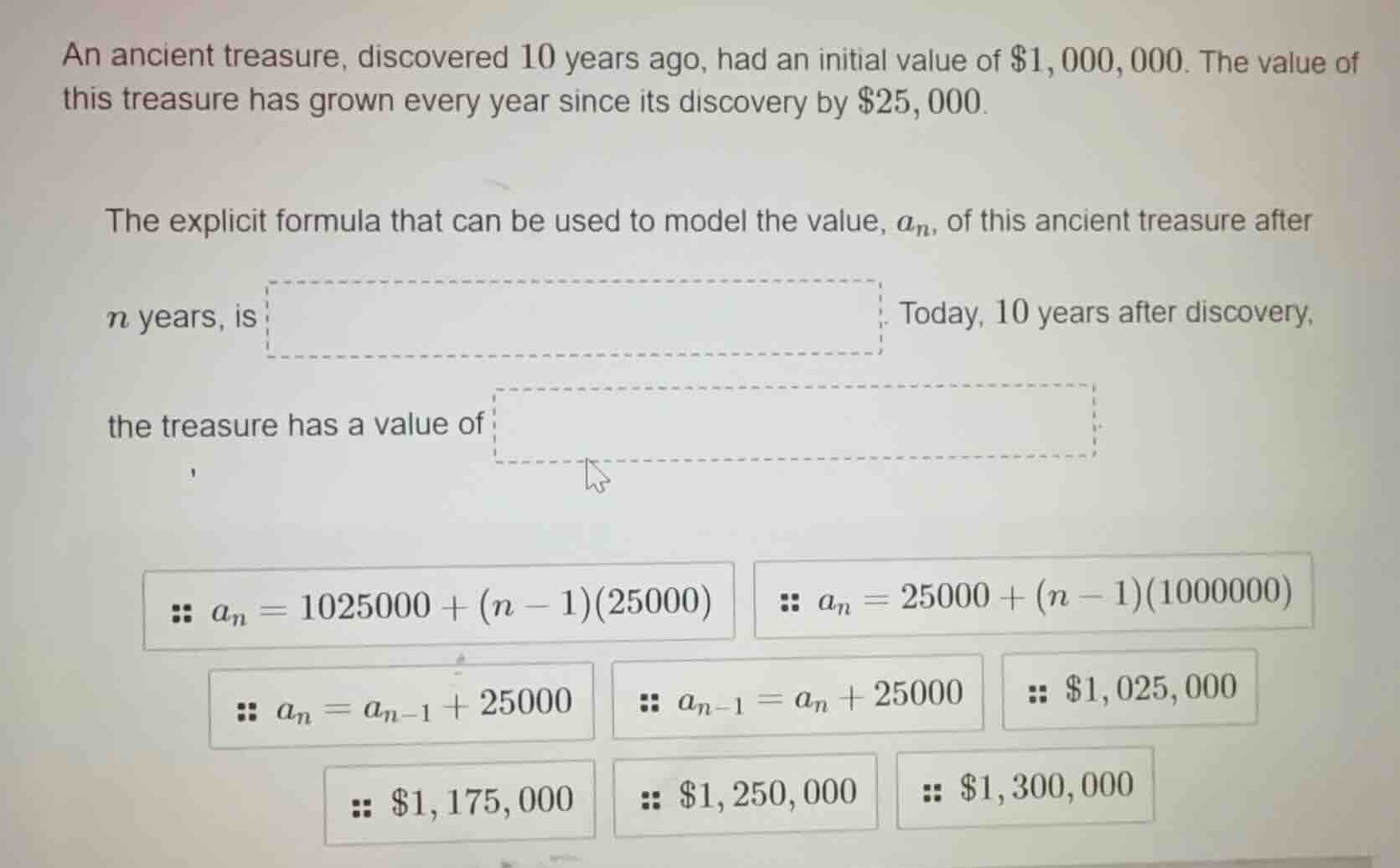
an ancient treasure, discovered 10 years ago, had an initial value of $1,000,000. the value of this treasure has grown every year since its discovery by $25,000.
the explicit formula that can be used to model the value, $a_n$, of this ancient treasure after $n$ years, is \boxed{}. today, 10 years after discovery, the treasure has a value of \boxed{}.
\begin{tabular}{|c|c|}hline $a_n = 1025000 + (n - 1)(25000)$ & $a_n = 25000 + (n - 1)(1000000)$ \hline $a_n = a_{n - 1} + 25000$ & $a_{n - 1} = a_n + 25000$ quad $$1,025,000$ \hline $$1,175,000$ & LXB11,300,000$ \hlineend{tabular}
Step1: Identify the sequence type
This is an arithmetic sequence where the initial value \( a_1 = 1000000 \) and the common difference \( d = 25000 \). The explicit formula for an arithmetic sequence is \( a_n=a_1+(n - 1)d \). Substituting the values, we get \( a_n = 1000000+(n - 1)(25000) \)? Wait, no, wait. Wait, when \( n = 1 \), it's the initial value. Wait, maybe the first term is at \( n = 0 \)? Wait, no, the problem says "after \( n \) years". Wait, the initial value is at discovery (0 years? Or 1 year?). Wait, the treasure was discovered 10 years ago, initial value \( \$1,000,000 \). Then each year it grows by \( \$25,000 \). So the explicit formula for an arithmetic sequence is \( a_n=a_1+(n - 1)d \), but if \( n = 1 \) is the first year after discovery, then \( a_1 = 1000000 \), \( d = 25000 \), so \( a_n=1000000+(n - 1)25000 \). But let's check the options. Wait, one of the options is \( a_n = 25000+(n - 1)(1000000) \) which is wrong, because the common difference is 25000, not 1000000. Another option is \( a_n = 1025000+(n - 1)(25000) \), no. Wait, maybe the initial term is at \( n = 0 \), so \( a_n=1000000 + 25000n \). But let's check the value after 10 years. After 10 years, the value is \( 1000000+25000\times10=1000000 + 250000=1250000 \)? Wait, no, wait the options include \( \$1,250,000 \). Wait, but let's re - examine the formula. Wait, maybe the first term \( a_1 = 1000000 \) (at year 1), then \( a_n=a_1+(n - 1)d \). For \( n = 10 \), \( a_{10}=1000000+(10 - 1)\times25000=1000000 + 225000=1225000 \)? No, that's not in the options. Wait, maybe the initial value is at year 0, so \( a_n=1000000+25000n \). Then at \( n = 10 \), \( a_{10}=1000000+25000\times10 = 1250000 \), which is one of the options. Now, the explicit formula: the arithmetic sequence explicit formula is \( a_n=a_1+(n - 1)d \), but if \( a_1 = 1000000 \), \( d = 25000 \), then \( a_n=1000000+(n - 1)25000=1000000 - 25000+25000n=975000 + 25000n \), which is not in the options. Wait, maybe the formula is \( a_n=25000+(n - 1)1000000 \) which is wrong. Wait, another option: \( a_n=a_{n - 1}+25000 \) is a recursive formula, not explicit. So the explicit formula should be \( a_n = 1000000+25000n \)? But that's not in the options. Wait, wait the options for the formula: let's check again. The options are:
- \( a_n = 1025000+(n - 1)(25000) \)
- \( a_n = 25000+(n - 1)(1000000) \)
- \( a_n=a_{n - 1}+25000 \) (recursive)
- \( a_{n - 1}=a_n+25000 \) (wrong, since it's decreasing)
Wait, maybe the problem considers the initial value at \( n = 1 \) as \( 1000000 \), and the formula is \( a_n=1000000+(n - 1)25000 \), but when we expand that, \( a_n=1000000 - 25000+25000n=975000 + 25000n \). But that's not matching. Wait, maybe the first term is at \( n = 0 \), so \( a_0 = 1000000 \), then \( a_n=1000000+25000n \). For \( n = 10 \), \( a_{10}=1000000+25000\times10 = 1250000 \), which is an option. Now, the explicit formula: among the options, the correct explicit formula? Wait, no, the options for the formula: maybe I made a mistake. Wait, the problem says "the explicit formula that can be used to model the value, \( a_n \), of this ancient treasure after \( n \) years". Let's think again. The sequence is arithmetic with first term \( a_1 = 1000000 \) (at year 1) and common difference \( d = 25000 \). So the explicit formula is \( a_n=a_1+(n - 1)d=1000000+(n - 1)25000 \). But when we look at the options, none of the formula options seem to match this. Wait, wait, one of the formula options is \( a_n = 25000+(n - 1)(1000000) \) which is wrong. Another is \( a_n…

Snap & solve any problem in the app
Get step-by-step solutions on Sovi AI
Photo-based solutions with guided steps
Explore more problems and detailed explanations
The explicit formula is \( \boldsymbol{a_n = 1025000+(n - 1)(25000)} \) and the value of the treasure after 10 years is \( \boldsymbol{\$1,250,000} \)