QUESTION IMAGE
Question
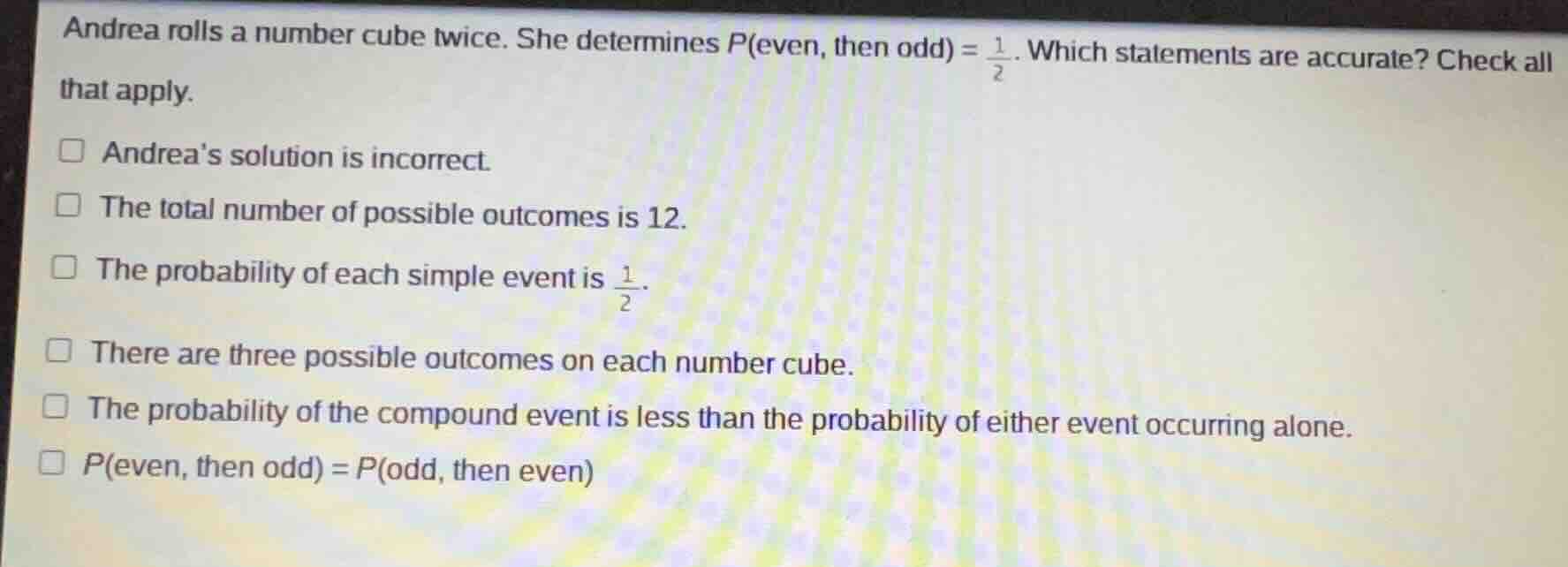
andrea rolls a number cube twice. she determines ( p(\text{even, then odd}) = \frac{1}{2} ). which statements are accurate? check all that apply.
- andrea’s solution is incorrect.
- the total number of possible outcomes is 12.
- the probability of each simple event is ( \frac{1}{2} ).
- there are three possible outcomes on each number cube.
- the probability of the compound event is less than the probability of either event occurring alone.
- ( p(\text{even, then odd}) = p(\text{odd, then even}) )
Step 1: Analyze total outcomes
A number cube has 6 faces. Rolling it twice, total outcomes = \(6\times6 = 36\). So "total outcomes is 12" is wrong.
Step 2: Probability of even/odd
A cube has 3 even (2,4,6) and 3 odd (1,3,5) numbers. Probability of even: \(\frac{3}{6}=\frac{1}{2}\), same for odd. So each simple event (even or odd) has probability \(\frac{1}{2}\).
Step 3: Probability of compound event
\(P(\text{even, then odd}) = P(\text{even})\times P(\text{odd})=\frac{1}{2}\times\frac{1}{2}=\frac{1}{4}
eq\frac{1}{2}\). So Andrea's solution is incorrect.
Step 4: Outcomes per cube
A number cube has 6 outcomes (1 - 6), not 3. So "three outcomes" is wrong.
Step 5: Compare compound and simple probabilities
Compound event probability (\(\frac{1}{4}\)) is less than simple event probability (\(\frac{1}{2}\)).
Step 6: Compare \(P(\text{even, then odd})\) and \(P(\text{odd, then even})\)
\(P(\text{odd, then even})=\frac{1}{2}\times\frac{1}{2}=\frac{1}{4}\), same as \(P(\text{even, then odd})\). So they are equal.

Snap & solve any problem in the app
Get step-by-step solutions on Sovi AI
Photo-based solutions with guided steps
Explore more problems and detailed explanations
Andrea's solution is incorrect.
The probability of each simple event is \(\frac{1}{2}\).
The probability of the compound event is less than the probability of either event occurring alone.
\(P(\text{even, then odd}) = P(\text{odd, then even})\)