QUESTION IMAGE
Question
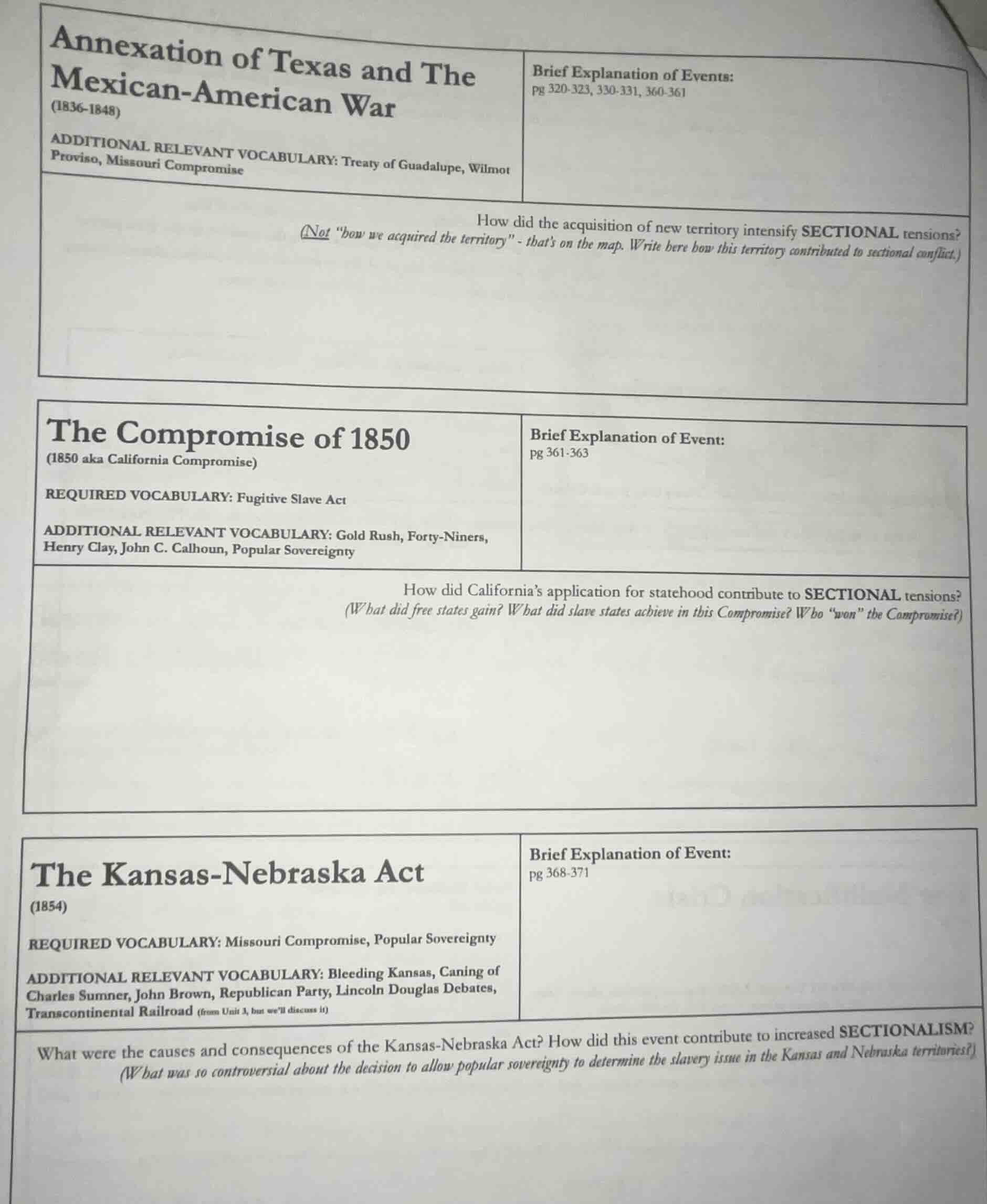
annexation of texas and the mexican-american war (1836-1848)
additional relevant vocabulary: treaty of guadalupe, wilmot proviso, missouri compromise
brief explanation of events:
pq 320-323, 330-331, 360-361
how did the acquisition of new territory intensify sectional tensions? (not \how we acquired the territory\ - thats on the map. write here how this territory contributed to sectional conflict.)
the compromise of 1850 (1850 aka california compromise)
required vocabulary: fugitive slave act
additional relevant vocabulary: gold rush, forty-niners, henry clay, john c. calhoun, popular sovereignty
brief explanation of event:
pq 361-363
how did californias application for statehood contribute to sectional tensions? (what did free states gain? what did slave states achieve in this compromise? who \won\ the compromise?)
the kansas-nebraska act (1854)
required vocabulary: missouri compromise, popular sovereignty
additional relevant vocabulary: bleeding kansas, caning of charles sumner, john brown, republican party, lincoln douglas debates, transcontinental railroad (from unit 3, but well discuss it)
brief explanation of event:
pq 368-371
what were the causes and consequences of the kansas-nebraska act? how did this event contribute to increased sectionalism? (what was so controversial about the decision to allow popular sovereignty to determine the slavery issue in the kansas and nebraska territories?)
1. Annexation of Texas and The Mexican-American War
- Brief Explanation of Events:
The U.S. annexed Texas (1845) which sparked the Mexican-American War (1846-1848). The Treaty of Guadalupe Hidalgo (1848) gave the U.S. vast western territory (Mexican Cession). The Wilmot Proviso, a failed bill to ban slavery in new territories, exposed deep sectional rifts.
- Sectional Tensions Impact:
The new territory broke the Missouri Compromise's balance. Northerners feared slavery would expand into the Mexican Cession, while Southerners argued Congress had no right to restrict slavery in new lands. The debate over slavery's spread deepened distrust between free and slave states.
2. The Compromise of 1850
- Brief Explanation of Events:
California applied for statehood as a free state in 1849, threatening the free-slave state balance. Henry Clay proposed a series of bills: California became free, Utah and New Mexico used popular sovereignty for slavery, the Fugitive Slave Act was strengthened, and the slave trade ended in Washington D.C.
- Sectional Tensions Impact:
- Free states gained California (tilting Senate power to free states) and end of D.C. slave trade.
- Slave states gained a stricter Fugitive Slave Act (forcing Northerners to return escaped enslaved people) and popular sovereignty in Utah/New Mexico.
- No clear "winner": Northerners resented the Fugitive Slave Act, while Southerners feared the spread of free states, keeping sectional anger high.
3. The Kansas-Nebraska Act
- Brief Explanation of Events:
Congress passed the act to organize the Kansas and Nebraska territories, allowing popular sovereignty to decide slavery. This directly repealed the Missouri Compromise's ban on slavery north of 36°30'. Pro-slavery and anti-slavery groups flooded Kansas, leading to violent clashes ("Bleeding Kansas").
- Causes, Consequences, and Sectionalism:
- Causes: Desire to organize territory for a transcontinental railroad, and Southern pressure to expand slavery.
- Controversy: Repealing the Missouri Compromise broke a long-standing sectional agreement, opening previously free territory to slavery.
- Consequences: "Bleeding Kansas" showed sectional conflict turning violent; the Republican Party formed to oppose slavery's expansion, and sectional distrust reached new heights, pushing the nation closer to civil war.

Snap & solve any problem in the app
Get step-by-step solutions on Sovi AI
Photo-based solutions with guided steps
Explore more problems and detailed explanations
- Annexation of Texas and The Mexican-American War
- Brief Event Explanation: U.S. annexed Texas (1845), fought Mexico (1846-1848), gained Mexican Cession via Treaty of Guadalupe Hidalgo. Wilmot Proviso exposed slavery rifts.
- Sectional Tensions: New territory broke Missouri Compromise balance; North/South clashed over slavery's expansion into the land, deepening distrust.
- The Compromise of 1850
- Brief Event Explanation: California sought free statehood; Henry Clay's compromise admitted California as free, established popular sovereignty in Utah/New Mexico, strengthened Fugitive Slave Act, ended D.C. slave trade.
- Sectional Tensions: Free states gained California and D.C. slave trade ban; slave states gained strict Fugitive Slave Act. No clear winner, as both regions resented parts of the compromise, keeping tensions high.
- The Kansas-Nebraska Act
- Brief Event Explanation: Act organized Kansas/Nebraska, let popular sovereignty decide slavery, repealing the Missouri Compromise. Violent clashes ("Bleeding Kansas") followed.
- Causes/Consequences/Sectionalism: Caused by railroad plans and Southern slavery pressure; repealing the Missouri Compromise broke a key sectional truce. Led to violent conflict in Kansas, formation of the anti-slavery Republican Party, and intensified sectional hatred.