QUESTION IMAGE
Question
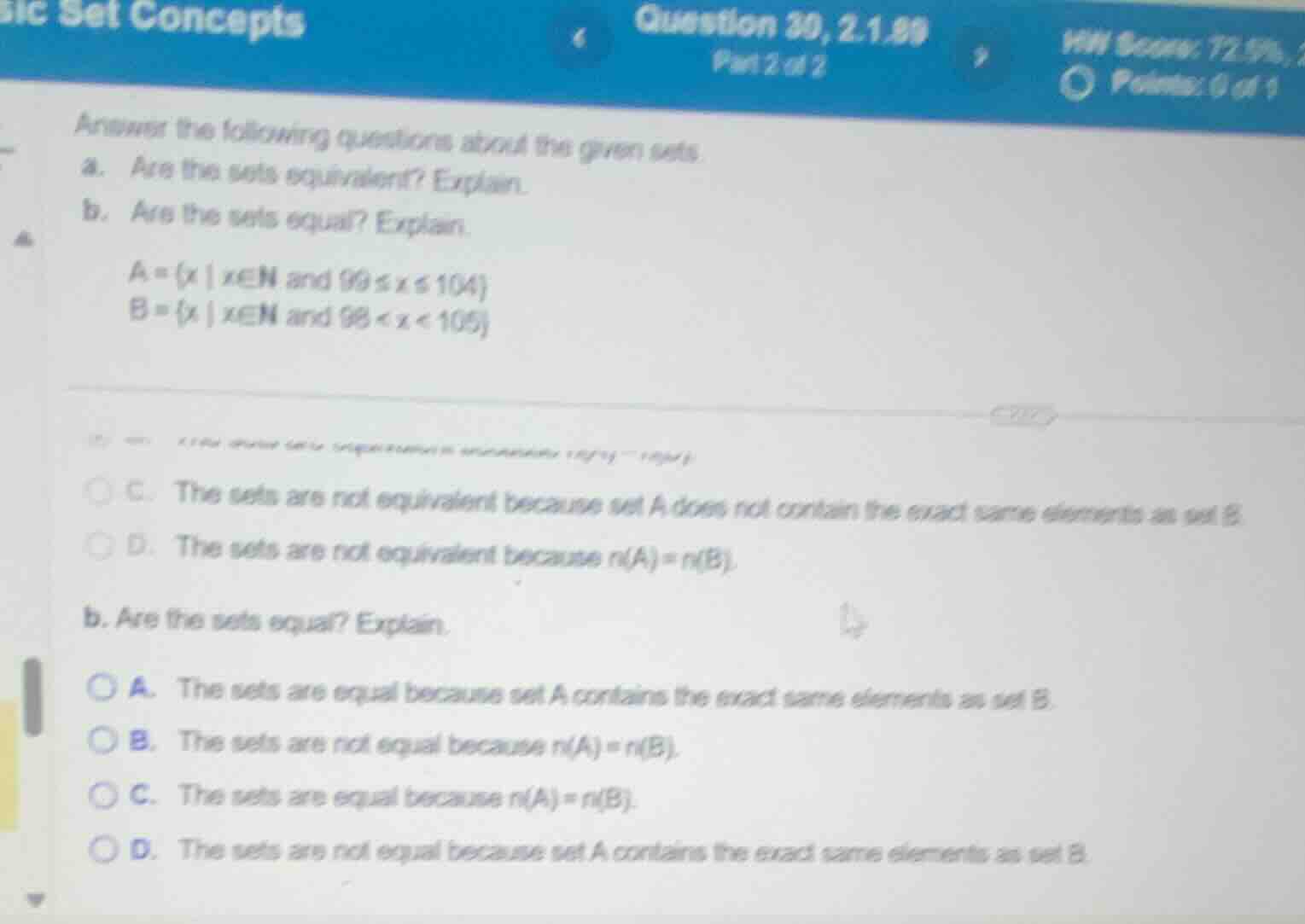
answer the following questions about the given sets.
a. are the sets equivalent? explain.
b. are the sets equal? explain.
a = {x | x ∈ n and 99 ≤ x ≤ 104}
b = {x | x ∈ n and 98 < x < 105}
c. the sets are not equivalent because set a does not contain the exact same elements as set b.
d. the sets are not equivalent because n(a) = n(b).
b. are the sets equal? explain.
a. the sets are equal because set a contains the exact same elements as set b.
b. the sets are not equal because n(a) = n(b).
c. the sets are equal because n(a) = n(b).
d. the sets are not equal because set a contains the exact same elements as set b.
Step1: List elements of set A
$A = \{99, 100, 101, 102, 103, 104\}$, so $n(A)=6$
Step2: List elements of set B
$B = \{99, 100, 101, 102, 103, 104\}$, so $n(B)=6$
Step3: Answer part (a)
Equivalent sets have equal cardinality. Since $n(A)=n(B)=6$, the sets are equivalent.
Step4: Answer part (b)
Equal sets have identical elements. $A$ and $B$ share all elements, so they are equal.

Snap & solve any problem in the app
Get step-by-step solutions on Sovi AI
Photo-based solutions with guided steps
Explore more problems and detailed explanations
a. The sets are equivalent because $n(A) = n(B) = 6$ (they have the same number of elements).
b. A. The sets are equal because set A contains the exact same elements as set B.