QUESTION IMAGE
Question
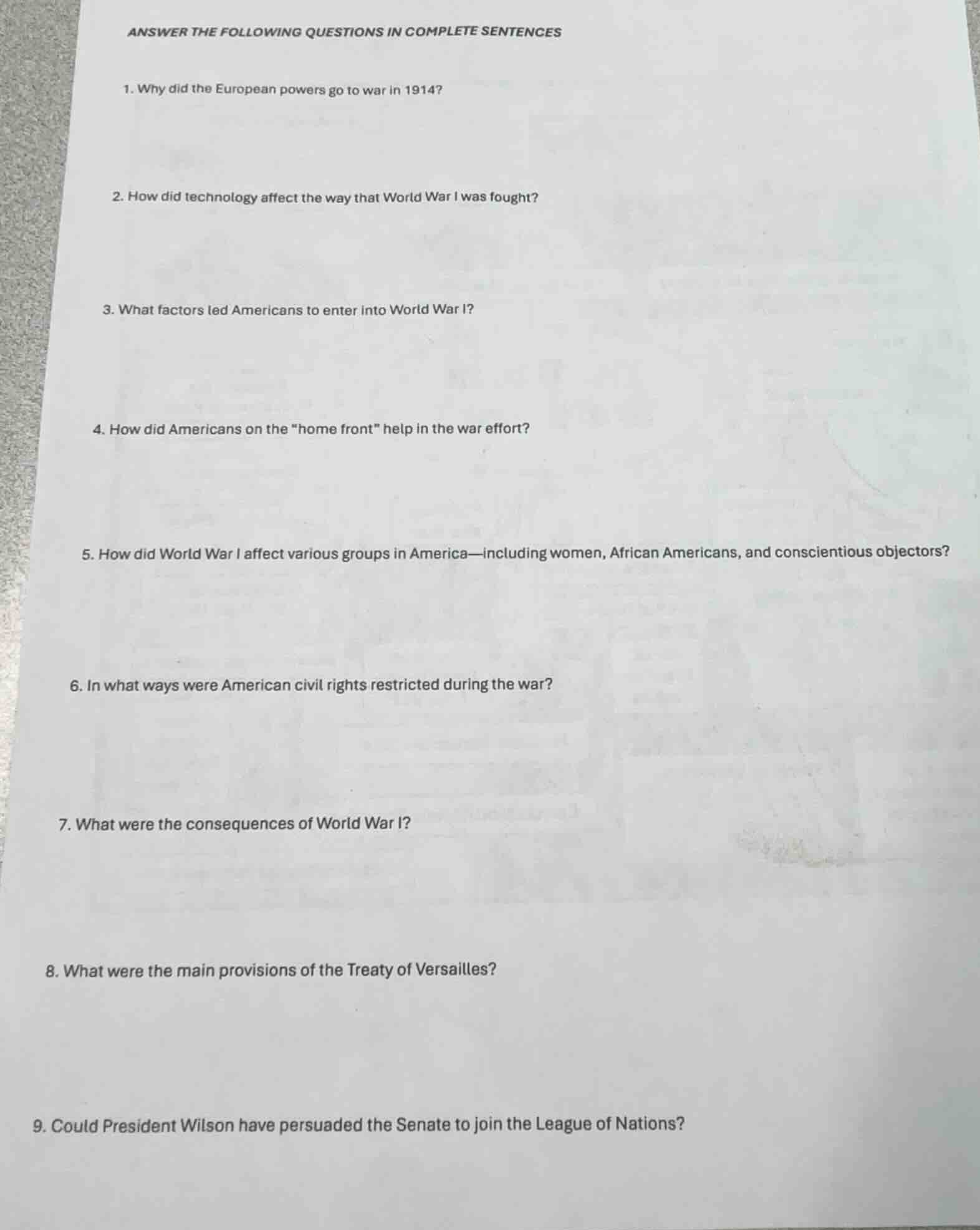
answer the following questions in complete sentences
- why did the european powers go to war in 1914?
- how did technology affect the way that world war i was fought?
- what factors led americans to enter into world war i?
- how did americans on the \home front\ help in the war effort?
- how did world war i affect various groups in america—including women, african americans, and conscientious objectors?
- in what ways were american civil rights restricted during the war?
- what were the consequences of world war i?
- what were the main provisions of the treaty of versailles?
- could president wilson have persuaded the senate to join the league of nations?
Brief Explanations
- The immediate cause was the assassination of Archduke Franz Ferdinand of Austria-Hungary by a Serbian nationalist in 1914, which triggered a chain reaction due to complex alliance systems, imperial rivalries, militarism, and nationalism across Europe.
- New technologies like machine guns, poison gas, tanks, and aircraft led to static trench warfare, high casualty rates, and shifted combat to long-range, industrialized fighting rather than open-field battles.
- Key factors included the German policy of unrestricted submarine warfare (which sank U.S. ships like the Lusitania), the interception of the Zimmermann Telegram (proposing a German-Mexican alliance against the U.S.), and growing cultural and economic ties to the Allied Powers.
- Americans on the home front supported the war by buying war bonds, rationing food and materials, working in war-related factories, volunteering for civil defense roles, and participating in propaganda campaigns to boost morale and enlistment.
- Women gained new factory jobs and greater public visibility, laying groundwork for suffrage; African Americans migrated north for industrial work in the Great Migration but faced ongoing racism; conscientious objectors were either drafted into non-combat roles, imprisoned, or faced public backlash for refusing military service.
- Civil rights were restricted via the Espionage Act of 1917 and Sedition Act of 1918, which criminalized anti-war speech, criticism of the government or military, and dissent, leading to the arrest of activists and suppression of left-wing and anti-war groups.
- Consequences included massive loss of life and economic devastation in Europe, the collapse of empires (Austro-Hungarian, Ottoman, German, Russian), the rise of totalitarian regimes in the interwar period, the redrawing of European borders, and the establishment of the League of Nations.
- The main provisions included forcing Germany to accept full blame for the war (War Guilt Clause), requiring Germany to pay heavy reparations, limiting Germany's military to a small volunteer force, seizing German territories and colonies, and creating the League of Nations to prevent future conflicts.
- It is plausible but unlikely; Wilson refused to compromise with Republican senators who opposed the League, particularly over Article X (which committed the U.S. to defend other nations), and his failure to build bipartisan support or adjust the treaty's terms made Senate ratification nearly impossible.

Snap & solve any problem in the app
Get step-by-step solutions on Sovi AI
Photo-based solutions with guided steps
Explore more problems and detailed explanations
- European powers went to war in 1914 primarily because of the assassination of Archduke Franz Ferdinand, which activated pre-existing alliance systems, alongside underlying tensions from militarism, imperialism, and nationalism across the continent.
- Technology transformed World War I by creating static trench warfare through weapons like machine guns and poison gas, introducing mechanized combat with tanks and aircraft, and making battles far more deadly and industrialized than prior conflicts.
- Americans entered World War I due to Germany's unrestricted submarine warfare that targeted U.S. vessels, the Zimmermann Telegram revealing a proposed German-Mexican anti-U.S. alliance, and strong economic and cultural ties to the Allied Powers.
- Americans on the home front supported the war effort by purchasing war bonds, rationing essential goods, working in war production factories, volunteering for civilian defense roles, and engaging in propaganda to encourage enlistment and loyalty.
- World War I affected American groups by opening factory jobs for women (advancing suffrage efforts), spurring the Great Migration of African Americans north for work (though racism persisted), and subjecting conscientious objectors to imprisonment or non-combat military service.
- American civil rights were restricted during the war through the Espionage and Sedition Acts, which criminalized anti-war speech, criticism of the government, and dissent, leading to the arrest of activists and suppression of dissenting groups.
- The consequences of World War I included millions of military and civilian deaths, the collapse of four major European empires, heavy reparations imposed on Germany, the redrawing of European national borders, and the creation of the League of Nations.
- The main provisions of the Treaty of Versailles were forcing Germany to accept full war guilt, demanding large reparations payments from Germany, drastically limiting Germany's military capacity, seizing German territories and colonies, and establishing the League of Nations.
- President Wilson likely could not have persuaded the Senate to join the League of Nations, as he refused to compromise with Republican opponents who opposed the treaty's collective security provisions, particularly Article X, and failed to build the bipartisan support needed for ratification.